
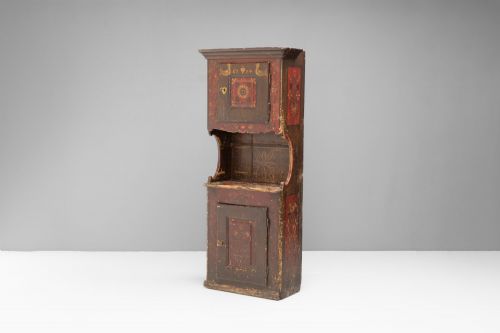


Rustic Folk Art Cabinet
A rustic folk art cabinet brings painted charm and vernacular character into a room, offering honest storage rooted in European traditions.
Rustic Folk Art Cabinet
When you search for a rustic folk art cabinet, you encounter vernacular storage furniture originating from various European regions and domestic traditions. These pieces reflect local craftsmanship rather than courtly design, serving practical household needs with distinct regional character.
Forms include hanging cupboards, marriage cupboards, kitchen dressers, and chests of drawers. Many display original painted finishes, ragwork patterns, or floral motifs characteristic of Scandinavian and Central European folk art.
How They Were Made
Makers built these pieces primarily from solid pine using traditional joinery suited to domestic workshops. Surfaces were frequently prepared with layers of paint, often incorporating techniques like ragwork or hand-painted floral decoration.
Hardware such as iron, brass, and metal hinges, latches, and pulls were applied to secure doors and drawers. Glass panels occasionally appeared in upper sections, while ceramic elements might feature in fitted interiors or decorative accents.
One standout piece reuses a closed wooden bed front from Brittany, turning an enclosed sleeping compartment into an unexpected nineteenth-century cabinet.
What Varies in Quality
Quality rests significantly on the survival and authenticity of the original painted surface. Pieces retaining their early or primary pigment layers hold greater visual integrity than those stripped or heavily repainted over time.
Construction robustness and the preservation of original hardware also separate standard examples from finer works. The sophistication of the regional painting style, whether simple ragwork or intricate floral decoration, further defines the character of each piece.
The Rustic Folk Art Cabinet Glossary
- Ragwork
- A decorative painting technique using rags or cloths to apply or manipulate paint on a surface, creating mottled or textured patterns. This finish appears frequently on nineteenth-century Scandinavian storage furniture.
- Marriage cupboard
- A substantial cabinet commissioned or gifted to mark a wedding, often inscribed, dated, or decorated with symbolic motifs. These pieces typically display higher decorative ambition than standard utility cupboards.
- Wall cupboard
- A compact storage cabinet designed to be hung directly on a wall rather than resting on the floor. They often feature single doors and served to store small household provisions.
- Gustavian
- The Swedish neoclassical style spanning the late eighteenth and early nineteenth centuries, characterised by lighter proportions and muted painted finishes. It influenced vernacular cabinetmaking across Scandinavian regions.
Rustic Folk Art Cabinet: Frequently Asked Questions
Where were these cabinets made?
The pieces originate from various European regions, with a strong representation from Sweden, Hungary, Austria, Finland, Italy, and Brittany.
Local workshops and provincial cabinetmakers built them using native softwoods to serve rural and domestic households.
How do I use a wall cupboard?
Wall cupboards mount securely to kitchen, hallway, or living room walls to provide compact enclosed storage for tableware or dry goods.
Their shallow depth allows them to function well in smaller spaces without dominating the room.
What wood was used?
Pine serves as the primary material across the vast majority of these regional cabinets and dressers.
Carpenters relied on it for its accessibility and workability in provincial workshops throughout the eighteenth and nineteenth centuries.