
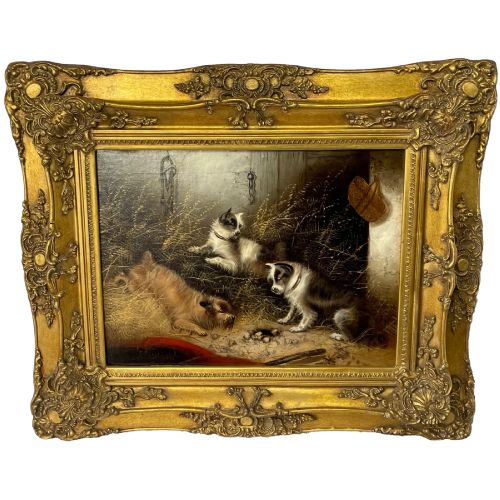


Rustic Barn Oil Painting
A rustic barn oil painting brings agricultural life onto canvas, capturing nineteenth-century farmyards, livestock, and vernacular timber structures with enduring appeal.
Rustic Barn Oil Painting
A rustic barn oil painting represents rural architecture, farmyards, and agricultural scenes across the Victorian era, the nineteenth century, and into the 1920s and 1930s. Buyers searching this phrase encounter depictions of livestock shelters, cart sheds, and stable interiors rendered in oil paint on canvas.
The pieces appearing on this page range from Victorian genre realism and pastoral scenes to Scottish Impressionism, British Impressionism, and Modern British works. Farmyard settings populated by sheep, cattle, poultry, and terriers dominate the available subjects.
Makers and followers represented in the record include James Kyd, Percival Glenfern, Thomas Sidney Cooper, Robert Russell MacNee, Ernest Higgins Rigg, George Armfield, Nora Munro Summers, Frank Moss Bennett, Louis Marie Dominique Robbe, and William Shayer Snr.
How they were made
These works utilise oil paint applied to canvas supports, capturing the textures of timber barns, masonry, and animal coats through layered pigment. Artists built up compositions using brushwork characteristic of Victorian realism and later British impressionist movements.
Many surviving canvases are housed within wood, gesso, and gold leaf gilt wood frames that complement the period aesthetic of the paintings. The combination of oil on canvas and period framing defines the physical construction of these artworks.
Terriers intent on ratting share barn floors with sheep, chickens, and livestock across the decades.
What varies in quality
Quality in a rustic barn oil painting rests upon the sureness of the brushwork and the artist's ability to render light across timber structures and animal forms. Works by named practitioners or their close followers often display superior anatomical precision in livestock and dogs compared to anonymous studio pieces.
The integrity of the canvas support and the preservation of the original oil paint layer dictate the visual impact of the piece. Additionally, the presence of period gilt wood and gesso frames enhances the overall standing of the work.
James Kyd·Percival Glenfern·Thomas Sidney Cooper·Robert Russell MacNee·Ernest Higgins Rigg·George Armfield·Nora Munro Summers·Frank Moss Bennett·Louis Marie Dominique Robbe·William Shayer Snr·Ernest Betigny
The Rustic Barn Oil Painting Glossary
- Canvas
- A heavy woven fabric stretched across a wooden frame to serve as a support for oil painting. It provides the textured surface upon which the pigment sits.
- Gesso
- A plaster-like mixture applied to wooden frames as a base before gilding with gold leaf. It creates a smooth surface for decorative mouldings.
- Genre painting
- Artwork that depicts aspects of everyday life, such as farmyard scenes and agricultural labour. These subjects capture social and domestic history.
- Impressionism
- An art movement focusing on transient effects of light and spontaneous brushwork. British and Scottish variations adapted these principles to local landscapes and rural subjects.
Rustic Barn Oil Painting: Frequently Asked Questions
What subjects appear in these paintings?
The works depict agricultural settings, including farmyards, stable interiors, cart sheds, and livestock shelters. Animals such as sheep, cattle, poultry, and terriers frequently populate the scenes.
Artists focused on the vernacular architecture of rural Britain and Europe, recording daily agricultural life through the nineteenth and early twentieth centuries.
How do I date an oil painting?
Dating relies on stylistic evidence, artist signatures, canvas stamps, and framing techniques. Victorian realism differs visibly from later 1920s and 1930s British Impressionism.
Period frames made of gilt wood and gesso also provide clues, as framing styles shifted across the nineteenth and twentieth centuries.
Where should I hang these artworks?
These paintings suit traditional interiors, libraries, dining rooms, and hallways where wooden furniture and historic decor complement rural subjects. Keep canvases away from direct sunlight and damp environments to protect the oil paint and canvas.
Proper placement ensures the gilt wood frames and canvas remain stable over time.
What is the difference between realism and impressionism here?
Realist works from the Victorian era emphasise detailed rendering of textures, animal anatomy, and architectural elements. Brushwork is controlled and descriptive.
Impressionist pieces from later decades prioritise loose brushstrokes and atmospheric effects of light over meticulous detail.