


Rural Harvest Oil Artwork
Rural harvest oil artwork captures agricultural toil and quiet fields, offering traditional pastoral charm through pigment on canvas.
Rural Harvest Oil Artwork
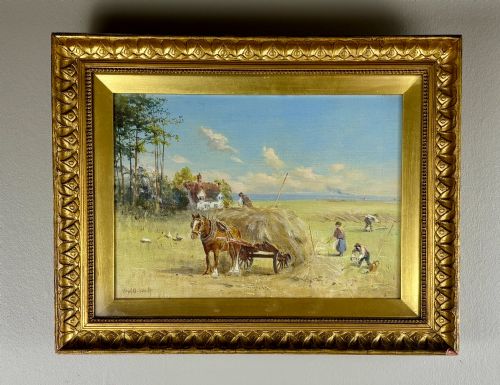
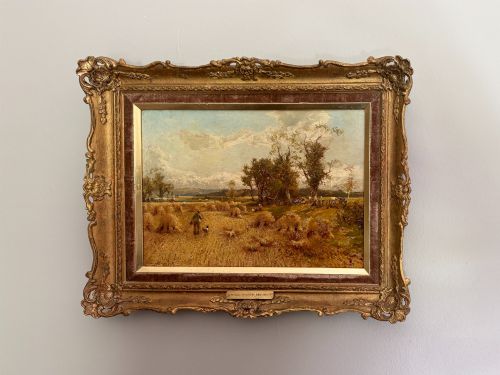
These pieces focus centrally on agricultural labour, depicting haymaking, cornfields and farming figures across canvas supports.
Most examples originate from the nineteenth and twentieth centuries, spanning Victorian pastoral scenes to mid-century naive interpretations.
Makers frequently employ British Impressionism, Victorian Realism and Edwardian Pastoral styles to record the seasonal gathering of crops.
Distinguishing quality in the works
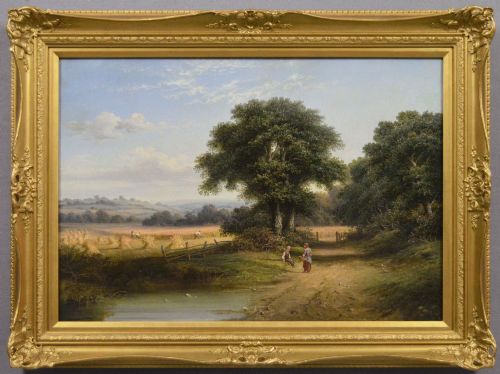
Superior execution shows in the handling of natural light and atmospheric depth across the harvest field or riverbank.
Detail in figures and farming equipment separates accomplished regional artists from simpler naive school interpretations.
Listings span from eighteen eighty to nineteen fifty, incorporating canvas supports and giltwood frames.
Walter Heath Williams·William Grant Murray·James William Booth·Herbert Royle·Arthur Walker Redgate·Henry H Parker·Joseph Thors
The Rural Harvest Oil Artwork Glossary
- Oil paint
- A slow-drying medium composed of pigment particles suspended in a drying oil, typically linseed. This substance allows artists to build rich textures and subtle colour gradations.
- Giltwood
- Wood carved and treated with gold leaf or metallic gilt powder to create a decorative surface. It commonly surrounds traditional landscape frames.
- Canvas
- A heavy woven fabric stretched tightly over a wooden frame to form the painting support. It provides the primary foundation for nineteenth and twentieth-century oil works.
- Impressionism
- An artistic style focusing on accurate depiction of light in its changing qualities. Works in this manner emphasise open brushwork and ordinary subject matter.
Rural Harvest Oil Artwork: Frequently Asked Questions
What subjects do these paintings feature?
The compositions focus primarily on agricultural scenes, including figures harvesting wheat, hayricks and country fields.
Many works also incorporate rural rivers, farm animals and distant pastoral villages.
How should I clean the canvas surface?
Dust accumulates gently on oil paintings over time and requires only a soft, dry brush for removal.
Avoid using water, chemical cleaners or abrasive cloths on the painted surface or giltwood frame.
Where should I hang these artworks?
Display the pieces away from direct sunlight and excessive moisture to protect the oil pigments and canvas.
Traditional frames pair well with period interiors, wooden furniture and neutral wall backgrounds.
How do I identify the period of a piece?
Examine the style of brushwork, costume details of the figures, and the construction of the frame.
Nineteenth-century examples often lean towards Victorian realism, while twentieth-century pieces adopt impressionist or naive techniques.