


Ruby Red Wine Glass
A ruby red wine glass brings deep colour and warmth to a table, combining rich glassmaking traditions from the Victorian period onwards.
Ruby Red Wine Glass
A ruby red wine glass is a striking drinking vessel designed for serving wine, found primarily in Victorian, Edwardian and later periods. The examples on this page encompass various forms such as individual wine glasses, roemers, and champagne coupes.
Most pieces seen here belong to the Victorian and Edwardian eras, spanning from the mid-nineteenth century into the early twentieth century. These items frequently appear as matched sets of wine glasses or as single decorative decanters and serving bottles.
Alongside English production, pieces originate from continental workshops, including Bohemian makers. The selection ranges from simple hand-blown stemware to elaborate table settings featuring cut and engraved crystal.
How they were made
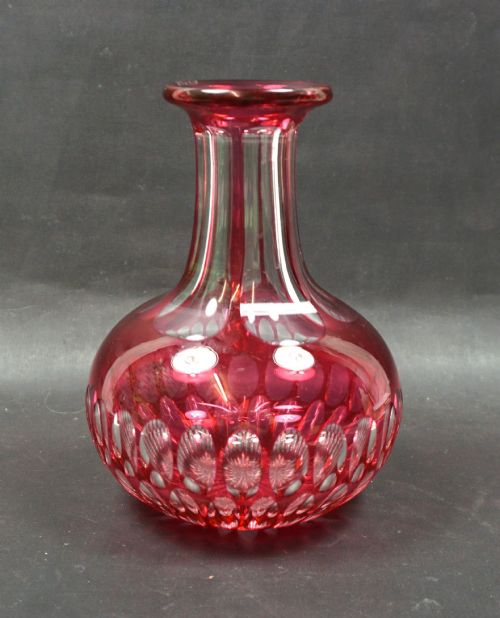
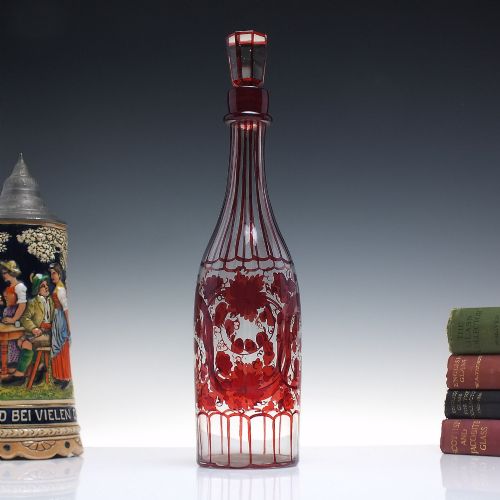
Glassmakers utilised lead crystal and clear glass layered with rich ruby or cranberry glass, often employing an overlay technique. This method allowed craftsmen to cut away portions of the coloured outer layer to reveal the clear glass beneath.
Decoration relied heavily on hand engraving and wheel cutting, producing intricate motifs of fruiting vines and birds. Some vessels also incorporated hand-painted enamel details or sterling silver mounts applied during the Edwardian period.
Listings feature items spanning from the mid-nineteenth century through the Edwardian era, incorporating clear glass, lead crystal, and silver plate.
What varies in quality
Quality rests upon the depth and evenness of the colour, alongside the precision of the glass cutting and wheel engraving. Superior pieces display crisp, detailed motifs such as vines and birds that catch the light cleanly.
The weight and clarity of the crystal foundation also dictate the standard of a piece, with heavier lead crystal vessels offering a more resonant ring and sharper facets. Complete sets with uniform colour saturation command greater attention than mismatched groups.
The Ruby Red Wine Glass Glossary
- Cranberry Glass
- A transparent pinkish-red glass coloured with gold chloride during production. It is characteristic of nineteenth-century tableware.
- Overlay Glass
- A technique where a layer of coloured glass is fused over a clear glass body. Artisans then cut through the top layer to create contrasting patterns.
- Roemer
- A traditional continental European wine glass featuring a large bowl on a cylindrical, ribbed stem. They frequently appear in green or ruby shades.
- Champagne Coupe
- A shallow, broad-bowled stemmed glass designed originally for sparkling wine. These often showcase engraved decoration across the bowl and foot.
- Decanter
- A vessel used for holding and serving wine, usually fitted with a stopper. In this category, many feature ruby overlay or sterling silver mounts.
Ruby Red Wine Glass: Frequently Asked Questions
How do I clean antique ruby glass?
Wash these pieces by hand using lukewarm water and mild soap, avoiding abrasive sponges or harsh detergents that might damage the surface.
Dry them immediately with a soft lint-free cloth to prevent water spots and protect any delicate engraved details.
Can I use these glasses for daily dining?
While sturdy enough for careful use, antique glassware benefits from gentle handling during dinner parties and special occasions.
Keep them away from modern dishwashers and sudden temperature changes to preserve the integrity of the historic material.
What is the difference between ruby and cranberry glass?
Cranberry glass specifically refers to a lighter pinkish-red hue achieved using gold in the glass batch, while ruby glass can encompass a broader range of deep red tones.
Both terms appear frequently across nineteenth-century tableware and describe similar decorative traditions.
How do I date a ruby wine glass?
Examine the pontil mark on the base, the weight of the metal, and the style of any cut or engraved decoration.
Victorian and Edwardian pieces often exhibit hand-blown irregularities and specific vine motifs characteristic of nineteenth-century design.