
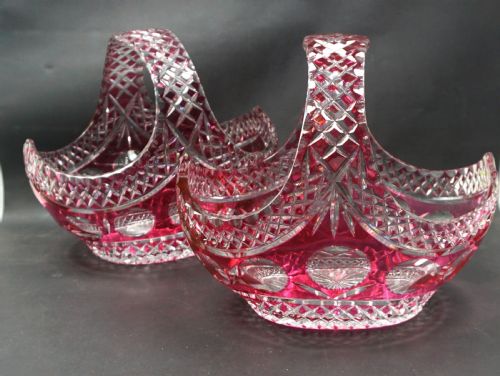


Ruby Overlay Glass
Ruby overlay glass brings rich colour and layered depth to a room, offering a striking focal point for any collector.
Ruby Overlay Glass
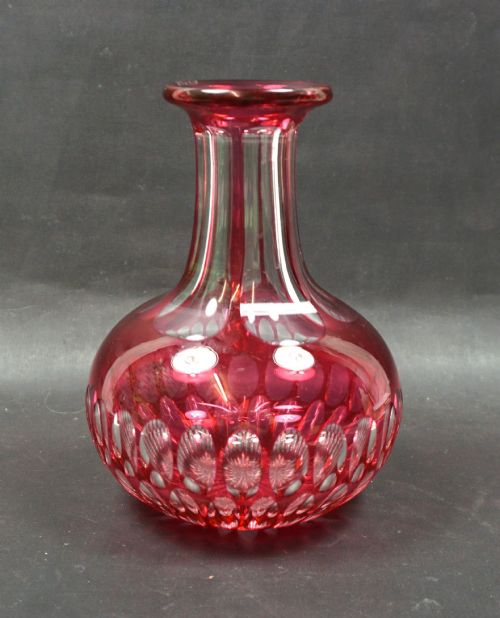
When you search for ruby overlay glass, you are looking at dual-layer tableware and display objects where a vibrant red or cranberry casing covers a clear crystal core. The pieces span the eighteenth, nineteenth and twentieth centuries, originating from English, Belgian and Bohemian workshops.
The selection on this page centres heavily on Victorian and Edwardian examples, alongside Art Deco designs from makers such as Val St. Lambert. Common forms include decanters, scent bottles, vases and decorative baskets designed to catch the light.
You will encounter items featuring cut panels, engraved foliage and precious metal mounts. The layering technique creates high contrast when the outer ruby skin is cut away to reveal clear crystal beneath.
How they were made
The foundation of these pieces relies on glassblowing a clear lead crystal or glass body, which is then dipped into a molten batch of ruby glass to form a coloured outer layer. Once cooled, artisans shape the vessel before applying surface decoration.
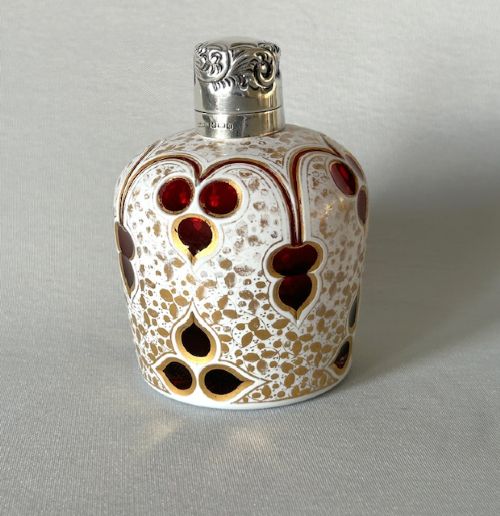
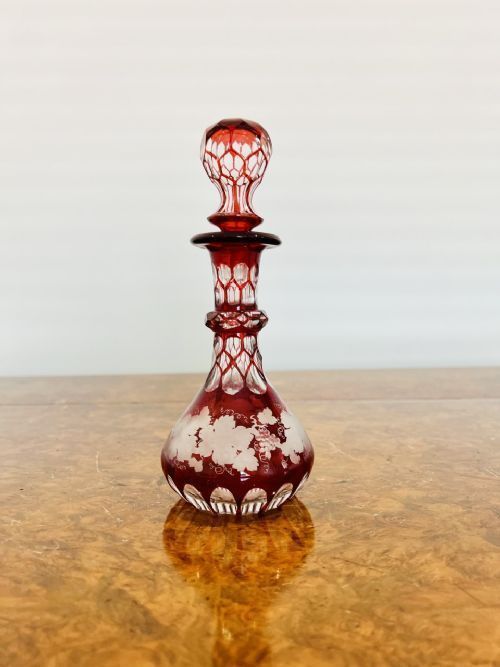
Makers utilised cutting wheels to slice through the ruby layer down to the clear crystal underneath, producing geometric panels or intricate patterns. Further embellishment involved hand-applied gold leaf, enamel painting and engraving with motifs such as birds and vines.
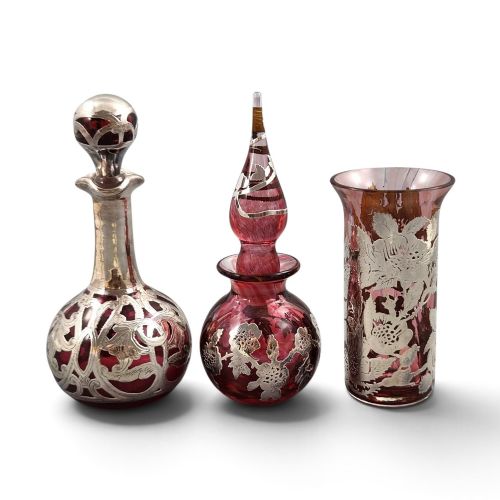
Many items received functional or decorative mounts in sterling silver or silver plate. These mountings were fitted around necks, stoppers and bases by silversmiths working in collaboration with glasshouses.
Object forms found across the archive and current stock include scent bottles, decanters, vases, goblets, champagne coupes and vanity sets.
What varies in quality
The precision of the wheel-cutting separates standard items from finer works. Sharp, clean edges where the ruby layer meets the clear crystal demonstrate superior craftsmanship by the glass cutter.
The depth and uniformity of the ruby colour also dictate the tier of the piece. Rich, even saturation without cloudiness or bubbles in the metal indicates higher grade raw materials and expert thermal control during the blowing process.
Additional artistry in the surface decoration elevates a piece. Fine hand-engraving of foliage, delicate gilding and hallmarked sterling silver mounts instead of base metal point to superior original commissioning.
Val St. Lambert·Gorham·John Douglas
The Ruby Overlay Glass Glossary
- Cranberry glass
- A transparent pinkish-red glass coloured with gold chloride during production. It frequently appears in Victorian tableware and scent bottles.
- Mercury glass
- A double-walled blown glass object coated on the interior with a silver liquid solution to create a reflective mirror finish.
- Lead crystal
- A heavy glass variety containing lead oxide, which increases brilliance and weight. It provides the clear base for many layered items.
- Gilding
- The application of gold leaf or powdered gold to the glass surface for ornamentation. It is often fired onto the piece for permanence.
- Overlay
- A technique of fusing one layer of coloured glass over a contrasting body of clear or coloured glass. Subsequent cutting exposes the lower layer.
Ruby Overlay Glass: Frequently Asked Questions
How can I tell Bohemian pieces apart?
Bohemian items often display deep, complex wheel-cutting and rich gilding that reflects nineteenth-century Central European aesthetics. They frequently take the form of heavy goblets, decanters and panelled vases.
English examples tend to favour refined cranberry tones with lighter engraving, while Belgian works from the Art Deco period embrace sleek geometric forms.
Were these items meant for daily use?
Decanters, wine glasses and carafes were produced for dining and entertaining, serving wine and spirits at the table. Scent bottles and vanity sets served personal grooming roles in dressing rooms.
Display items like vases and baskets were intended for floral arrangements and interior decoration. Today, collectors primarily preserve them as cabinet pieces.
What causes the different shades of red?
The colour variation depends on the chemical composition used during the melting process. Cranberry glass achieves its pinkish hue through the addition of gold.
Darker ruby reds typically rely on copper or selenium compounds. The thickness of the applied overlay layer also alters how deep the final red appears against the light.