


Royal Navy Oil Painting
These royal navy oil painting works capture the salt, steel and service of Britain's sea power across centuries of canvas.
Royal Navy Oil Painting
When you search for a royal navy oil painting, you are looking at canvases that record the ships, squadrons and senior officers of Britain's maritime history. These works range from action scenes of wooden warships and cruisers to formal portraits of admirals and royalty in naval uniform.
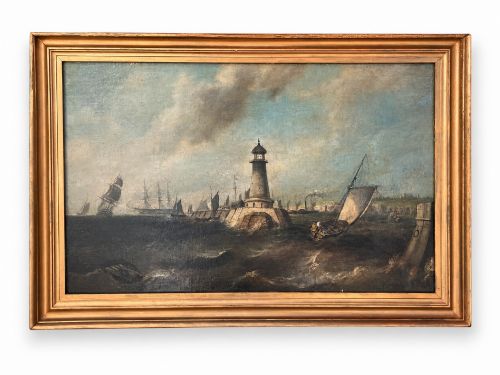
The pieces you meet on this page span the Victorian and Edwardian eras, alongside mid-century portraiture and earlier Georgian depictions. They vary from atmospheric marine art to detailed records of specific vessels like Plymouth Breakwater Lighthouse or HMS Swift.
How they were made
These works are executed in oil paint upon canvas, utilising the rich depth and blendability of the medium to render water, sky and uniform braid. Artists built up their compositions through layered brushwork, capturing the play of light on sea spray and regalia.
Finished canvases are housed in wood frames, frequently enhanced with gold leaf and gilt framing. This traditional presentation complements the solemnity of naval portraits and the dramatic sweep of maritime action scenes.
Listings feature works spanning from the eighteenth century through the 1950s, executed in oil on canvas with wood and gold leaf framing.
What varies in quality
Quality in these maritime works rests upon the precision of the draughtsmanship and the authority of the brushwork. A master painter renders the rigging of a ship or the medals upon an admiral's chest with absolute conviction, whereas lesser hands produce stiff and generalised forms.
The depth of historical provenance also marks out the superior piece. Canvases that correctly identify specific vessels, actions or sitters by known artists carry greater artistic and documentary weight than anonymous marine paintings.
Nicholas Condy·Charles Dixon·Henry L Gates·Samuel Lane·John Laviers Wheatley·William Dring·Maurice Codner·Richard Hall
The Royal Navy Oil Painting Glossary
- Oil on Canvas
- A painting medium where pigments bound in drying oil are applied to stretched canvas cloth. This combination allows for rich colour blending and durable preservation over centuries.
- Gilt Frame
- A wooden picture frame coated with a thin layer of gold leaf or metallic paint. It provides a traditional, ornamental border suited to formal historical portraits.
- Maritime Art
- Works of art that draw inspiration from the sea, including ship portraits, naval battles and coastal scenes. It forms a distinct genre within British painting.
- Regalia
- The decorations, medals, uniform insignia and badges worn by naval officers and royalty. In portraiture, these details indicate rank and historical service.
Royal Navy Oil Painting: Frequently Asked Questions
How do I identify the ship in a painting?
Look for painted inscriptions on the canvas, stern nameplates, or specific signal flags flying from the masts. Historical records often match the depicted vessel's class and rigging to documented navy ships.
Compare the hull structure and armament with naval architectural records from the era of the painting. Many works record specific historical vessels known to the Admiralty.
Where should I hang a naval portrait?
Choose a wall with stable ambient temperature away from direct sunlight to protect the oil paint and canvas from drying out. A location with controlled artificial lighting helps illuminate the dark tones typical of formal military portraiture.
Pair the canvas with a room that matches its period aesthetic, such as a study or traditional reception room. Ensure the weight of the gilt wooden frame is properly supported by wall fixings.
What is the difference between marine art and portraiture?
Marine art focuses primarily on ships, naval actions, and coastal weather conditions with the vessel as the central subject. These scenes emphasise historical engagements or general squadron maneuvers.
Portraiture concentrates on individual officers, admirals or royals, using the naval uniform as a marker of rank and duty. The human subject takes precedence over the surrounding maritime backdrop.
How do I date a naval painting?
Examine the style of the uniform, facial hair, and medals worn by the sitter to establish a decade. Admiral's uniforms and crown styles changed predictably across the Victorian and Edwardian periods.
Look for artist signatures, dates inscribed on the canvas reverse, or stretcher frame construction methods. Stylistic markers like early twentieth-century realism also narrow down the creation window.