





Round Walnut Foyer Table
A round walnut foyer table anchors an entrance hall with rich timber grain and a practical circular surface.
Round Walnut Foyer Table
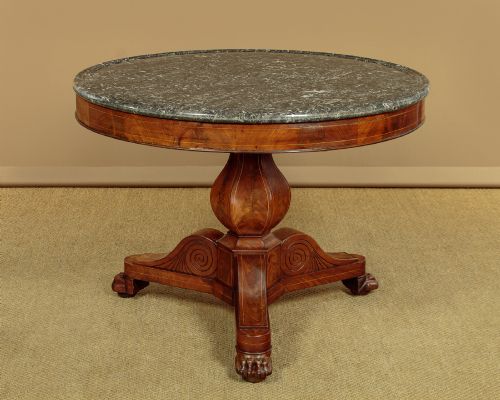
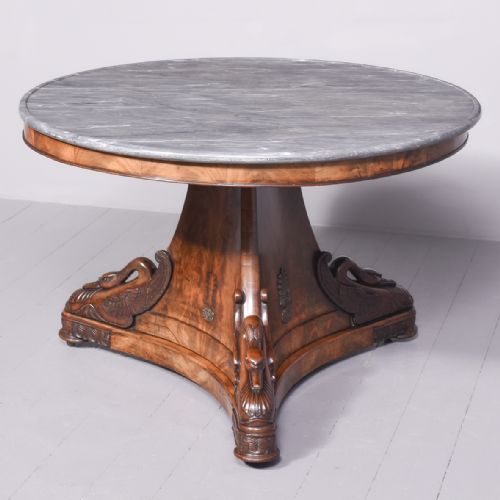
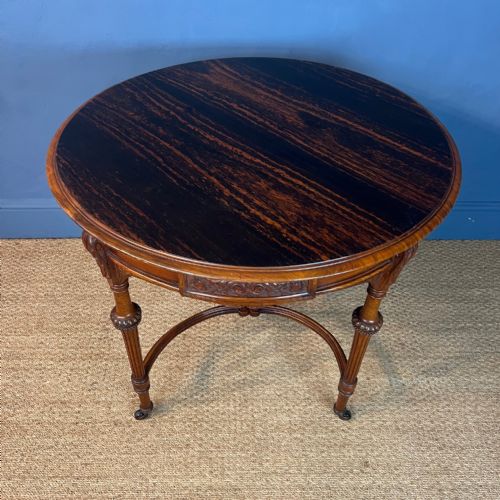
A round walnut foyer table appears on this page primarily through nineteenth century and early twentieth century centre tables, occasional tables, and console forms. These pieces often serve as striking hallway focal points, offering circular tops supported by carved pedestals or four legs.
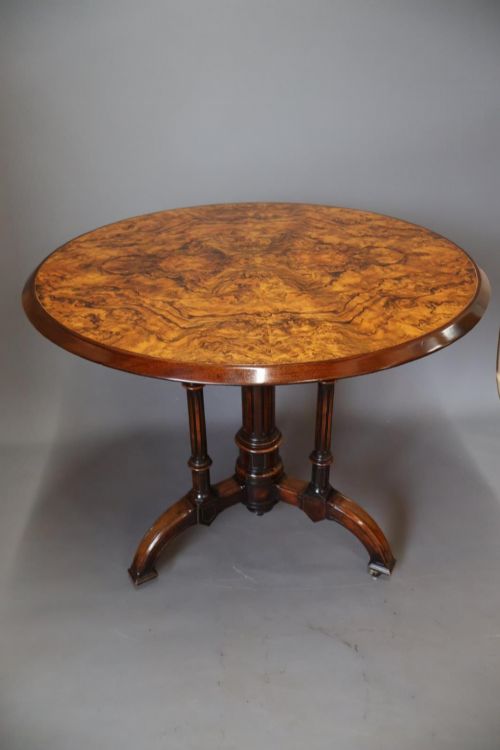
Makers designed these items across Victorian, Art Deco, and Regency periods, utilising rich walnut timbers often enhanced by marquetry inlay or burr walnut figuring. The selection spans straightforward domestic furnishings to grander marble-topped gueridon designs.
Buyers seeking a round walnut foyer table will encounter diverse stylistic influences, including Aesthetic Movement details and French neoclassical forms. Each piece brings specific period characteristics to an entrance space, from the deep tones of Victorian walnut to the clean geometric lines of Art Deco production.
How they were made
Cabinet makers constructed these tables using solid walnut and applied burr walnut veneers, which reveal intricate swirling grain patterns across circular table tops. Workshops frequently employed marquetry inlay, incorporating contrasting timbers and specimen woods to create detailed geometric or floral surface designs.
Structural embellishments often included hand carving on pedestals and aprons, alongside brass mounts or gilt details depending on the period and stylistic influence. Some examples integrated inset marble or glass tops, requiring precise joinery to support heavy stone surfaces within wooden frames.
Some tables are so heavily inlaid with specimen woods they double as botanical reference libraries for people who cannot identify trees.
What varies in quality
Quality in these tables rests on the selection of the timber and the precision of the veneer work, particularly on burr walnut surfaces where matching grain creates a cohesive visual effect. Superior examples display crisp, deep hand carving on wooden mounts and pedestals rather than shallow or mechanical shaping.
The sophistication of the marquetry inlay and the integration of secondary materials, such as specimen marble or cast brass elements, distinguish finer workshop output from standard production. Construction methods, including the stability of the central pillar or leg joints, determine the structural integrity of the circular top.
The Round Walnut Foyer Table Glossary
- Burr walnut
- A highly figured timber taken from the growth excrescences of walnut trees, prized for its swirling patterns on table tops.
- Gueridon
- A small circular table on a single central pillar or tripod base, originating in seventeenth century France.
- Marquetry
- Decorative patterns formed by fitting together thin veneers of various woods, sometimes combined with other materials.
- Console table
- A table designed to stand against a wall, frequently supported by wall brackets or curved console legs.
- Specimen wood
- Timbers collected from various exotic or domestic species, arranged to showcase contrasting natural colours in inlay work.
Round Walnut Foyer Table: Frequently Asked Questions
How do I style a round walnut foyer table?
Place the table centrally in an entrance hall to allow clear movement around its circular perimeter. A single large decorative object, such as a ceramic bowl or a floral arrangement, works well on the surface without cluttering the grain.
Pair the piece with appropriate wall lighting or a matching mirror to balance the vertical space above the timber top. The rich tones of walnut coordinate effectively with both neutral walls and deeper traditional colour schemes.
What periods do these tables come from?
The pieces span the eighteenth, nineteenth, and early twentieth centuries, encompassing Regency, Victorian, and Art Deco eras. Each period brings distinct design traits, from ornate carved Victorian pedestals to streamlined modernist lines.
Earlier nineteenth century examples often feature French influences or elaborate marquetry, while later pieces adopt simpler geometric forms. Identifying the period relies on examining the combination of timber types, construction joints, and decorative carving styles.
Can I use an occasional table in a hallway?
Occasional tables and centre tables function effectively in entrance areas provided the floor space permits a circular footprint. Their original design as freestanding centre pieces means they offer visual interest from every viewing angle.
Consider the diameter of the table relative to the hallway width to ensure comfortable passage for daily use. These versatile surfaces provide a practical drop zone for keys and post upon entering the home.
What is burr walnut?
Burr walnut derives from a tree growth deformity that produces highly complex, clustered grain patterns full of swirling eyes. Cabinet makers sliced this wood into thin veneers to cover large flat surfaces like table tops.
Because of its striking appearance, burr walnut was reserved for higher quality furniture production across Victorian and Edwardian workshops. The pattern is unique to every cut, ensuring each table top possesses a distinct visual texture.