





Round Eagle Crest Mirror
A round eagle crest mirror brings fierce Regency presence to a room, catching the light in a curved convex glass.
Round Eagle Crest Mirror
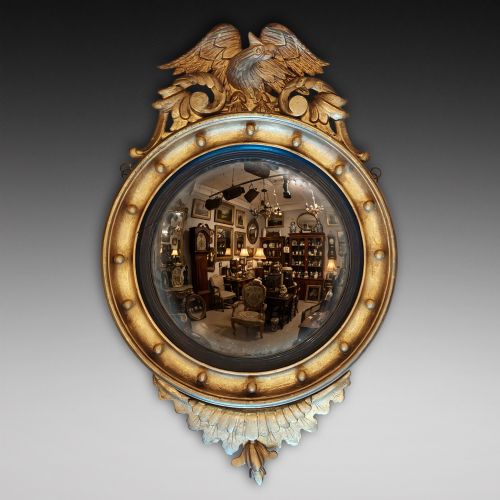
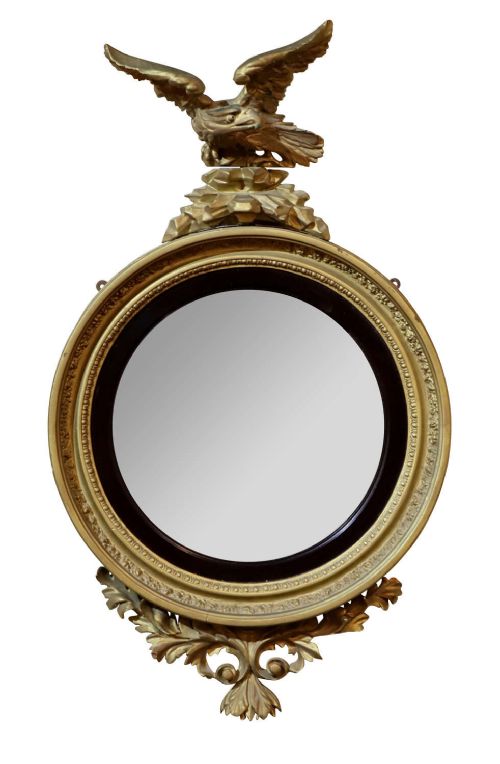
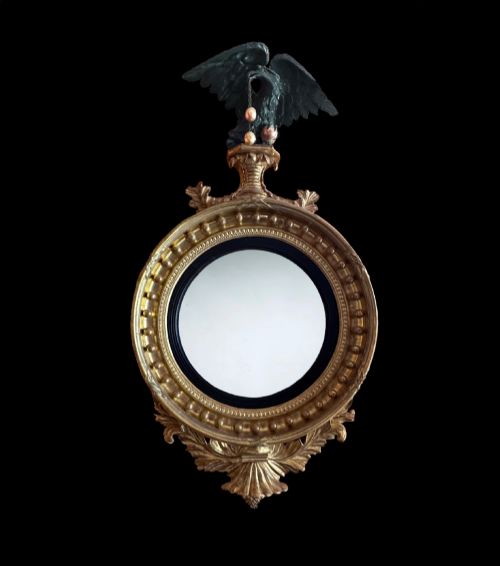
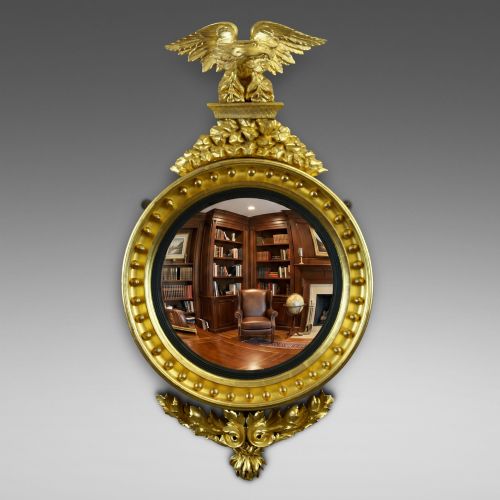
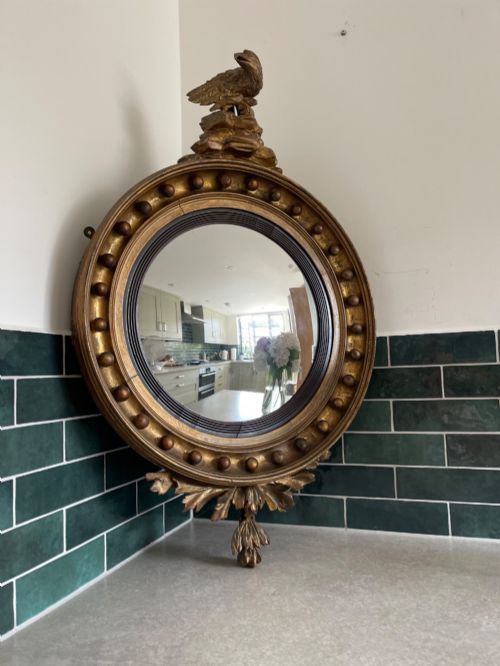
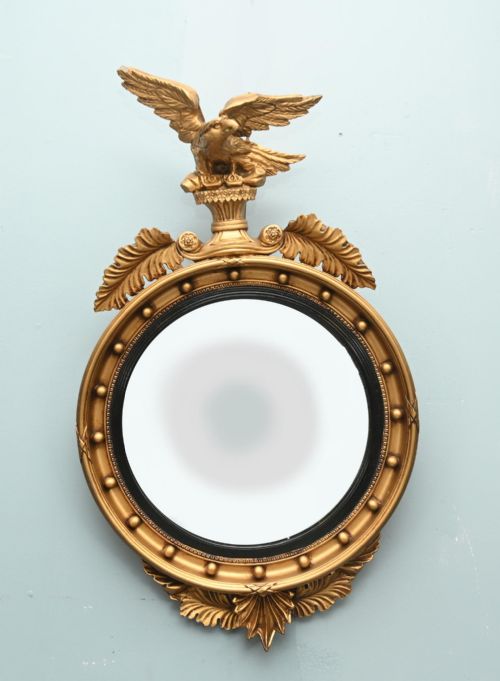
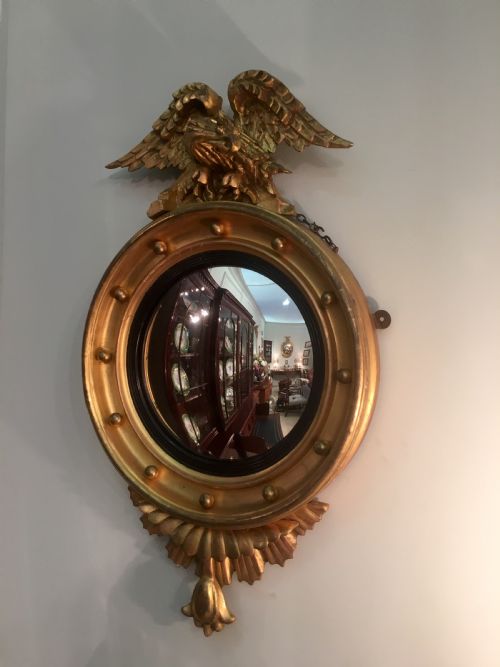
A round eagle crest mirror centres on a circular convex glass framed in giltwood, most commonly appearing from the Regency period alongside 19th Century and Georgian examples. These wall mirrors draw the eye with a prominent bird surmount perched at the top of the frame, often with wings spread wide.
The form functions primarily as a decorative convex wall mirror rather than a dressing glass, designed to reflect a wide angle of the room in miniature. Buyers looking for this phrase meet grand Regency interpretations and simpler 19th Century iterations alike, all sharing the distinctive round format.
Materials and construction methods
Makers shaped these frames from timber, applying layers of gesso before gilding the surface to create the bright metallic finish characteristic of giltwood. Mirrored glass was curved into a convex shape to distort the reflection outwards, capturing the entire room within the circular boundary.
Carved details such as the eagle surmount required skilled woodworking, while brass elements sometimes appeared as candle arms on girandole variations. Ebonised wood also emerges in the framing, providing a dark contrast to the gilt surfaces.
Round Eagle Crest Mirror Retail Price Guide 2026
Typical asking prices for round eagle crest mirror among the pieces listed under this phrase on Sellingantiques today, from the lower quarter to the upper quarter. They describe what is for sale here now, not the wider market.
Current listings span the Regency, Georgian, and Victorian periods, constructed from giltwood, ebonised wood, and brass.
Distinctions in craftsmanship and form
The vigour of the carved eagle surmount separates ordinary examples from finer works, with depth and anatomical detail marking the upper tier. The crispness of the gesso mouldings and the smoothness of the giltwood finish similarly indicate the maker's original investment of time.
Proportion plays a role in overall merit, where the weight of the eagle balances harmoniously with the diameter of the circular frame. Preservation of the original convex glass and the integrity of the gilt surface complete the distinction.
The Round Eagle Crest Mirror Glossary
- Convex mirror
- A curved glass that bends outwards to reflect a wide-angle, miniaturised view of the surrounding interior. These were historically called bullseye mirrors.
- Giltwood
- Timber coated in fine layers of gesso and gold leaf or gold paint. This finish creates the bright reflective surface seen on traditional frames.
- Gesso
- A plaster-like mixture applied to timber frames to build up a smooth base for carving and gilding. It allows for crisp ornamental details.
- Girandole
- A decorative wall mirror fitted with candle branches or sconces attached to the frame. The polished metal or glass reflects the candle flame.
- Surmount
- An ornamental feature placed at the very top of a mirror frame. In these pieces, it takes the form of a carved eagle.
Round Eagle Crest Mirror: Frequently Asked Questions
What is a convex mirror used for?
A convex mirror distorts reflections to capture a wide field of view in a compact circular space. Historically, these pieces helped monitor activity across large drawing rooms.
Today, they serve as striking focal points above mantelpieces or console tables. Their curved glass adds depth and ambient light to dark hallways.
How do you date a Regency mirror?
Dating relies on stylistic markers such as reeded ebonised slips within the frame and the specific form of the eagle carving. Regency pieces from the early 19th Century often display bold classical motifs.
Construction traits, including timber types and the composition of the gesso ground, also help separate genuine period items from later 19th Century revivals.
Why does the eagle feature on top?
The eagle surmount carried strong patriotic and neoclassical symbolism during the Georgian and Regency eras. It added vertical height and grandeur to the round frame.
Master carvers used the bird to project power and alertness, making the mirror both a functional optic and an authoritative wall sculpture.
Are girandole mirrors different?
A girandole incorporates candle arms branching out from the sides of the frame. This design amplified candlelight across the room before the arrival of electricity.
Standard convex mirrors lack these sconces, keeping the circular giltwood frame uninterrupted by protruding metal arms.