


Rosewood Storage Caddy
A rosewood storage caddy brings rich grain and deep colour to a room, holding tea or trinkets with the quiet substance of the Regency and Victorian eras.
Rosewood Storage Caddy
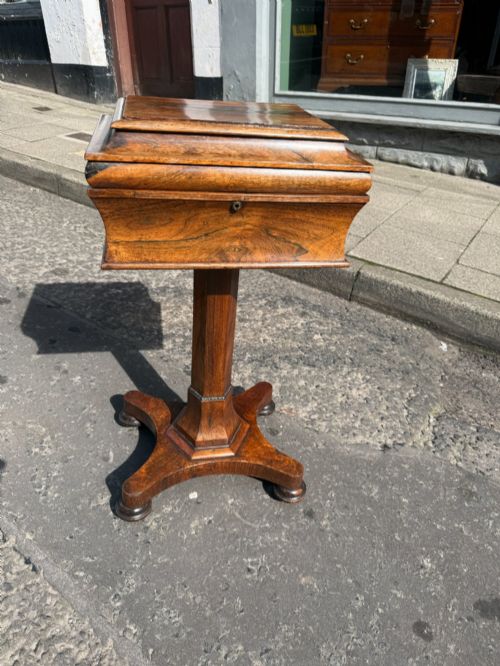
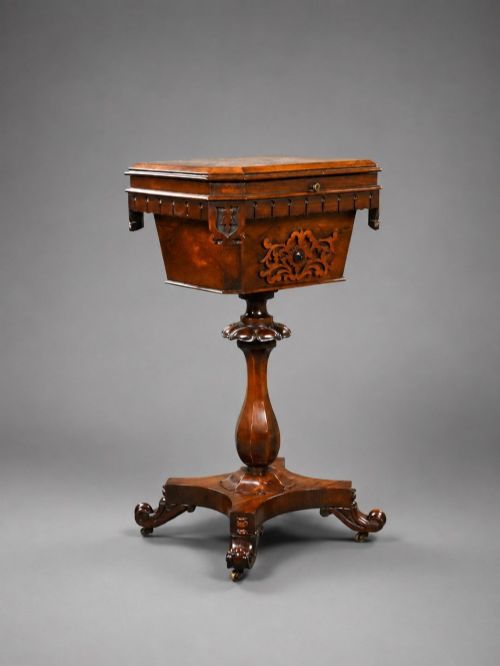
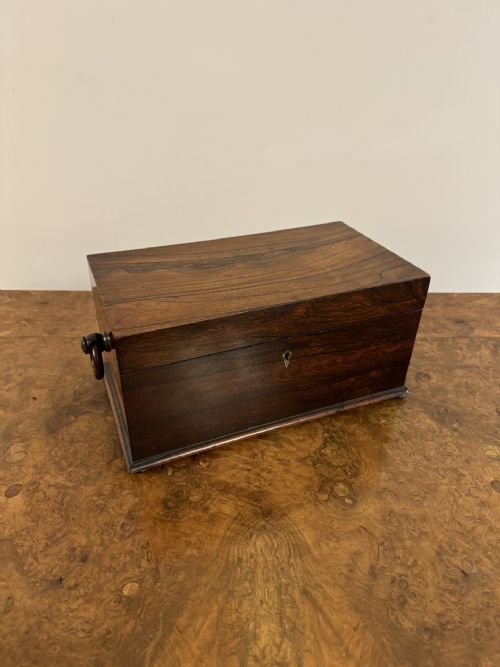
A rosewood storage caddy is principally a tea caddy, teapoy or small box designed to hold precious dry leaf, with occasional music canterburys appearing in the same dense timber. The examples found here span the Georgian, Regency, William IV and Victorian periods, with sarcophagus forms appearing frequently alongside domed and rectangular boxes.
Makers of the era shaped these vessels as centrepieces for the drawing room, often fitting them with internal compartments, loose leaf cases and working locks with keys. While the traditional tea caddy dominates the selection, related storage boxes and jewellery boxes share the same opulent cabinet-making traditions.
The materials reflect a period of high craftsmanship, uniting dark tropical timbers with pale contrasting stringing and intricate geometric decoration. Buyers searching for a rosewood storage caddy encounter pieces that balance practical containment with decorative display.
Materials and construction
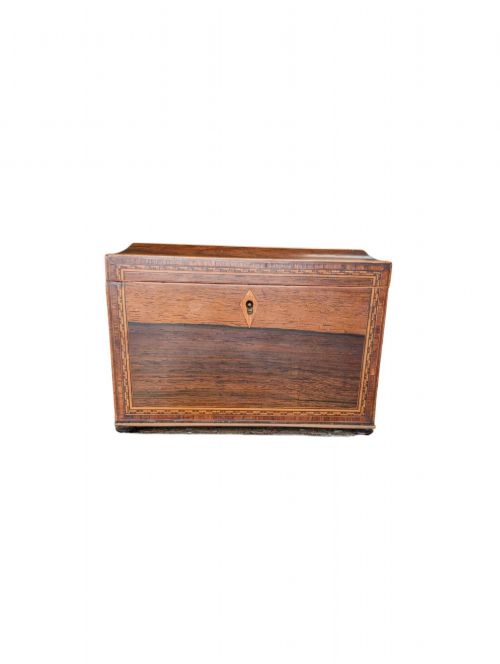
Cabinet-makers relied on solid rosewood and fine rosewood veneers laid over secondary timbers, exploiting the rich, dark grain of the wood for dramatic effect. This dense timber was frequently enhanced with contrasting boxwood and satinwood stringing to define the edges and geometric panels.
Many boxes incorporate brass inlay, lion mask handles and escutcheons, requiring precise recessing into the hard rosewood surface. Specialised techniques such as Tunbridge Ware mosaic and parquetry create intricate pictorial or geometric banding using multiple natural coloured woods.
Current listings feature rosewood storage pieces spanning the Georgian, Regency, William IV, and Victorian periods, incorporating brass, boxwood, and bone inlay.
Distinctions in quality
The hierarchy of quality rests on the crispness of the parquetry, the ambition of the brass inlay and the integrity of the timber veneer. Finer pieces display continuous grain wrapping smoothly across the sarcophagus curves, whilst simpler boxes rely on plain polished surfaces.
Internal fittings dictate the grade of a piece, separating standard storage boxes from elaborate teapoys equipped with original glass mixing bowls and multiple lidded canisters. The precision of the joinery and the survival of functioning locks and decorative brass handles further elevate the standing of a specimen.
The Rosewood Storage Caddy Glossary
- Sarcophagus form
- A box shape featuring sloping sides and a domed or stepped lid, mimicking ancient monumental tombs. This silhouette became the dominant fashion for luxury tea caddies during the Regency period.
- Teapoy
- A small stand or large table-height caddy fitted with internal storage for tea, often supported on a central pillar with tripod or platform feet. They served as movable tea stations in the nineteenth-century drawing room.
- Tunbridge Ware
- Woodworking characterised by mosaic tesserae creating intricate pictorial or geometric surface designs. Craftsmen assembled thousands of tiny wood blocks to form landscapes or floral bands.
- Parquetry
- Geometric mosaic woodwork formed by fitting small veneer pieces together in repeating patterns. It differs from marquetry by sticking to strict geometric grids rather than flowing pictorial designs.
- Escutcheon
- A protective plate surrounding a keyhole, usually cast in brass or inlaid in bone. On these pieces, it serves both a functional role and a decorative focal point on the front panel.
Rosewood Storage Caddy: Frequently Asked Questions
What is the difference between a tea caddy and a teapoy?
A tea caddy is a portable box designed to sit on a table or sideboard, holding loose tea leaves in internal compartments. A teapoy is a much larger vessel, often standing on its own pillar and base, functioning as a standalone piece of furniture in the room.
Both forms served the same ultimate purpose of securing expensive imported tea under lock and key. The terminology often overlaps in nineteenth-century inventories, but the scale remains the primary visual distinction for buyers.
How do I date a rosewood tea caddy?
Dating relies heavily on architectural silhouette, decorative motifs, and construction techniques. Sarcophagus shapes with brass lion mask handles and bold feet typically point to the Regency and William IV eras.
Victorian examples frequently introduce heavier floral marquetry or Tunbridge Ware mosaic work. Examining the interior linings and internal canister lids also offers clear clues to the exact decade of manufacture.
Can I still use these boxes for storage today?
These vessels transition easily into modern homes as storage for jewellery, trinkets, letters, or modern tea bags. The internal lidded compartments remain practical for organising small items.
Care should be taken to protect the historical wood finish from excessive moisture and direct sunlight. Working locks add a layer of functional security for personal valuables.
What caused the popularity of rosewood in the nineteenth century?
Cabinet-makers prized rosewood for its deep, dark purple-brown heartwood and striking black grain patterns. The timber took a high polish, making it the premier material for opulent drawing room accessories.
As global trade routes expanded during the Georgian and Victorian periods, exotic timbers became status symbols for affluent households. This aesthetic preference drove the creation of intricately inlaid boxes and caddies.