
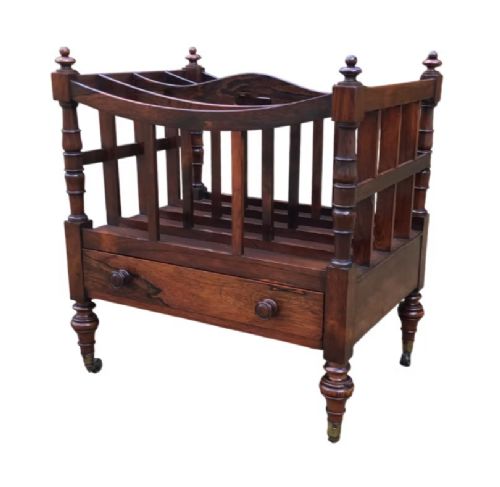


Rosewood Newspaper Holder
A rosewood newspaper holder brings rich grain and practical division to a room, serving as an elegant home for journals and sheets.
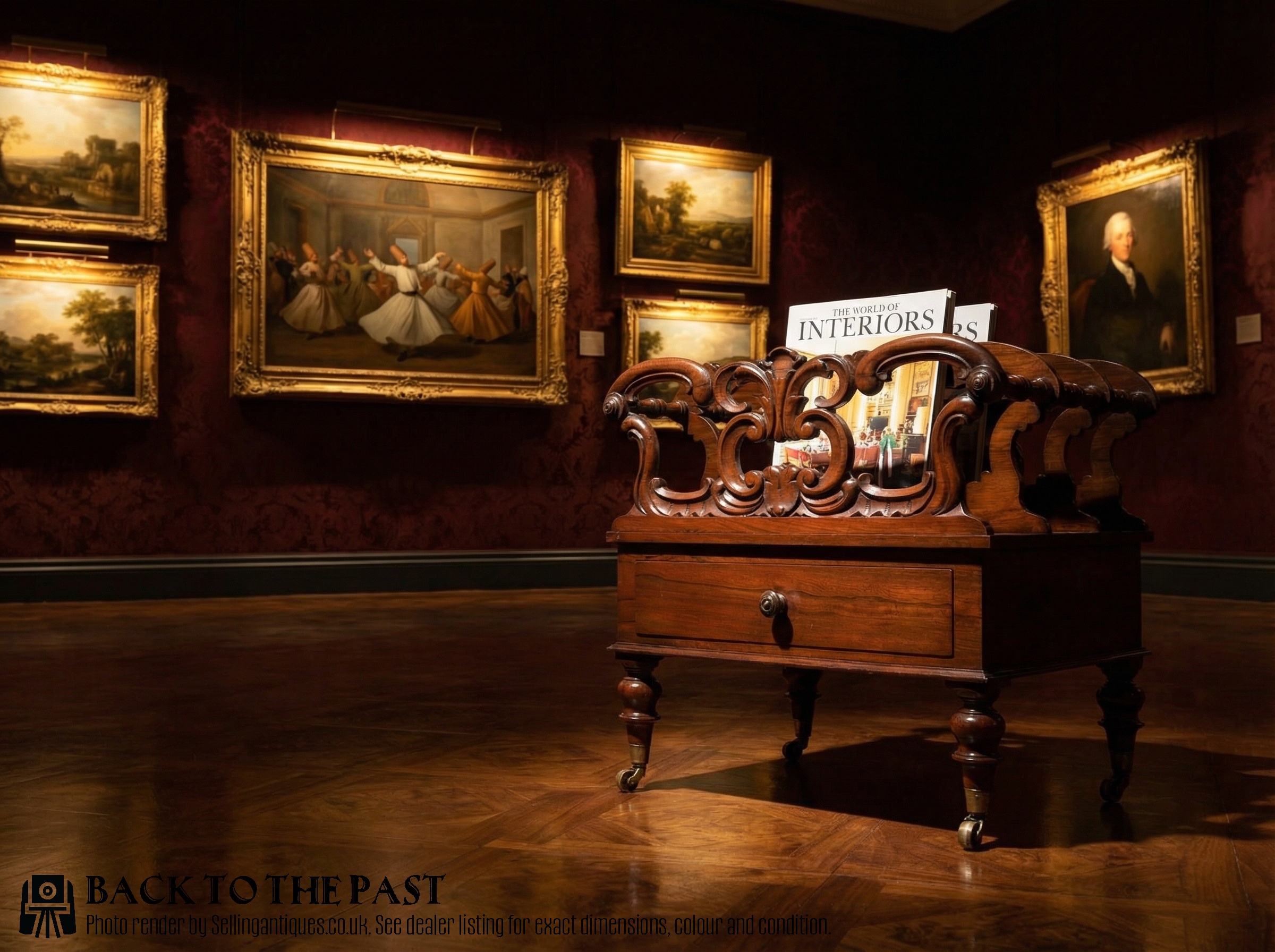
Rosewood Newspaper Holder
When you search for a rosewood newspaper holder, you are looking at fine nineteenth-century furnishings often catalogued as canterburys, magazine racks, or music stands. These pieces combine slotted divisions for paper with sturdy stands, frequently raised on castors for easy movement around a drawing room.
The version you are most likely to meet on this page is the classic Canterbury, spanning Regency, George III, George IV, and Victorian periods. They appear in rich rosewood timbers, sometimes accented with brass details or carved foliate designs, reflecting the domestic habits of the nineteenth century.
How they were made
Cabinet makers utilised dense, richly figured rosewood to construct the upright divisions and main frames of these stands. The timber takes a fine polish, highlighting the dark grain and natural warmth of the wood.
Many examples incorporate slender turned supports, carrying handles, and delicate brass fittings or castors. Joinery techniques from the Georgian and Victorian eras ensure the vertical slats remain robust enough to hold heavy folios and journals.
What varies in quality
The distinction between standard examples and the finest pieces lies in the crispness of the timber selection and the sophistication of the joinery. Superior items exhibit carefully matched rosewood veneers and well-proportioned divisions that balance utility with decorative refinement.
Details such as finely turned carrying handles, original brass castors, and subtle carved foliate flourishes elevate an ordinary stand into a work of cabinet art. The integrity of the structure and the depth of the polished surface ultimately define the standing of the piece.
Gillows
The Rosewood Newspaper Holder Glossary
- Regency
- A British design period spanning the early nineteenth century, known for classical restraint and elegant, slender proportions. Pieces from this era often draw inspiration from ancient Roman and Greek forms.
- George IV
- The period covering the reign and regency of King George IV, marked by rich ornamentation and confident cabinet-making. Furniture from this time often displays substantial rosewood frames and refined turned details.
- Foliate design
- A decorative motif incorporating leaf and plant patterns, frequently carved into the wood or cast in brass. It adds organic texture to the structured lines of a newspaper rack.
- Division
- One of the vertical partitions that separates the interior space of a rack into individual compartments. These slots keep newspapers and folios neatly upright.
Rosewood Newspaper Holder: Frequently Asked Questions
What is a rosewood newspaper holder used for today?
These versatile stands serve well beside a favourite armchair or sofa to store current newspapers, magazines, and weekly journals. They keep reading material organised and within easy reach while adding period character to a room.
Collectors also utilise them in studies and libraries to display large folios or sheet music. Their divided compartments prevent papers from slumping or scattering across surfaces.
How do I tell a Regency canterbury from a Victorian one?
Regency pieces generally exhibit cleaner, more restrained lines inspired by classical antiquity, often featuring slender turned supports and subtle brass accents. They date from the early decades of the nineteenth century.
Victorian examples tend to incorporate heavier proportions, richer carving, and sometimes foliate designs. They reflect the later nineteenth-century preference for ornate domestic ornamentation.
Are these stands strong enough for daily use?
Cabinet makers built these pieces to withstand the regular demands of a nineteenth-century drawing room. The solid rosewood construction and secure joinery provide reliable support for stacks of heavy periodicals.
Gentle handling and placement away from direct heat sources will keep the structure stable. The original castors, where present, make repositioning the stand straightforward.
Why are they sometimes called music racks?
Many early nineteenth-century canterburys were specifically designed to hold sheet music near a piano or music room seating. The upright divisions kept scores neatly sorted and upright for quick selection.
Over time, owners adapted these convenient partitioned stands to hold newspapers and magazines. The terms often overlap in historic descriptions and dealer records.