



Rosewood Demilune Table
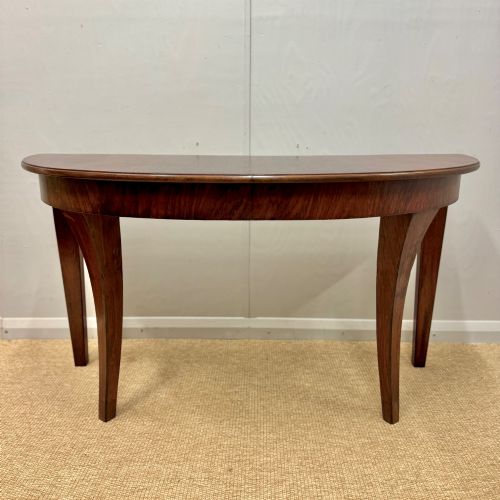
A rosewood demilune table brings a graceful half-moon silhouette and rich grain to a hallway or drawing room.
Rosewood Demilune Table
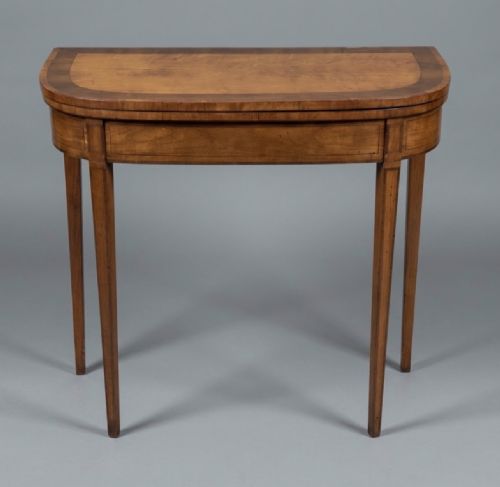
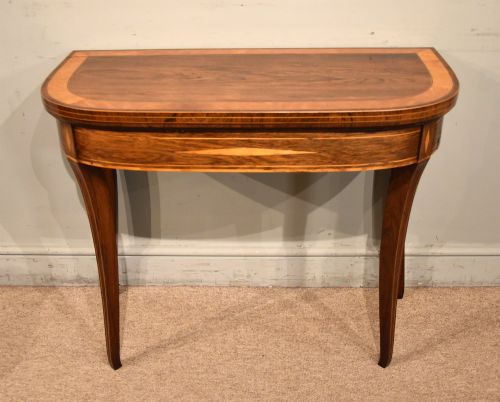
A rosewood demilune table appears in forms designed for compact spaces against a wall, frequently doubling as a card or games table with a fold-over top. The pieces handled here span the Georgian, Regency, and nineteenth-century periods, often incorporating satinwood stringing and mahogany secondary timbers.
Makers and cabinetmakers of the eighteenth and nineteenth centuries utilised the semicircular shape to showcase figured veneers and cross-banded borders. Surviving examples encompass console tables with concave legs, marble tops, and detailed inlaid motifs typical of Sheraton and French Louis XV styles.
How they were made
Cabinetmakers constructed these tables using dense tropical hardwoods, applying figured rosewood and satinwood veneers over solid underlying carcases of mahogany or deal. Stringing and banding in lighter boxwood created crisp geometric borders around the semicircular tops.
Decorative hardware included cast brass mounts and ormolu accents, particularly on pieces influenced by French design. Specialised workshops such as Thonet also utilised bentwood techniques for nineteenth-century console variations.
Rosewood Demilune Table Retail Price Guide 2026
Typical asking prices for rosewood demilune table among the pieces listed under this phrase on Sellingantiques today, from the lower quarter to the upper quarter. They describe what is for sale here now, not the wider market.
Listings feature rosewood, satinwood, and mahogany timbers paired with marble and ormolu mounts across Georgian, Regency, and nineteenth-century periods.
What varies in quality
The sophistication of the timber selection distinguishes standard pieces from exceptional ones, with rich grain matching and balanced contrasting borders indicating superior workshop output. Subtle differences in the execution of boxwood stringing and the crispness of inlaid motifs reveal the hand of skilled cabinetmakers.
Structural integrity depends on the retention of original timber framing and the harmonious ageing of the rosewood surface beneath traditional finishes. Tables that maintain their matching secondary timbers and original brass fittings hold greater visual cohesion.
Thonet
The Rosewood Demilune Table Glossary
- Demilune
- A half-moon shape used for furniture designed to sit flat against a wall. This profile became particularly popular for side and card tables during the Georgian and Regency periods.
- Cross-banding
- A narrow strip of veneer laid perpendicular to the grain of the main surface, often framed by contrasting stringing lines. This technique creates a distinct visual border around the tabletop.
- Satinwood
- A durable, lustrous timber from the Indian Ocean region with a golden yellow appearance. Cabinetmakers utilised it for contrasting stringing, marquetry, and full veneer panels.
- Ormolu
- Gilded bronze used for decorative mounts and accents on furniture. French-influenced pieces frequently incorporated these cast metal details.
- Bentwood
- A technique of steaming and bending solid wood into curved shapes. This method appears in later nineteenth-century Austrian production.
Rosewood Demilune Table: Frequently Asked Questions
How were card tables used?
Card tables served as multi-functional furniture in drawing rooms, remaining folded against the wall when not in use. Hosts unfolded the top to reveal a baize-lined surface for evening games.
Many rosewood demilune examples on this page function specifically as card or games tables from the Regency and Georgian periods.
How do I identify a Regency table?
Regency tables typically display architectural lines, bold rosewood veneers, and classical brass mounts or inlaid stringing. Makers working in this period often drew inspiration from ancient Greek and Roman forms.
Look for concave legs, cross-banded borders, and rich dark timbers characteristic of the early nineteenth century.
Where should I place a console table?
A console table fits naturally in a hallway, landing, or beneath a mirror in a principal reception room. Because the back is flat, it occupies minimal floor depth while offering surface area.
Marble-topped variants provide a durable surface for lamps and decorative objects, whereas wooden fold-over tops offer flexibility.