
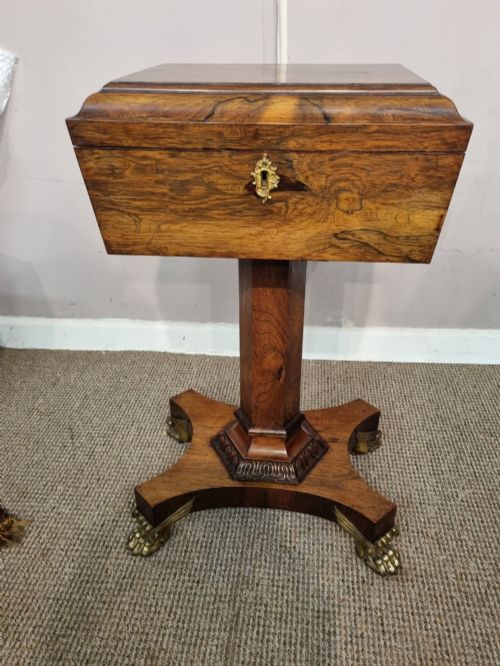
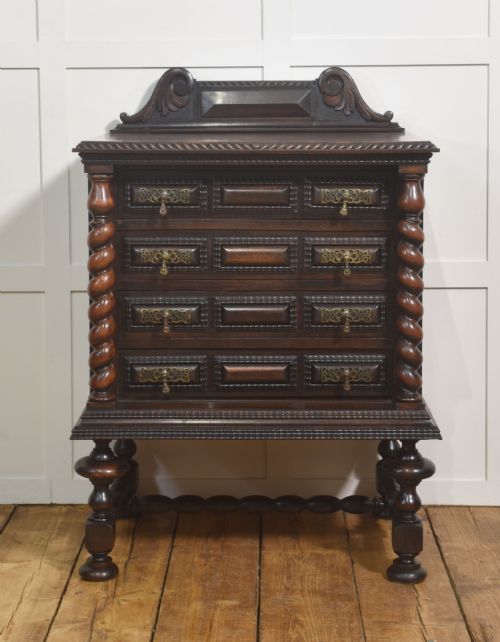


Rosewood Chest on Stand
A rosewood chest on stand brings rich timber grain and compact proportion to a room, offering both surface display and refined storage.
Rosewood Chest on Stand
When searching for a rosewood chest on stand, you are looking at elevated case furniture that combines figured cabinetwork with a raised support structure. These pieces span periods from the Georgian and Regency eras into the nineteenth century, reflecting global tastes from English workshops to Portuguese colonial centres.
The version you are most likely to meet on this page is the teapoy or small cabinet raised upon legs, often taking form as a work box or tea caddy mounted on a dedicated stand. Such items served domestic rituals in formal rooms, holding precious dry goods or needlework supplies.
Beyond standard chests, the selection includes music cabinets, floor and table cabinets, and canterburys sharing the same dense timber palette. Each variant demonstrates how cabinetmakers elevated utilitarian storage into decorative furniture.
How they were made
Makers utilised dense, dark rosewood as the primary face timber, often selecting veneers with striking grain patterns to cover structural carcases of secondary woods. Surface enrichment relied on precision metalwork, incorporating brass inlay and mounts that catch the light against the deep brown and purple tones of the wood.
Detailing frequently extended to contrasting materials set into the timber surface, including bone, tortoiseshell, and glass elements in specialised compartments. Traditional joinery secured the boxes to their stands, whether through simple tapered legs or elaborate turned and carved supports reflecting regional styles.
Tea was once so valuable that small boxes needed sturdy locks and stands to keep servants away from the leaves.
What varies in quality
The standard of execution in cabinetwork separates standard utility pieces from exceptional examples of the maker's art. Precision in the brass inlay, the crispness of turned supports, and the careful matching of rosewood veneers determine the visual harmony of the finished object.
Internal arrangement also marks distinction, where fitted compartments retain original trays, bone containers, or glass mixing bowls rather than later replacements. The integrity of the stand relative to the upper chest dictates historical coherence and balance.
The Rosewood Chest on Stand Glossary
- Teapoy
- A small chest or box mounted on a stand, originally designed for storing dry tea leaves and equipped with internal caddies. Regency examples frequently feature elaborate brass inlay and fitted interiors.
- Canterbury
- A low stand with partitions used for holding sheet music, books, or portfolios, often fitted with a drawer below. Nineteenth-century interpretations utilised rosewood and turned supports.
- Inlay
- A decorative technique where contrasting materials such as brass or bone are set flush into the wooden surface. This method defined much of the Regency output seen in this category.
- Carcase
- The structural body of a chest or cabinet before exterior veneers and finishes are applied. The quality of internal construction dictates the longevity of the piece.
- Veneer
- A thin layer of figured rosewood applied over a stable secondary timber to create decorative exterior surfaces. Skilled matching of these sheets produced symmetrical patterns across drawer fronts and lids.
Rosewood Chest on Stand: Frequently Asked Questions
What is a teapoy?
A teapoy is a lidded box on a stand, designed to hold tea leaves and utensils in the drawing room.
Many incorporate mixing bowls and internal caddies alongside locking mechanisms to secure valuable commodities.
How do I date a rosewood piece?
Dating relies on stylistic markers such as brass inlay patterns, leg turnings, and overall proportion relative to known periods.
Georgian and Regency examples tend toward classical restraint, while later nineteenth-century pieces embrace revival styles.
Where were these pieces used?
These cabinets and stands inhabited principal rooms of the house, including parlours, drawing rooms, and studies.
They functioned as moveable storage surfaces that could be repositioned for tea service or needlework.
What distinguishes Portuguese colonial pieces?
Portuguese colonial cabinetwork often combines native tropical hardwoods with distinctive proportions and carved decorative motifs.
These items reflect cross-cultural exchange and specialised trade routes active during the nineteenth century.