



Rosewood Bureau Plat
A rosewood bureau plat offers a sophisticated writing surface, combining rich timber and polished bronze mounts for a striking library centrepiece.
Rosewood Bureau Plat
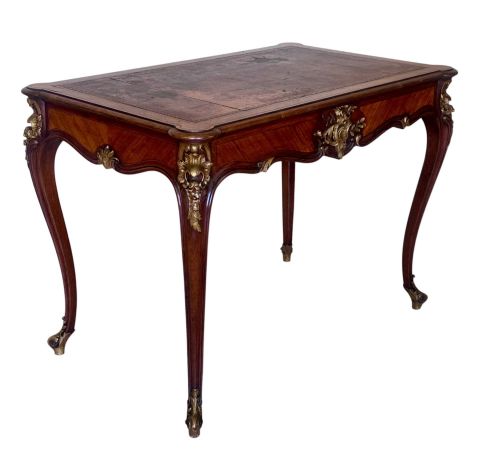
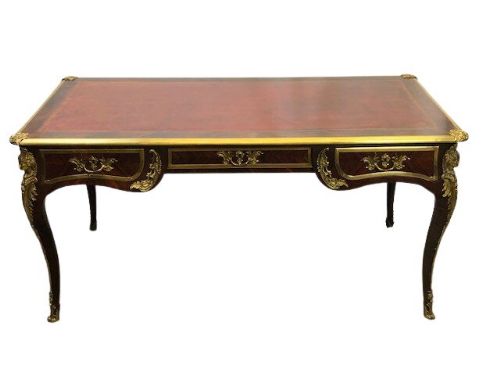
A rosewood bureau plat is a freestanding writing table designed to sit in the centre of a room rather than against a wall. These desks typically feature a rectangular top inset with leather, supported by elegant cabriole or tapering legs.
The pieces available span several distinct periods, with nineteenth-century examples and revival interpretations being the most common. Makers frequently drew upon Louis XV and Louis XVI styles, incorporating elaborate curves and symmetrical mounts.
Alongside standard writing desks, the selection includes related forms such as centre tables and ladies' desks. These variations maintain the characteristic freestanding format and ornamental mounts that define the group.
Judging quality and craftsmanship
Quality in these desks is largely determined by the precision of the marquetry and the crispness of the bronze or ormolu mounts. Finer pieces display sharply cast metalwork and seamless veneer matching across the entire carcass.
The attribution to notable makers or documented firms elevates a piece significantly within the range. Execution of the internal construction and the selection of secondary timbers further separate standard production from exceptional work.
The documented pieces span the Regency era through to the mid-twentieth century.
Francois Linke·CH. Jeanselme & Co·Gillows Of Lancaster
The Rosewood Bureau Plat Glossary
- Bureau plat
- A freestanding writing table, typically fitted with drawers and an inset leather top. It is designed to be viewed from all sides.
- Ormolu
- Gilded bronze used for decorative mounts and sabots on fine furniture. The technique involves applying a gold amalgam to cast bronze.
- Marquetry
- The art of applying pieces of veneer to a structure to form decorative patterns. Craftsmen use various coloured woods to create pictorial designs.
- Kingwood
- A dense, richly figured timber often used in conjunction with rosewood for contrasting veneers. It was a favourite material of eighteenth-century cabinetmakers.
- Cartonnier
- A decorative cabinet or set of pigeonholes designed to hold papers, sometimes mounted on top of a desk. It matches the style of the primary writing table.
Rosewood Bureau Plat: Frequently Asked Questions
Where should a bureau plat be placed?
These tables are designed as freestanding pieces intended to sit in the middle of a room or library. Their finished backs allow them to be viewed from any angle.
Positioning one away from the wall highlights the intricate marquetry and ormolu mounts on all sides.
How do I care for the leather top?
The leather writing surface benefits from regular dusting and occasional treatment with appropriate leather dressings. Keeping the material conditioned prevents cracking over time.
Avoid placing excessive moisture or unsealed drinks directly onto the leather to preserve the tooling.
What is the difference between a bureau plat and a pedestal desk?
A bureau plat stands on four legs rather than enclosed pedestals of drawers reaching the floor. This open structure gives the piece a lighter appearance in a room.
Pedestal desks offer significantly more integrated storage beneath the writing surface.
How do I identify a revival style?
Revival pieces emulate earlier historical aesthetics, such as Louis XV or Louis XVI designs, using nineteenth-century manufacturing methods. These items often feature standardised ormolu casting and machine-cut veneers.
Examining the secondary timbers and construction techniques helps determine the actual period of manufacture.