
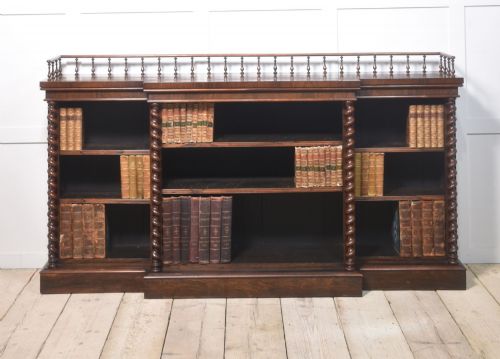


Rosewood Breakfront Low Bookcase
A rosewood breakfront low bookcase brings architectural scale and rich timber grain to a room, offering both display space and refined storage.
Rosewood Breakfront Low Bookcase
A rosewood breakfront low bookcase is a substantial cabinet featuring a central section that projects forward from flanking wings, designed to sit low against a wall rather than tower to the ceiling. These pieces belong primarily to the Regency and Victorian periods, manifesting as open bookcases, side cabinets, and chiffoniers.
The form combines utility with display, frequently incorporating glazed or panelled doors, brass inlays, and occasionally barley twist columns or parcel gilt highlights. The layout organises a room by providing a surface for decorative objects while keeping books or collections housed behind lower doors.
How they were made
Cabinet makers utilised dense tropical rosewood veneers laid over secondary timbers, often accentuating the darker grain patterns across the broad surfaces of the breakfront facade. Workshops integrated contrasting brass inlay work into the timber, alongside parcel gilt details and structural elements carved from solid wood.
Interiors and hardware required precise joinery to fit the breakfront configuration, incorporating adjustable shelving, glass panes, mirror glass backing, and fabric-lined compartments. Structural integrity relies on traditional cabinet-making joints designed to support heavy volumes and marble or timber top surfaces.
Listings feature rosewood, brass, marble, fabric, glass, giltwood, mirror glass, and parcel gilt across Regency and Victorian pieces.
What varies in quality
Quality rests in the selection and matching of the rosewood veneers, where continuous grain patterns across the breakfront doors and drawers indicate superior craftsmanship. The crispness of brass inlay work and the execution of carved details like barley twist columns separate workshop-produced standard items from more ambitious commissions.
Proportion and architectural presence dictate the standing of a piece, with finer examples demonstrating balanced setbacks in the breakfront design and sophisticated internal fittings such as leather-backed dummy books or integrated mirrors.
Gillow
The Rosewood Breakfront Low Bookcase Glossary
- Breakfront
- An architectural cabinet form where the central section projects forward from the recessed side sections. This design creates visual depth and breaks up the long horizontal line of a large piece of furniture.
- Rosewood
- A dense, heavily figured timber prized for its dark purple-brown coloration and dramatic black grain patterning. It takes a high polish and formed the primary exterior surface for high-status nineteenth-century cabinet work.
- Chiffonier
- A low cabinet originating in the nineteenth century, typically featuring enclosed shelving below and sometimes a small superstructure on top. They share functional similarities with sideboards and low bookcases of the period.
- Barley Twist
- A turning technique producing a spiral column resembling a twisted rope. This ornamental detail appears on nineteenth-century cabinet supports and uprights.
Rosewood Breakfront Low Bookcase: Frequently Asked Questions
How do I date a rosewood cabinet?
Dating relies on stylistic markers such as Regency brass inlays, parcel gilt accents, and architectural proportions, contrasted with the heavier Victorian elements like barley twist columns. Construction methods and secondary timbers inside the cabinet also provide clues to the era.
Comparative analysis of hardware, veneer thickness, and door configurations helps narrow the decade of manufacture within the nineteenth century.
Where should I place a low bookcase?
A low bookcase works best against a principal living room or library wall where its top surface can display lamps, bronzes, or ceramics. Because the height remains modest, it preserves wall art hung above.
Ensure the room maintains stable humidity levels away from direct heat sources to protect the rosewood veneer and prevent timber movement.
What is the difference between a chiffonier and a bookcase?
A chiffonier is a specific type of low sideboard or cabinet that typically includes enclosed lower storage behind doors and sometimes a raised back tier. Open bookcases focus primarily on shelf space for displaying volumes.
Many nineteenth-century pieces blur these categories, functioning as hybrid side cabinets that accommodated both books and tableware.