

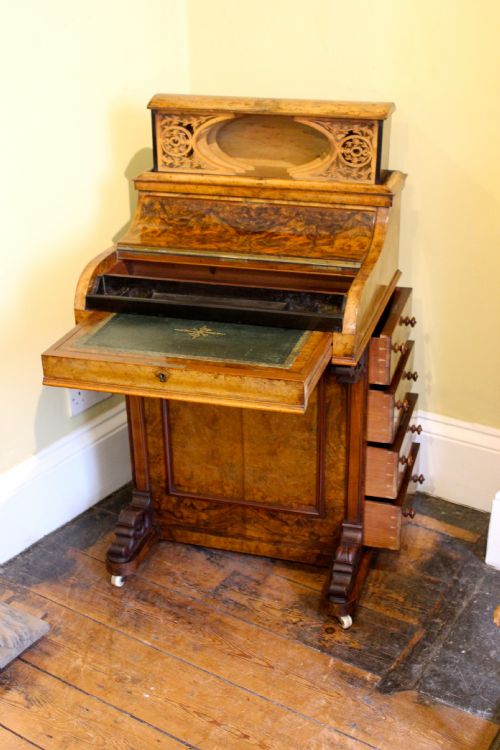


Roll Top Writing Cabinet
A roll top writing cabinet organises correspondence behind a curved moving shutter, offering secure enclosed workspace for letters and papers.
Roll Top Writing Cabinet
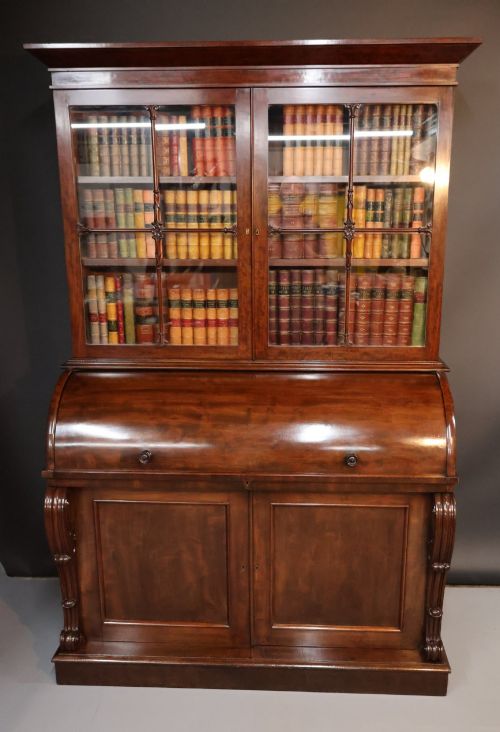
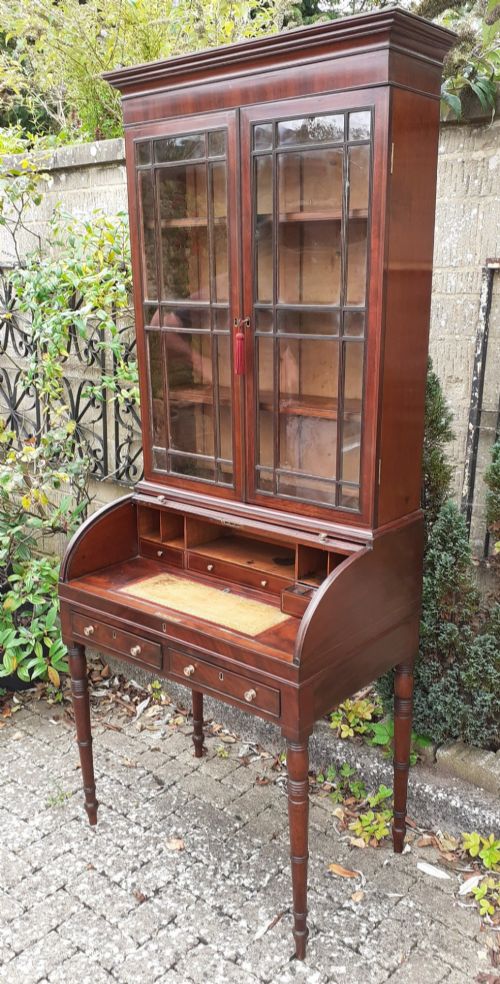
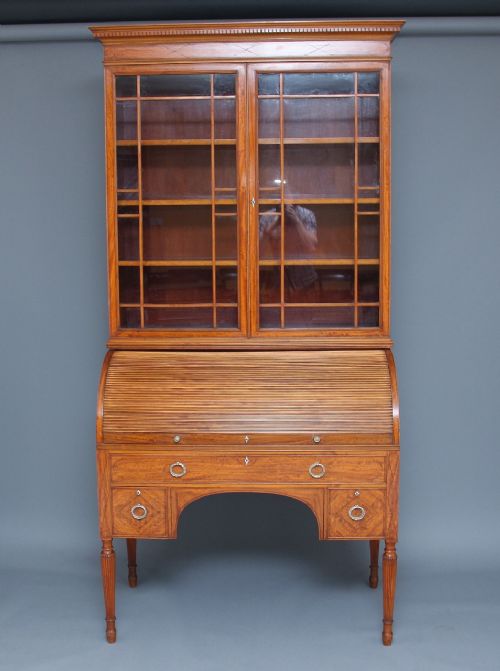
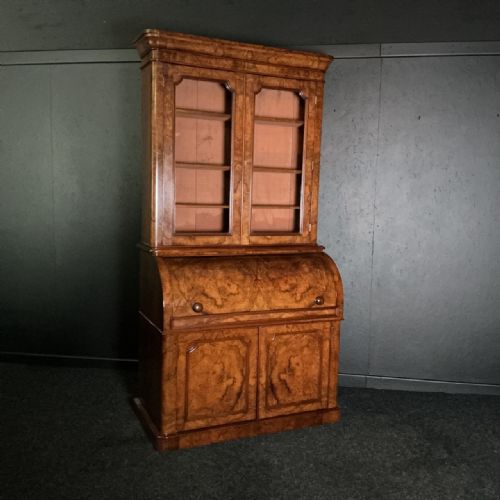
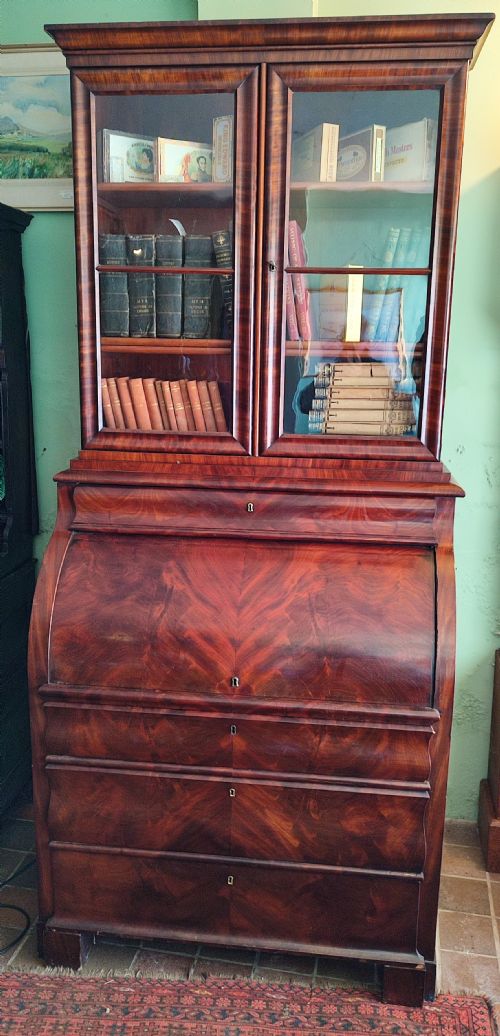
A roll top writing cabinet provides a private workspace where a flexible tambour shutter or rigid cylinder conceals fitted pigeonholes and drawers. These pieces range from compact Georgian satinwood ladies desks to substantial Victorian and Edwardian bureau bookcases featuring glazed upper shelving.
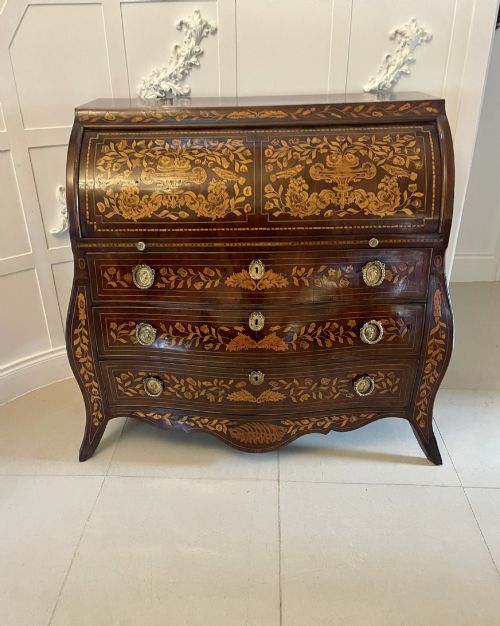
The selection includes freestanding cylinder desks, tambour writing tables, and fall-front or roll-top bureau variants spanning the eighteenth, nineteenth, and early twentieth centuries. Makers utilised diverse regional influences, creating Dutch bombé marquetry designs, Biedermeier interpretations, and Japanese Yosegi work alongside traditional British cabinet-making.
Buyers encounter mahogany most frequently, supplemented by satinwood, walnut, burr walnut, rosewood, and oak. Many examples combine the enclosed desk function with upper bookcase storage, stationary boxes, or miniature display cabinets.
Materials and Construction
Cabinet-makers built these pieces using solid timbers like mahogany, oak, and walnut, frequently applying fine veneers of satinwood, rosewood, and burr walnut across flat and curved surfaces. The signature rolling mechanism relies on tambour slats glued to a canvas backing or a curved solid wood cylinder pivoting on precise pivot points.
Decorative detailing incorporates intricate floral marquetry, contrasting stringing, and brass inlay. Interior fittings often feature concealed secret compartments, small drawers, and pigeonholes constructed from secondary timbers.
Listings feature mahogany, satinwood, walnut, burr walnut, oak, rosewood, and maple across eighteenth-century, Regency, and Victorian periods.
Assessing Craftsmanship
Quality rests upon the smooth operation of the rolling mechanism and the precision of the joinery where curved elements meet stationary framing. Superior pieces exhibit seamless tambour movement without binding, alongside tightly fitted interior drawers and crisp marquetry or inlay.
The selection of timber grain, particularly matched veneers of satinwood, burr walnut, or figured mahogany, distinguishes workshop production. Finer examples retain original brass hardware, fitted leather writing surfaces, and well-balanced proportions across both desk and bookcase sections.
Tudor & Burrey·Edwards & Roberts·John Mclean·Wiggers
The Roll Top Writing Cabinet Glossary
- Cylinder
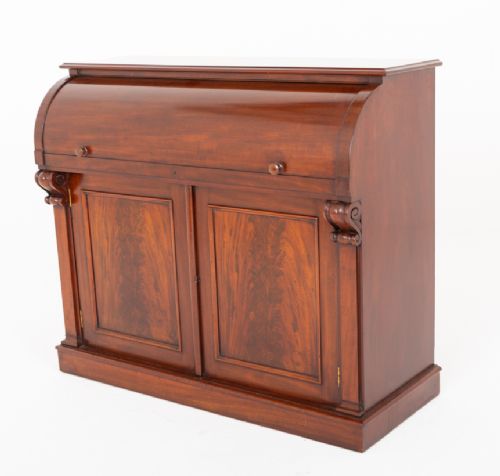
- A solid curved wooden shutter that rotates on a pivot to open and close the desk interior. This rigid form requires exact carpentry to maintain smooth movement across the writing surface.
- Tambour
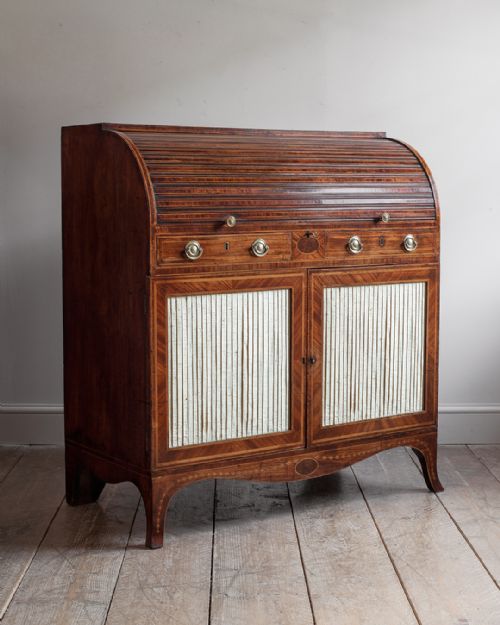
- A flexible shutter constructed from narrow strips of wood glued to a fabric backing, allowing the panel to slide along a curved track. It conceals pigeonholes and small drawers when closed.
- Marquetry
- Decorative veneer work formed by fitting pieces of various coloured woods together to create pictorial or floral patterns. Eighteenth-century examples often display elaborate botanical motifs across the cylinder front.
- Secretaire
- A cabinet or desk designed specifically for writing, typically incorporating a fold-down or sliding writing flap. These fittings often conceal multiple small interior compartments.
- Bonheur Du Jour
- A light ladies writing desk originating in the eighteenth century, usually featuring a small cabinet or shelf superstructure above the writing surface.
Roll Top Writing Cabinet: Frequently Asked Questions
How does a cylinder desk differ from a tambour desk?
A cylinder desk uses a solid, curved piece of wood that rotates on a fixed axis to cover the writing area. This solid sweep offers a clean, unbroken profile when closed.
In contrast, a tambour desk employs many narrow slats glued to a fabric backing, allowing the flexible shutter to slide around a tight track. Both mechanisms serve to hide correspondence and stationery from view.
Where were these cabinets placed in a period home?
These cabinets sat in private libraries, drawing rooms, or dedicated studies where householders managed personal correspondence and household accounts. Their lockable roll tops kept sensitive documents secure from staff and visitors.
Smaller satinwood and rosewood variants often stood in ladies boudoirs, while larger bureau bookcases occupied prominent wall spaces in gentlemen's libraries.
How do I care for the sliding mechanism?
Keep the cabinet in a stable environment away from direct heat sources and excessive humidity to prevent the timber from warping. Seasonal temperature changes can cause wood to expand, which affects the smooth glide of the cylinder or tambour.
Periodically clean dust from the internal tracks using a dry, soft brush and consult a professional restorer before applying any lubricants.
How can I distinguish Regency from Victorian pieces?
Regency pieces often display neoclassical restraint, featuring rosewood or mahogany veneers enhanced by precise brass inlay and formal geometric lines. The hardware tends to be finely chased or cast brass.
Victorian cabinets generally exhibit heavier proportions, darker carved mahogany or walnut timbers, and occasionally more eclectic decorative influences such as marquetry or applied mouldings.