

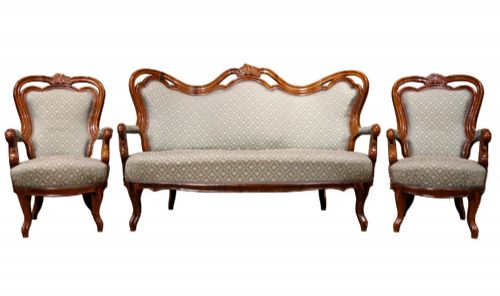


Rococo Salon Settee
A rococo salon settee brings curvilinear grace and fluid ornament to a room, offering an inviting seat shaped by centuries of revival design.
Rococo Salon Settee
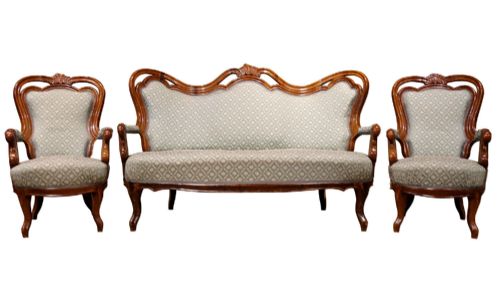
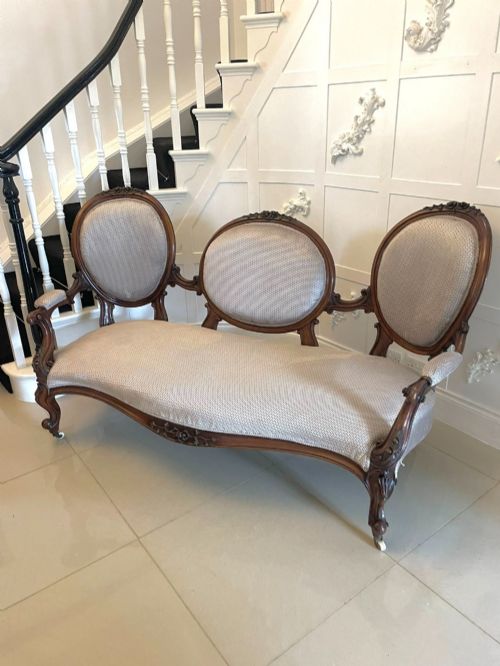
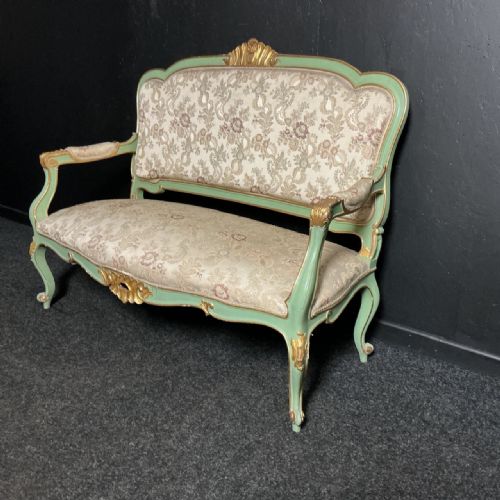
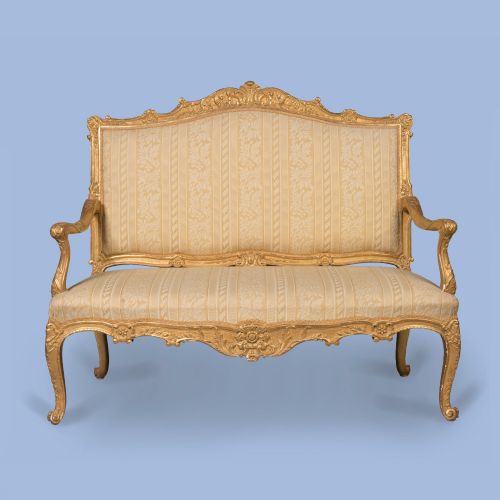
When searching for a rococo salon settee, you look for a piece defined by asymmetrical curves, C-scrolls, and organic motifs derived from mid-eighteenth-century French taste. The examples on this page are heavily represented by nineteenth-century revivals, including Victorian walnut framings and Continental giltwood canapés.
Most pieces you encounter blend French Louis XV style influences with local cabinet-making traditions, spanning walnut, mahogany, and giltwood frames. Forms range from compact cameo-back settees and double-end seating to grand three-piece salon suites accompanied by matching armchairs.
Origin and period vary from English Victorian interpretations to French country house or salon pieces dating across the nineteenth century into early twentieth-century revivals. Each maker adapted the sweeping lines and carved floral flourishes to suit the formal entertaining spaces of their era.
Assessing Quality and Execution
The distinction between tiers rests upon the crispness of the hand-carving along the wooden frame and the depth of the relief work in motifs like foliage and scrolls. Superior examples display seamless joint work and finely figured timber, whereas simpler pieces show coarser shaping and plain secondary woods.
Proportion and scale dictate the visual success of the piece, with better-balanced frames offering harmonious curves from the crest rail down to the feet. The quality of the gilding or polish and the fidelity to period revival lines further separate standard production from master workshops.
One unexpected listing places a diminutive carved settee specifically at the end of a bed, proving that rococo comfort finds a home anywhere.
The Rococo Salon Settee Glossary
- Cabriole leg
- A furniture leg that bends outward in a convex curve and tapers inward in a concave curve, ending in a pad or scroll foot. This form is central to Louis XV and rococo revival designs.
- Cameo back
- A settee back shaped to resemble a cameo medallion, often framed by carved wooden scrolls and floral garlands. It provides a distinct focal point for Victorian walnut seating.
- Double end settee
- A sofa featuring two raised scroll ends or backrests opposed symmetrically, allowing a person to recline against either side. It appears frequently in nineteenth-century English and Continental forms.
- Giltwood
- Wood that has been coated with thin gold leaf or gold powder over a prepared ground. It provides the brilliant metallic finish seen on many formal French salon pieces.
Rococo Salon Settee: Frequently Asked Questions
What defines a rococo salon settee?
A rococo salon settee is characterised by fluid, asymmetrical lines, C-scrolls, and organic floral carving inspired by mid-eighteenth-century French design. These pieces often feature exposed wooden frames in walnut, mahogany, or giltwood.
Most examples found today date from nineteenth-century revivals, reflecting Victorian and French Louis XV tastes. Their compact or grand proportions were designed specifically for formal entertaining and reception rooms.
How were these settees used historically?
Historically, these settees served as formal seating in nineteenth-century drawing rooms, boudoirs, and salons. They provided elegant spots for conversation, reading, and receiving guests.
Because they were meant for display as much as comfort, many formed part of matching salon suites alongside armchairs. Their decorative backs ensured they looked striking from any angle in a room.
How do I live with a antique settee?
Living with an antique settee involves placing it away from direct sunlight to protect delicate textiles and polished wood surfaces. Using breathable upholstery fabrics helps preserve the integrity of the piece.
Consider the scale of your room, as these curved frames draw the eye and work well as statement centerpieces. Pair them with complementary antique seating or contrast them within a modern interior.
How can I tell the period apart?
Differentiating periods relies on examining timber selection, carving styles, and structural assembly methods. Victorian pieces often use heavy walnut or mahogany frames with deep buttoning or cameo backs, while French-inspired pieces lean toward giltwood finishes and lighter cabriole legs.
Makers' marks or stamps, when present, offer definitive clues to origin and date. Comparing the fluidity of the carving helps distinguish mid-nineteenth-century work from later twentieth-century revivals.