



Rococo Revival Timepiece
A rococo revival timepiece brings exuberant nineteenth-century curves, gilt bronze, and painted porcelain into a room.
Rococo Revival Timepiece
A rococo revival timepiece combines ornate nineteenth-century design with functional timekeeping, most often appearing as mantel clocks, desk clocks, and boudoir clocks. These pieces draw heavily on earlier French motifs, translating asymmetrical scrolls and naturalistic forms into heavier Victorian interpretations.
The objects on this page span the nineteenth century, including specific dates such as eighteen-eighty and nineteen-hundred alongside broader Victorian periods. French influences dominate the selection, ranging from standard mantel pieces to petite bedside and table clocks.
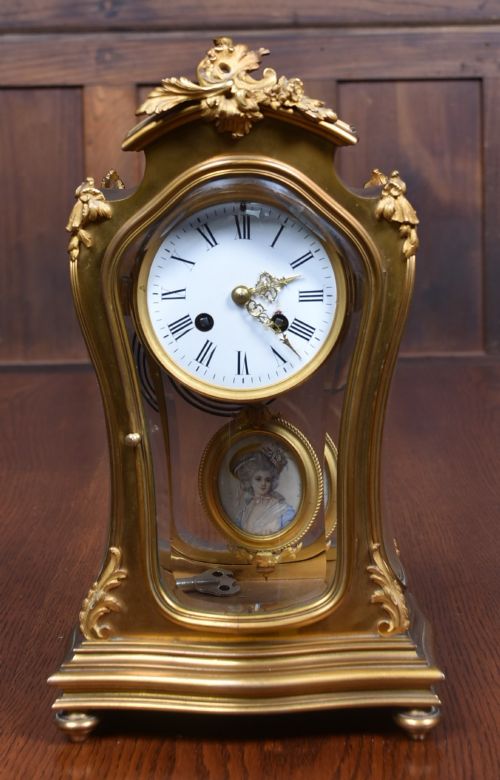
Buyers encounter varied formats, from substantial ormolu and porcelain constructions to smaller boudoir models decorated with enamel dials and hand-painted panels. Each variation reflects the nineteenth-century taste for decorative excess and technical precision.
Materials and construction
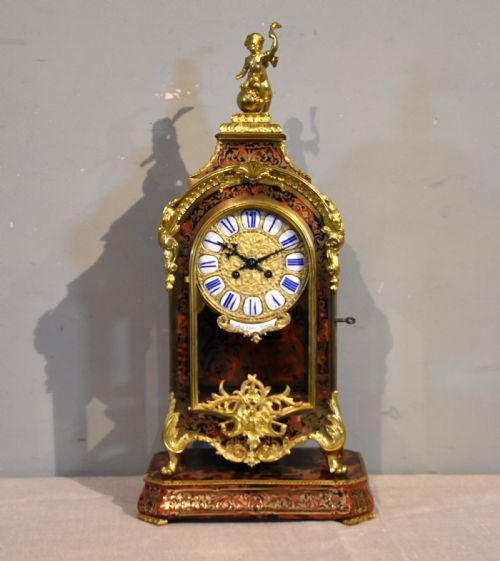
Gilt bronze and ormolu form the structural and decorative basis for many examples, providing the characteristic metallic sheen and deep relief casting. These cast brass and bronze components receive a gold mercury wash or electroplating to achieve a brilliant surface finish.
Porcelain panels and dials, including Sevres style ceramics, are integrated alongside enamel chapter rings and glass bezels. Some pieces incorporate tortoiseshell and cut brass in intricate Boulle marquetry patterns across wooden carcases.
Makers housed precision mechanical movements within these heavy metal and ceramic housings, utilising signed plates and miniature components produced by specialised French workshops.
One petite advertising boudoir clock carries the specific inscription presented by Sporting Sketches.
Assessing quality
The refinement of the cast metal ornamentation separates superior examples from simpler production, visible in the crispness of the scrollwork and the depth of the chasing on the ormolu. Finer pieces display hand-chiselled detailing that sharpens the cast contours rather than leaving them soft.
The quality of the porcelain and enamel work dictates the aesthetic standing of the object, with finely hand-painted floral panels and crisp dial numerals commanding greater attention. Integrated movements signed by established makers add a layer of horological accomplishment.
The weight and stability of the housing, whether mounted on substantial marble stands or formed entirely from heavy cast bronze, indicate the original cost and ambition of the manufacture.
Japy Freres·Leon Message·Jollet et Cie·Rodier
The Rococo Revival Timepiece Glossary
- Ormolu
- Gilded bronze. The term refers to applied gold or mercury gilding over a bronze base, popular in nineteenth-century decorative metalwork.
- Boulle
- Marquetry technique. This method uses tortoiseshell and cut brass inlay to create contrasting patterns across the surface of the clock case.
- Champleve
- Enamelling technique. Molten glass is fired into depressions or troughs carved directly into the metal surface.
- Sevres
- Porcelain factory mark or style. It denotes soft-paste porcelain decorated with rich coloured grounds and hand-painted scenes.
- Chapter ring
- Dial ring. This is the outer circle on the clock face that bears the numerals for the hours.
Rococo Revival Timepiece: Frequently Asked Questions
Where do I place a mantel clock?
These clocks suit prominent flat surfaces such as fireplace mantels, large sideboards, or deep console tables where their height and ornate frames remain visible.
Ensure the chosen surface is level and stable, as heavy gilt bronze and marble stands require solid support.
How do I wind an antique clock?
Most mechanical pieces use a key inserted into specific winding holes on the dial to tension the spring inside the movement.
Turn the key gently until resistance increases, avoiding over-winding to protect the historical mechanism.
How do I identify a French movement?
French movements often feature stamped workshop symbols, serial numbers, or maker names on the back brass backplate.
Opening the rear access door reveals the arrangement of the gears and the pendulum suspension.
What is a boudoir clock?
A boudoir clock is a smaller timepiece designed for private rooms, dressing tables, or bedside placement.
These pieces typically feature delicate enamel or porcelain details scaled down from larger mantel designs.