


Rococo Revival Side Cabinets
Rococo revival side cabinets bring fluid curves and opulent mounts into domestic spaces, offering both practical storage and dramatic decorative presence.
Rococo Revival Side Cabinets
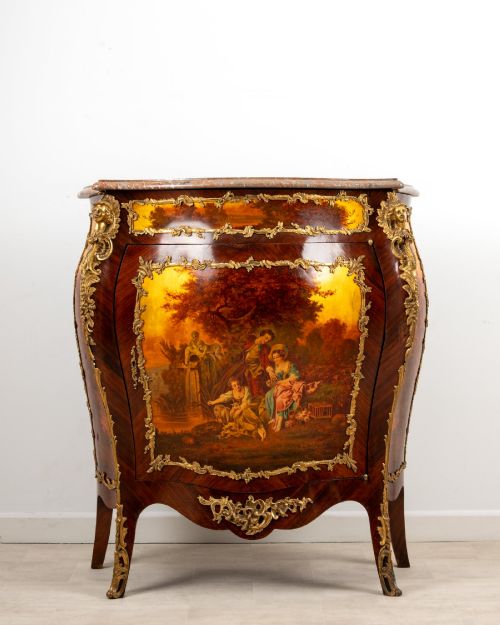
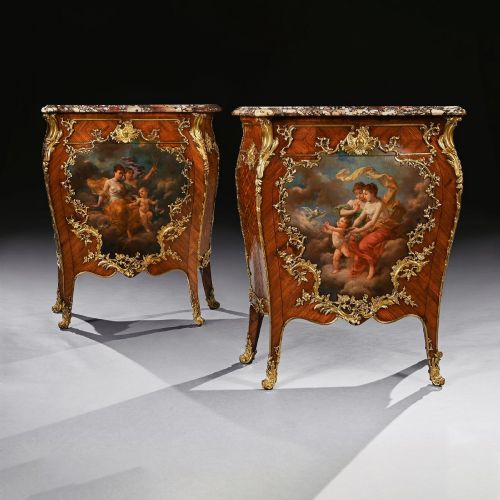
When you search for rococo revival side cabinets, you encounter a selection of nineteenth and early twentieth-century case furniture defined by asymmetric curves and French-inspired forms. The examples found here span diverse configurations, from serpentine commodes and bedside tables to glazed display cabinets and music cupboards.
Most pieces originate from Victorian and Edwardian workshops, alongside continental items carrying rich marquetry and painted panels. Buyers frequently meet walnut, rosewood, and kingwood carcasses elevated by elaborate mounts.
These items served both functional and social roles in period drawing rooms and bedrooms. Their varied silhouettes range from compact bedside chests to impressive credenzas.
How they were made
Cabinet makers utilised dense timber foundations such as walnut, mahogany, and rosewood, often enhanced with kingwood or burr walnut veneers. Skilled artisans shaped these woods into bombe and serpentine profiles requiring precise joinery.
Gilt bronze and ormolu mounts were cast and chased to accentuate the sweeping structural lines. Marble tops and glazed panels were integrated to complete the decorative scheme.
Painters applied Vernis Martin techniques and intricate marquetry to embellish surfaces, combining traditional cabinet making with elaborate decorative arts.
Some music cabinets cleverly concealed sheet scores behind painted Vernis Martin doors, keeping parlour melodies ready for evening entertainment.
What varies in quality
The distinction between standard and exceptional pieces rests in the execution of the timber veneers and the crispness of the bronze mounts. Finer examples display meticulous matching of burr walnut or figured rosewood across undulating surfaces.
Mount quality reveals the maker's hand through deeply chased detailing and heavy gilding rather than hollow or superficial casting. Structural integrity in the curved framework and well-fitted marble tops also separate superior items from simpler productions.
Gillows·Zweiner
The Rococo Revival Side Cabinets Glossary
- Ormolu
- Gilded bronze used for decorative mounts and accents. This material provides the bright metallic highlights characteristic of French-inspired furniture.
- Bombe
- An outwardly swelling, convex shape typical of continental case furniture. This curved profile requires advanced woodworking skill to execute properly.
- Marquetry
- Inlaid wood veneers forming decorative patterns or pictorial scenes. Craftsmen cut contrasting timbers to fit precisely within the primary surface.
- Vernis Martin
- A type of decorative lacquer finish developed in eighteenth-century France and revived later. It mimics Asian lacquer work with painted scenes under a clear glaze.
- Credenza
- A sideboard or display cabinet often featuring glass doors and elaborate mounts. These low pieces served dining rooms and formal reception spaces.
Rococo Revival Side Cabinets: Frequently Asked Questions
Where should I place a side cabinet?
These cabinets suit reception rooms, hallways, or spacious bedrooms where their decorative surfaces and storage capacity remain visible. Their finished backs and detailed sides allow them to occupy prominent positions.
Ensure the dimensions align with surrounding furniture so the curved profiles do not obstruct walkways.
How do I clean marble tops?
Wipe marble surfaces with a soft damp cloth using mild, neutral soap when necessary. Avoid acidic cleaners that etch the polished stone.
Dry the surface thoroughly to maintain the natural sheen and protect the surrounding wood veneers.
What is the difference between commodes and bedside tables?
Commodes generally provide larger storage capacities with multiple drawers and broader proportions for principal rooms. Bedside tables scale down these forms to suit smaller spaces adjacent to a bed.
Both share the curved silhouettes and rich veneers typical of the revival style.
How do I identify a revival piece?
Look for construction methods, timber choices, and hardware characteristics typical of the nineteenth and early twentieth centuries. Machine-cut elements or secondary woods often help clarify the production era.
Stylistic markers draw heavily on eighteenth-century French motifs reinterpreted by later Victorian and Edwardian workshops.