

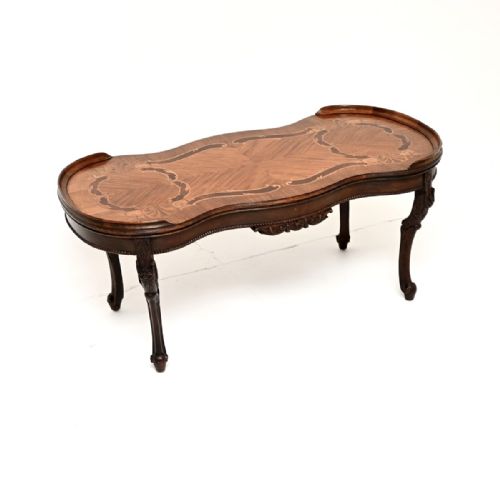
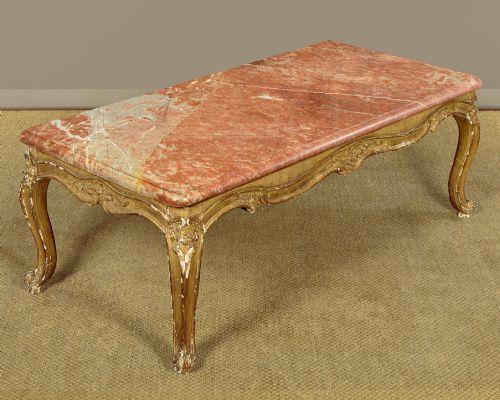
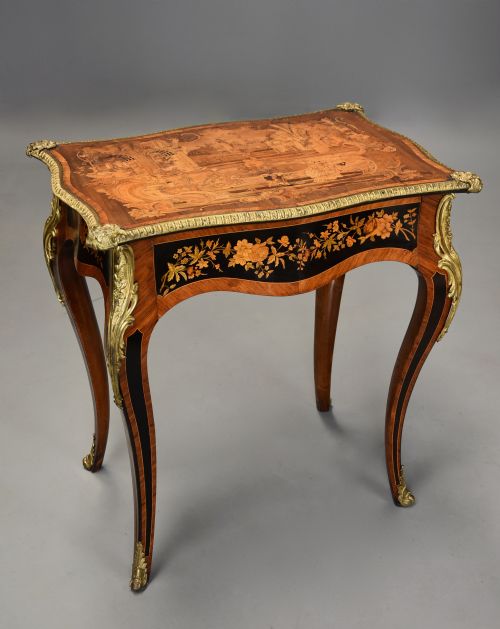
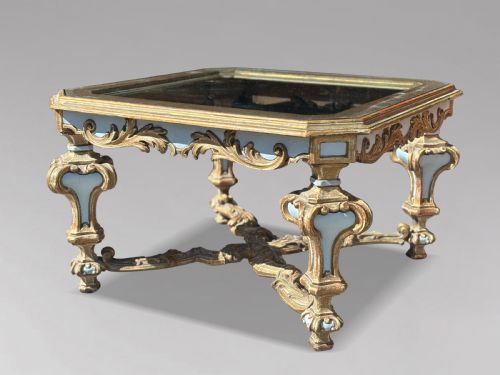


Rococo Revival Coffee Table
These rococo revival coffee table examples bring elaborate nineteenth-century curves and ornate decorative detail into modern sitting rooms.
Rococo Revival Coffee Table
A rococo revival coffee table unites nineteenth-century decorative energy with low proportions suited to modern seating. These low tables and centre tables draw directly on earlier French and Italian designs, reinterpreted during the Victorian era and into the early twentieth century.
Most examples found here date from the nineteenth century up to nineteen-thirty, spanning walnut, giltwood, and fruitwood constructions. Forms range from circular occasional tables to two-tier walnut designs and marble-topped low tables.
Makers adapted older centre table and centre stool formats to serve as low coffee tables, retaining serpentine aprons, cabriole legs, and elaborate marquetry inlay. Buyers encounter pieces reflecting French Louis XV revival styles alongside Italian baroque and rococo expressions.
How they were made
Cabinetmakers utilised dense timbers such as walnut, kingwood, and rosewood as structural bases for intricate marquetry and inlay work. Boxwood and fruitwood accents often contrast against darker veneers to define floral and scroll motifs.
Giltwood and ormolu mounts provide the characteristic metallic sheen associated with the style, complemented by heavy inset marble tops. Carved wooden frames receive gold leaf or paint finishes to echo grand European salon furniture.
Rococo Revival Coffee Table Retail Price Guide 2026
Typical asking prices for rococo revival coffee table among the pieces listed under this phrase on Sellingantiques today, from the lower quarter to the upper quarter. They describe what is for sale here now, not the wider market.
Listings feature walnut, kingwood, and rosewood alongside marble tops and ormolu mounts spanning the nineteenth and early twentieth centuries.
What varies in quality
The refinement of the timber carving and the precision of the marquetry inlay dictate the distinction between standard and superior examples. Crisp execution in the acanthus scrolls and naturalistic floral patterns separates workshop output from mass production.
Materials elevate certain pieces significantly, particularly heavy moulded marble tops paired with genuine fire-gilt ormolu mounts rather than plated substitutes. The structural integrity of the serpentine undercarriage and the depth of the figured wood grain determine long-term desirability.
B Battioli, Varese·Harrods
The Rococo Revival Coffee Table Glossary
- Marquetry
- Decorative veneer work arranged in pictorial or geometric patterns using various coloured woods. Craftsmen cut thin slices of timber to fit tightly together within the primary surface.
- Ormolu
- Gilt bronze ornamentation applied to furniture mounts and decorative hardware. The technique involves creating a mercury and gold amalgam fired onto a bronze base.
- Cabriole leg
- A furniture leg that curves outward in an arc and then tapers inward toward the foot. This form mimics the natural shape of an animal's leg and typifies rococo design.
- Giltwood
- Timber carved and subsequently covered with a thin layer of gold leaf or gold paint. This finish creates a brilliant reflective surface popular in formal reception rooms.
Rococo Revival Coffee Table: Frequently Asked Questions
Are these low tables genuine period antiques?
The selection spans the nineteenth century through to early twentieth-century revivals, reflecting changing tastes for historic European designs.
Craftsmen across these periods reproduced elaborate styles using traditional timber and carving methods suited to contemporary domestic spaces.
How do I care for a marble top?
Marble surfaces require prompt wiping of acidic liquids to prevent staining and etching on the polished stone.
Use coasters and gentle non-abrasive cleaners to maintain the natural sheen without damaging the historical finish.
Can these tables handle daily living room use?
Solid wood frames and inset marble tops provide sturdy surfaces for everyday placement of books and drinks.
Their decorative carvings and delicate cabriole legs benefit from careful placement away from heavy foot traffic.
What defines the rococo revival style?
Asymmetrical scrolls, shell motifs, and naturalistic floral carvings dominate the aesthetic of these ornate tables.
The design draws heavily from mid-eighteenth-century French court furniture, revived with Victorian enthusiasm for historical grandeur.