
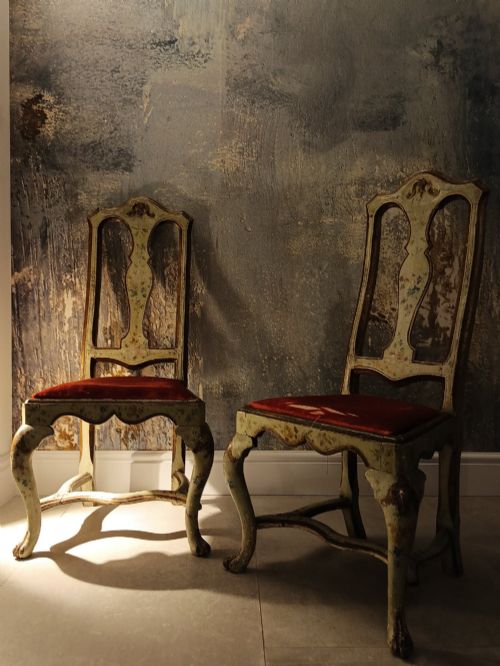


Rococo Painted Side Chairs
Rococo painted side chairs bring scrolling curves and aged decorative finishes into a room, offering both seating and striking historic form.
Rococo Painted Side Chairs
When you search for rococo painted side chairs, you are looking at seating defined by asymmetrical ornamentation, cabriole legs, and decorated wooden surfaces. The forms range from 18th Century North Italian and Venetian examples to later 19th Century French, Victorian, and Swedish interpretations.
You are most likely to meet sets or pairs originating from Italy, France, or Sweden, spanning the eighteenth century through the Victorian era and the mid-nineteenth century. These pieces combine painted finishes with carved wooden frames designed to stand against walls or complement dining tables.
The category encompasses side chairs, dining chairs, and occasional seats, alongside distinct regional forms such as Venetian gondola chairs and boudoir seating. Each piece reflects the enduring appeal of the Rococo style through curved lines and decorative painted surfaces.
How they were made
Makers shaped these chairs from wood, applying gesso as a smooth preparation layer before laying down paint, gold leaf, or giltwood highlights. The construction relies on traditional joinery to support the elaborate carved profiles characteristic of the style.
Surfaces received decorative paint layers, often distressed over time, alongside upholstery in fabric or velvet. French and Italian workshops utilised layered paint and gilding to accentuate the asymmetric cartouches and scrolling leaf motifs.
Current listings feature pieces spanning the 18th Century through the Victorian era, utilising wood, gesso, paint, fabric, velvet, gold leaf, and giltwood.
What varies in quality
The distinction between ordinary and exceptional examples lies in the crispness of the carved wooden ornament and the handling of the painted or gilded surface. Finer chairs display deep, fluid carving along the crest rails and cabriole legs rather than flat or mechanical profiling.
Authenticity of the painted surface and the integrity of the original wood structure dictate the standing of a piece. Earlier 18th Century examples generally show greater depth in their hand-carved details compared to later revival pieces from the Victorian period.
The Rococo Painted Side Chairs Glossary
- Gesso
- A plaster-like mixture applied to wood surfaces to create a smooth base for paint or gold leaf. It provides the foundation for intricate relief decoration.
- Giltwood
- Wood that has been covered with thin sheets of gold leaf or gold powder. This finish catches the light and highlights carved rococo details.
- Cabriole leg
- A furniture leg that bends outward in a convex curve and tapers inward in a concave curve, ending in a pad or scroll foot. It is a defining feature of Rococo design.
- Gondola chair
- An enclosed chair type originating in Venice with a curved, high backrest flowing continuously into the sides. It offers a compact and enveloping seat.
- Cartouche
- An ornamental frame resembling a rolled-up piece of paper or parchment, often featuring prominently on the crest rails of these chairs.
Rococo Painted Side Chairs: Frequently Asked Questions
How do I use these chairs today?
These chairs function well as occasional seating in hallways, bedrooms, or living rooms where their decorative profiles can be fully appreciated. They also serve around dining tables when acquired in matched pairs or larger sets.
Because of their historic painted surfaces, placing them out of direct sunlight helps preserve the pigments and gold leaf. Pairing them with contemporary interiors creates a striking contrast between modern spaces and 18th Century or Victorian craftsmanship.
How do I tell 18th century chairs from 19th century revivals?
Eighteenth-century examples display hand-carved joinery, heavier timber wear, and patinated paint layers accumulated over centuries of use. The wood grain beneath the paint often shows distinct tool marks from period hand-working methods.
Nineteenth-century revival pieces, such as those from the Victorian period or 1890, utilise similar stylistic vocabulary but often feature more uniform construction and harder factory-prepared ground layers. Comparing the crispness of the carving and the depth of the paint helps indicate the period of manufacture.
What is the difference between Italian and French rococo chairs?
Italian rococo chairs, particularly from Venice and Northern Italy, often exhibit bold, theatrical carving with vibrant painted or gilt finishes. They frequently incorporate whimsical proportions and distinct regional silhouettes like the gondola chair.
French equivalents, including Louis XV style and later 19th-century boudoir pieces, tend to focus on refined asymmetry, delicate floral motifs, and sophisticated pastel or gold paint schemes. Both traditions share the characteristic curved lines of the Rococo movement but express them through distinct regional aesthetics.
Are painted chairs sturdy enough for daily seating?
These chairs are structurally sound for normal use, provided the wooden joinery has been properly maintained over the decades. The underlying wood and gesso foundation give them stability despite their decorative appearance.
Care should be taken with older upholstery fabrics and delicate painted surfaces during regular handling. Using them as occasional or dining seats rather than heavy-lounge seating ensures they remain protected.