
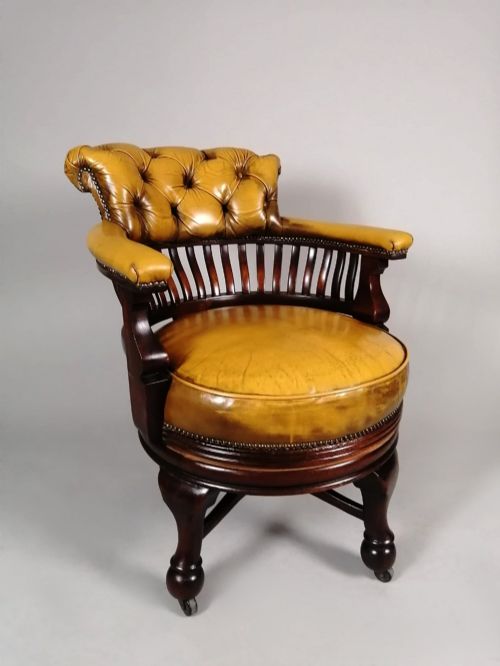
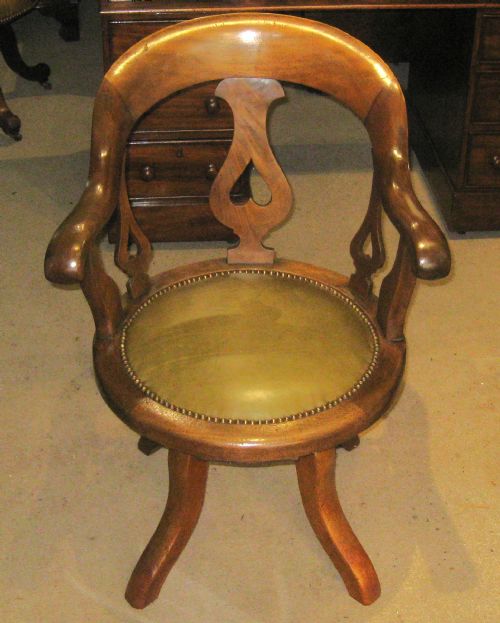


Revolving Executive Office Chair
A revolving executive office chair is a heavy-duty seat designed for work, prized for its combination of mobility and traditional timber construction.
Revolving Executive Office Chair
When you search for a revolving executive office chair, you are looking at practical seating designed for professional workspaces primarily from the Victorian and Edwardian periods. These chairs bridge the gap between heavy library furniture and mobile office equipment, giving you a functional seat with period character.
The versions you are most likely to meet on this page are constructed from mahogany or oak, often fitted with a swiveling mechanism and leather upholstery. They appear in forms ranging from standard desk chairs to larger armchairs built for long hours at a desk.
How they were made
Makers built these pieces using dense hardwoods like mahogany and oak, which provided the structural strength required for daily office use. Bentwood was also utilised to achieve curved supportive backs, paired with cast iron and brass components for the swivel and adjustment mechanisms.
Upholstery consisted of leather or fabric stretched over padded seats and backs, secured with brass tacks. Frames relied on sturdy joinery and cast iron hardware to support the rotating action without compromising stability.
Victorian office workers spun in circles just as much as we do, minus the emails.
What varies in quality
The standard of timber selection and the complexity of the frame construction set pieces apart at different price points. Superior examples feature figured mahogany or quarter-sawn oak with refined carving and robust swivel mechanisms that operate smoothly.
The quality of the upholstery and the intactness of the original ironwork dictate the overall finish of the piece. Chairs retaining their original patinated leather and functional brass hardware hold greater integrity than those with mismatched replacements.
The Revolving Executive Office Chair Glossary
- Swivel
- A mechanism allowing the chair to rotate fully on its base. This feature became standard in late nineteenth-century office furniture to improve workspace mobility.
- Bentwood
- Wood steamed and bent into curved shapes to form supportive chair backs. This technique allowed makers to create ergonomic shapes without heavy carving.
- Cast iron
- A strong, heavy metal used for the internal revolving mechanisms and spider bases of these chairs. It provided the necessary weight and durability for office seating.
- Quarter-sawn
- A method of cutting logs that produces oak with prominent, decorative grain patterns. This cut also added dimensional stability to the timber frame.
Revolving Executive Office Chair: Frequently Asked Questions
How do I date a revolving office chair?
You date these chairs by examining the timber, the hardware, and the construction methods used in the base. Victorian and Edwardian examples often feature heavy mahogany or oak frames combined with cast iron swivel mechanisms.
Later pieces from the 1920s and 1930s introduce simpler lines and different wood tones while retaining the core revolving function.
Are these chairs comfortable for daily work?
Many people find these chairs suitable for daily desk use thanks to their supportive wooden backs and padded leather seats. The ergonomic curves developed in the late nineteenth century were specifically designed for long hours of writing.
Adjustments vary by period, so checking the height mechanism and seat depth ensures it matches your modern desk.
What is the difference between a desk chair and an office armchair?
Desk chairs typically feature a compact footprint with an open back and sides, designed to tuck neatly beneath a writing table. Office armchairs include integrated armrests that offer additional support but require more clearance around the desk.
Both types utilise the same revolving swivel base found in traditional workspaces.
How should I maintain the leather on an antique desk chair?
Maintaining the leather involves applying appropriate conservation waxes or balms to keep the hide supple and prevent cracking. Regular dusting with a soft cloth protects the surface from abrasive particles.
Avoid placing the chair in direct sunlight or near heat sources, which can dry out the historic leather and timber.