
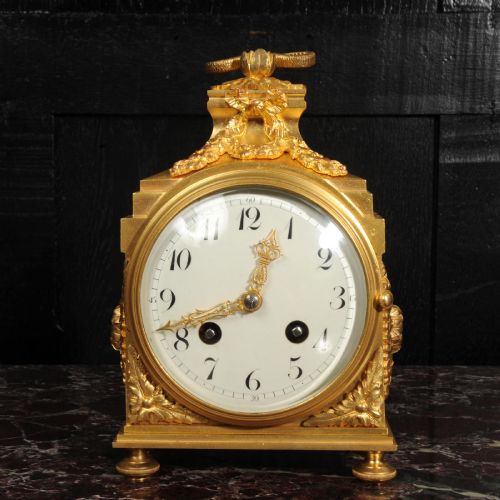


Restored French Carriage Clock
A restored french carriage clock brings mechanical precision and heavy brass casework together in a portable nineteenth-century design.
Restored French Carriage Clock
A restored french carriage clock is a portable timepiece housed in a heavy metal case with glass panels, designed for travel during the nineteenth century. These clocks originate from periods spanning the 1860s to 1900, reflecting Victorian, French Empire, and Second Empire aesthetics.
The versions most commonly met on this page include repeater models and grand sonnerie movements housed in brass, gilt brass, or ormolu cases. Many examples feature decorative enamel panels, bandings, or painted scenes alongside specialised complications like date work and moon-phases.
Makers and retailers such as Drocourt, Brunelot, and Captain Henry appear among the recorded pieces, offering standard and giant formats. Collectors encounter various case styles, including gorge cases and gothic designs, each thoroughly serviced to restore the internal mechanics.
Materials and construction
Cases rely on heavy brass, gilt brass, gilt bronze, and ormolu, providing the structural weight necessary to house intricate mechanical movements. Bevelled glass panels are fitted into the top and sides to allow a clear view of the escapement and gear trains within.
Enamel is utilised for circular dial faces and decorative exterior panels, often decorated with hand-painted details or bandings. Movements incorporate complex gear assemblies for striking, repeating, and calendar complications, finished to function reliably after restoration.
Travelling Victorians relied on these heavy brass timepieces to keep Greenwich Mean Time while bouncing along unpaved coach tracks.
Judging quality and execution
The artistry of the exterior casework further defines the hierarchy, with heavy gilt bronze, ormolu, and fine enamel paintings or bronze panels marking superior craftsmanship. Signed movements by notable makers add a layer of distinction to the overall construction.
Brunelot·Drocourt·Captain Henry·Alfred Drocourt
The Restored French Carriage Clock Glossary
- Carriage clock
- A small, portable spring-driven timepiece designed for travel, typically fitted with a carrying handle and glass panels. They were originally used by officers and travellers during the nineteenth century.
- Repeater
- A mechanism that chimes the hours and quarters on demand when a button or pendant is pressed. This complication required sophisticated internal engineering.
- Grand sonnerie
- A striking train that sounds both the hours and the quarters automatically as each quarter-hour passes, alongside chiming the hour on the hour.
- Ormolu
- Finely ground high-carat gold mercury-gilded onto a bronze or brass object. It provides a rich, durable surface finish seen on superior French cases.
- Gorge case
- A distinct rectangular brass carriage clock case style characterised by stepped mouldings around the top and base. The name derives from the indented shape of the handle and pillars.
Restored French Carriage Clock: Frequently Asked Questions
What is a repeater carriage clock?
A repeater carriage clock includes an extra mechanism that sounds the time audibly when you press a button on top of the case. This allowed owners to check the hour in the dark without striking a light.
These movements required precise gear work and careful adjustment by nineteenth-century clockmakers to function smoothly alongside the primary timekeeping train.
How do I wind my carriage clock?
Winding is typically performed using a matching key inserted into arbors located on the underside or back plate of the movement. Care must be taken not to over-wind the mainsprings.
Different arbors control the timekeeping train and any additional striking or alarm trains present in complex models.
Where were carriage clocks placed?
Carriage clocks were originally built for travel in horse-drawn carriages, trains, and ships, secured inside protective leather travelling cases. At their destination, they served as reliable mantel or desk clocks.
The folding handle on top allowed them to be lifted easily and moved from room to room.
How do I identify the period of a clock?
Dating relies on stylistic clues in the brass case design, the shape of the handle, the font used on the enamel dial, and signatures on the movement back plate. Pieces from the 1860s often display distinct gothic or heavy architectural influences.
Later Victorian and 1900 examples frequently incorporate refined gorge cases or elaborate painted enamel panels.