

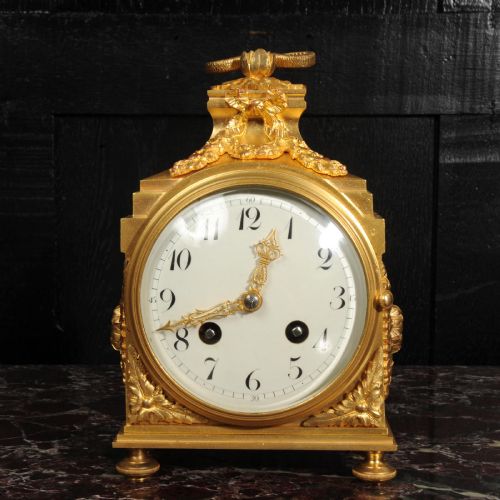


Restored Carriage Clock
A restored carriage clock brings nineteenth-century engineering and polished brass into a modern room.
Restored Carriage Clock
A restored carriage clock is a portable mechanical timepiece originating primarily from nineteenth-century France and Victorian Britain. These pieces combine heavy brass framing with bevelled glass panels designed to allow visibility of the interior movement.
Most examples encountered here belong to the French nineteenth-century tradition, spanning the eighteen-sixties to nineteen-hundreds. They frequently incorporate repeating mechanisms, striking trains, and decorative enamel panels alongside their restored movements.
Buyers look for both standard brass-cased variants and more elaborate formats featuring grand sonnerie complications, moon-phase dials, or porcelain paintings. Each item balances portability with heavy metal construction.
Materials and Construction
These clocks rely on brass, gilt brass, gilt bronze, ormolu, and solid silver for their structural cases, paired with thick bevelled glass panels to enclose the mechanical parts. Metalwork finishes include full gilding, engraving, and bronze casting.
Dials and decorative bands utilise white enamel with painted Roman or Arabic numerals, sometimes accompanied by miniature enamel paintings or intricate side panels. Internal movements are built from steel and brass components, engineered for striking and repeating functions.
Restored Carriage Clock Retail Price Guide 2026
Typical asking prices for restored carriage clock among the pieces listed under this phrase on Sellingantiques today, from the lower quarter to the upper quarter. They describe what is for sale here now, not the wider market.
Some double-sided carriage clocks let two people argue about the time from opposite sides of the room simultaneously.
Distinguishing Quality
Quality rests upon the complexity of the internal movement and the elaboration of the exterior case. Simple timepieces differ significantly from repeater mechanisms, grand sonnerie complications, and clocks featuring integrated date work or moon-phase displays.
The refinement of the casting and finishing also marks out superior examples. Cases with fully engraved brass, heavy gorge frames, or specialised enamel paintings demonstrate higher production standards than plain polished brass housings.
Brunelot·Captain Henry·Drocourt·Alfred Drocourt·St James·L Epee·Henry Jacot·William Comyns
The Restored Carriage Clock Glossary
- Carriage clock
- A small, spring-driven portable clock designed for travel during the nineteenth century. These clocks feature glass panels and a folding handle on top.
- Repeater
- A mechanism that chimes the hours and quarters on demand when a button on the case is pressed. This complication requires sophisticated internal gear trains.
- Grand sonnerie
- A striking train that sounds both the hours and the passing quarters automatically. It represents a higher tier of horological complexity.
- Gorge case
- A specific style of brass carriage clock case characterised by stepped mouldings and a distinct architectural profile. It is frequently associated with makers like Drocourt.
- Ormolu
- Finely ground high-carat gold applied to a bronze base using mercury amalgamation. It provides a durable, warm golden finish on nineteenth-century metalwork.
Restored Carriage Clock: Frequently Asked Questions
How do I wind a carriage clock?
Wind the movement using a dedicated key inserted into the arbours located on the underside or backplate of the clock. Care must be taken not to over-wind the mainsprings.
Most nineteenth-century movements require a steady, moderate turn until resistance is felt. Ensure the key matches the square winding arbor precisely to avoid damaging the components.
What is the difference between a striking and repeating clock?
A striking clock sounds the hours and half-hours automatically on a bell or gong as time progresses. It requires no user interaction to mark the passage of time.
A repeating clock includes an additional mechanism activated by pressing a button on the top. This causes the clock to chime the last hour and quarters on demand.
How should I clean the glass and brass case?
Dust the bevelled glass panels gently with a soft microfibre cloth to avoid scratching the surface. Avoid using liquid glass cleaners near the metal joints where moisture might seep inside.
Polishing the brass should be done sparingly, especially on gilt or ormolu surfaces. Aggressive chemical cleaners will strip the historic finish from the metal.
Where should I place a carriage clock in my home?
Position the clock on a stable, level surface away from direct sunlight and draughts. Heavy furniture like a mantelpiece or a sturdy desk provides an ideal foundation.
Because these clocks rely on a delicate escapement, a level surface ensures the pendulum or balance wheel beats evenly. Avoid areas subject to heavy vibrations, such as near loud speakers.