



Renaissance Revival Majolica Vase
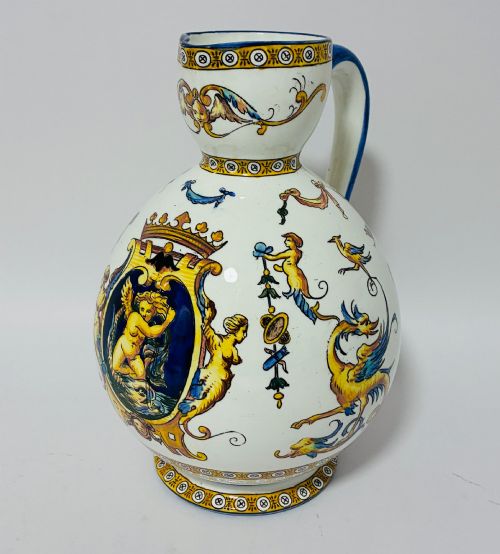
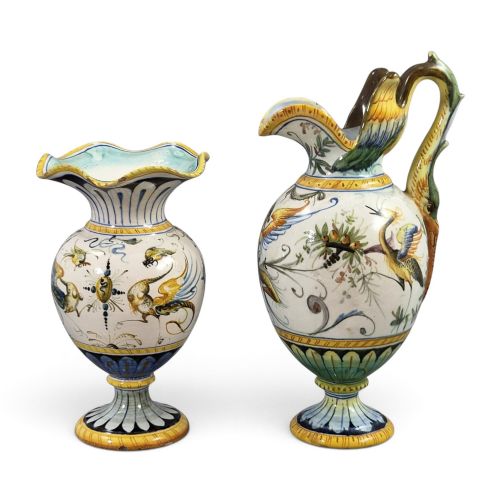
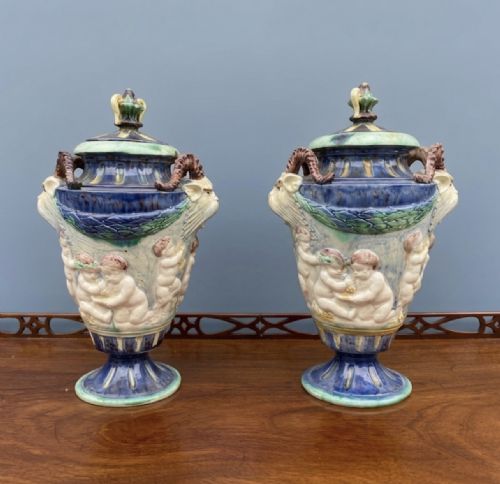
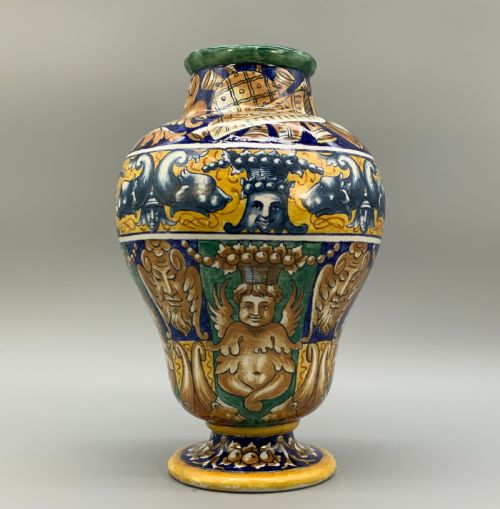
A renaissance revival majolica vase brings the saturated colour and historic ornament of the sixteenth century into Victorian interiors with bold tin glazes and classical forms.
Renaissance Revival Majolica Vase
When you search for renaissance revival majolica vase, you encounter nineteenth-century interpretations of earlier Italian pottery traditions. The examples appearing on this page span the Victorian era, specifically the decades around eighteen-eighty and eighteen-ninety.
Makers drew directly upon historical forms, producing ewers, lidded urns, pedestal vases, and table lamps. Italian workshops dominate the origin of these pieces, particularly production centres in Florence.
The aesthetic leans heavily into polychrome decoration and revival motifs. Many vessels adopt classical silhouettes, sometimes augmented with brass mounts or converted for electrical use.
How they were made
Potters built these vessels in earthenware and tin-glazed earthenware, applying an opaque white glaze that provided a smooth ground for painting. Artists then worked in metallic lustre and rich enamel colours directly onto the unfired or biscuit surface.
Firing fixed the complex polychrome palette, producing the glossy sheen characteristic of majolica. Workshops frequently incorporated moulded relief details to give the painted ornament three-dimensional depth before the final glaze application.
Renaissance Revival Majolica Vase Retail Price Guide 2026
Typical asking prices for renaissance revival majolica vase among the pieces listed under this phrase on Sellingantiques today, from the lower quarter to the upper quarter. They describe what is for sale here now, not the wider market.
Snake bottle vases appear in the archive, reminding us that Victorian collectors appreciated reptiles wrapped around their Renaissance fantasies.
What varies in quality
The success of a piece rests primarily on the control and vibrancy of the polychrome painting. Superior examples exhibit confident brushwork and precise detailing that honour sixteenth-century prototypes without appearing stiff.
The weight and modelling of the earthenware body also set standards apart. Heavier, well-balanced forms with crisp relief moulding and lustrous tin glazes command greater respect than simpler, flatter productions.
Cantagalli Florence·Ulisse Cantagalli
The Renaissance Revival Majolica Vase Glossary
- Majolica
- Opaque tin-glazed earthenware decorated with colourful metal oxides. This technique allows for rich, painterly finishes across nineteenth-century revival vessels.
- Polychrome
- Decoration employing multiple distinct colours. It defines the vibrant palette seen on renaissance revival ceramics.
- Tin Glaze
- A white, opaque glaze containing tin oxide. It creates the smooth background necessary for detailed overglaze painting.
- Ewers
- Pitchers with spouts and curved handles, often produced as decorative display pieces rather than functional tableware. They form a staple shape among Italian majolica imports.
- Lustre
- A metallic sheen applied over the glaze and fired at a low temperature to create an iridescent finish. It catches light across the surface of the ceramic.
Renaissance Revival Majolica Vase: Frequently Asked Questions
What is a renaissance revival majolica vase?
It is a nineteenth-century ceramic vessel produced in imitation of earlier Italian renaissance pottery. These pieces utilise tin glazes and bright polychrome decoration to recreate historical aesthetics.
Potters shaped earthenware into urns, ewers, and vases, often adding classical motifs and sculptural handles. They serve primarily as decorative objects rather than utilitarian vessels.
How do I identify a nineteenth-century piece?
Look closely at the ceramic body, the glaze texture, and the style of the painting. Nineteenth-century interpretations often feature brighter enamel colours and specific Victorian manufacturing marks on the base.
The use of tin-glazed earthenware combined with revival styling points directly to this period. Comparing the form to documented workshop output helps confirm the date.
Were these vases meant for display?
Most of these vessels were created strictly for interior display rather than holding water or flowers. Their elaborate painted surfaces and sculptural forms suited the decorative priorities of Victorian drawing rooms.
Some pieces, such as table lamps and large centrepieces, combined decorative majolica bodies with functional metal hardware. Their primary role remained visual impact within a furnished room.
How do I care for majolica ceramics?
Keep these pieces away from direct sunlight and moisture to protect the tin glaze and enamel paints. Dust them gently with a dry, soft cloth rather than using liquid cleaning agents.
Because earthenware can be porous if the glaze is chipped, handle them with care to avoid impacts. Stable indoor environments prevent thermal shock to the ceramic body.