

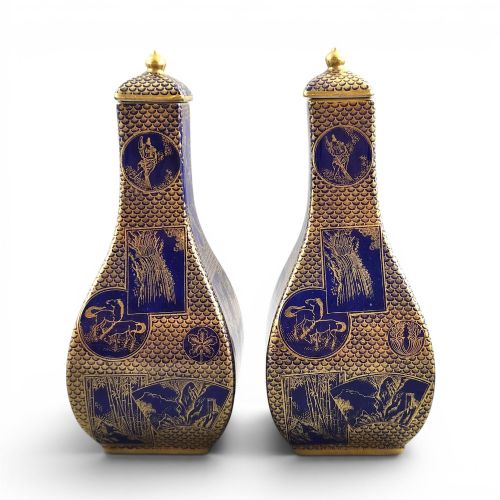
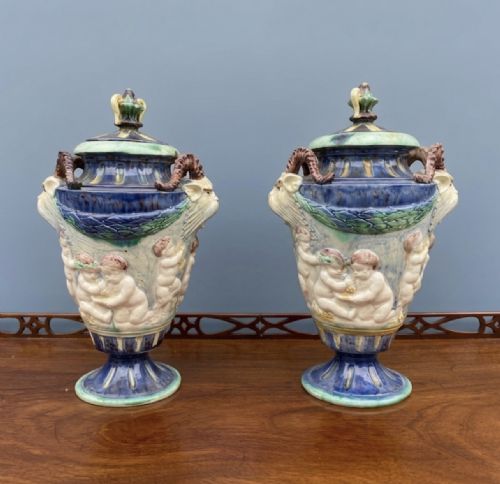


Pair Victorian Urns Covers
These pair victorian urns covers bring architectural presence and rich surface decoration to any mantelpiece or side table.
Pair Victorian Urns Covers
When you search for pair victorian urns covers, you encounter matching lidded vessels spanning the nineteenth century, including Georgian and later Victorian periods. These decorative items appear in forms such as bulbous vases, lidded jars, sweetmeat jars, and garden urns.
Origin points range from English factories and continental houses like Sitzendorf, Dresden, and Royal Vienna. Buyers predominantly meet hand-painted porcelain and ironstone examples bearing floral or Imari decoration.
How they were made
Potters and glassmakers utilised moulding and casting techniques to shape porcelain, ironstone, and glass bodies into bulbous and classical forms. Ironstone provided a durable ceramic base, while lead crystal and cut glass underwent intricate wheel-cutting and etching.
Surface ornamentation involved hand-painted floral motifs, decalcomania, and rich applications of gold leaf and gilding. Enamel colours were fired onto the ceramic bodies to achieve deep blue grounds and polychrome details.
Pair Victorian Urns Covers Retail Price Guide 2026
Typical asking prices for pair victorian urns covers among the pieces listed under this phrase on Sellingantiques today, from the lower quarter to the upper quarter. They describe what is for sale here now, not the wider market.
Listings feature 19th-century materials including porcelain, ironstone, cut glass, lead crystal, and cast iron.
What varies in quality
The crispness of the moulding and the depth of the cut glass define the initial standard of manufacture. Hand-painted details show distinct levels of artistic skill, from standard factory output to finely executed brushwork on porcelain surfaces.
The preservation of original gold leaf, enamel colours, and matching covers dictates the overall integrity of each pair. Consistent matching between the two vessels and their respective lids remains central to the standing of the piece.
Sitzendorf·Mason's·Augustas Rex·Dresden·Royal Worcester
The Pair Victorian Urns Covers Glossary
- Decalcomania
- A technique of transferring printed designs onto glass or ceramic surfaces, popular in the nineteenth century for interior decoration. It allowed manufacturers to produce elaborate pictorial scenes efficiently.
- Imari
- A style of ceramic decoration featuring deep underglaze blue and iron red with supplementary gold, originating in Japan and emulated by European factories. Victorian interpretations often combined these palettes on porcelain bodies.
- Ironstone
- A patented heavy earthenware developed in England known for its durability and resistance to chipping. It served as a robust alternative to porcelain for large decorative vases and jugs.
- Sweetmeat jar
- A covered glass or ceramic jar traditionally used to hold sweets, preserves, or dry confections. In nineteenth-century interiors, matched pairs functioned primarily as decorative mantel ornaments.
- Blush ivory
- A soft cream-coloured porcelain glaze with subtle pink and gold shading, developed and popularized by Victorian potteries. It provided a muted background for delicate floral hand-painting.
Pair Victorian Urns Covers: Frequently Asked Questions
What are pair victorian urns covers used for?
These covered vessels functioned primarily as decorative focal points on mantelpieces, sideboards, and pedestals in nineteenth-century drawing rooms. Their matching lids and substantial forms gave a sense of symmetry and balance to interior spaces.
Today, collectors place them on tables and cabinets to add height, colour, and historical character to a room. They remain purely decorative rather than functional utility items.
How do I care for antique porcelain urns?
Dust these pieces gently with a soft, dry brush to prevent accumulation on delicate hand-painted surfaces and gilding. Avoid using chemical cleaners, water, or abrasive cloths that can damage gold leaf and enamel decorations.
Keep them away from direct sunlight and areas subject to sudden temperature changes to protect the ceramic body and glaze. Handle covers separately and with both hands to prevent chipping the rims.
How can I tell different nineteenth-century styles apart?
Neoclassical and Rococo Revival styles often feature classical urn shapes, scrollwork, and mythological or floral motifs executed in porcelain or cast iron. Chinoiserie examples incorporate Asian-inspired decorative themes, while Gothic influences appear in heavier architectural detailing.
Examining the base material, such as ironstone versus lead crystal, also clarifies the manufacturing tradition. Makers' marks and factory styles further help distinguish English ironstone from continental porcelain houses.
Why do some urns have matching covers?
Covers were designed as an integral part of the vessel's silhouette, completing the classical urn or jar form. Lidded vases and sweetmeat jars required matching tops to maintain the balanced proportions prized by Victorian and Georgian designers.
Finding a pair with their original matching covers intact is significant because lids were easily separated or broken over time. The cover often mirrors the decorative motifs found on the main body of the vase.