





Relief Moulded Stoneware Pitcher
A relief moulded stoneware pitcher brings tactile narrative and robust utility to the table, and these heavy, ornamented vessels reward careful handling.
Relief Moulded Stoneware Pitcher
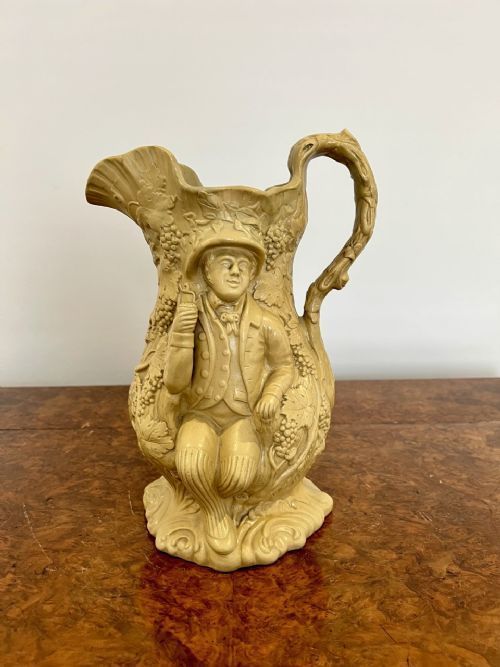
When you search for a relief moulded stoneware pitcher, you are looking at substantial vessels designed for pouring ale, water or cider during the Georgian and Victorian eras. These robust containers feature raised decorative scenes pressed into the body during manufacture, creating a textured surface that stands out from smooth ceramic. The examples met on this page span the nineteenth century, including pieces from the Georgian and Victorian periods, often taking the form of jugs and pitchers with generous handles.
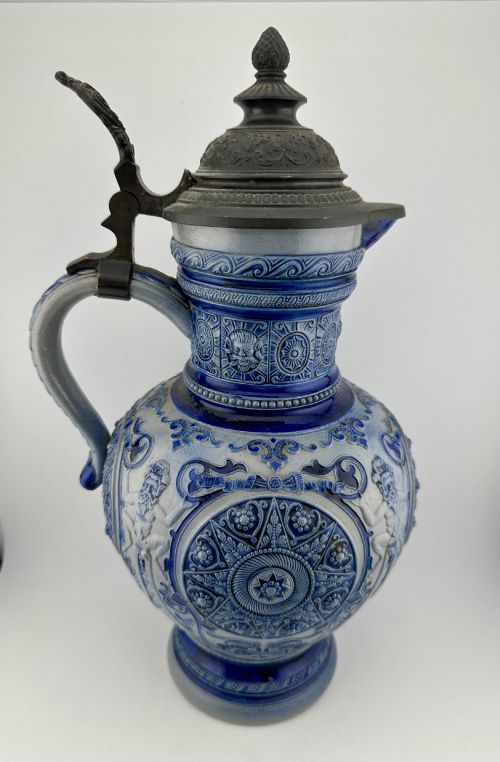
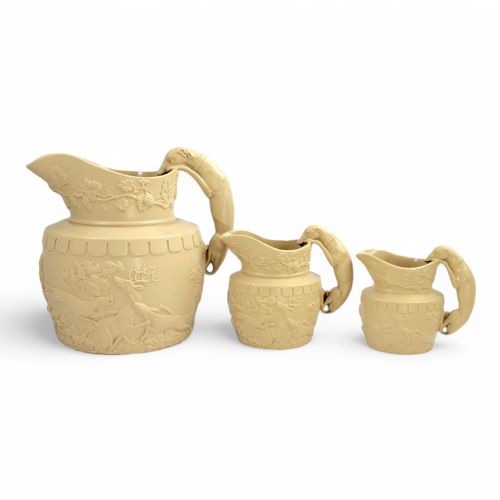
The decorative motifs on these pitchers frequently draw on classical, mythological or hunting themes, such as the Bacchanalian revels or stag hunts recorded in the listings. Makers utilised salt-glazed stoneware, buff-coloured stoneware and earthenware to achieve different surface finishes, sometimes pairing the ceramic body with hinged pewter lids. You will encounter both large serving vessels, such as the large one point five gallon Victoria and Wellington jug, and smaller table pitchers.
Origin and period markers help distinguish these pieces, with German Westerwald blue and grey stoneware appearing alongside English Staffordshire productions. The styles range from German Renaissance Revival and Victorian Classical Revival to Gothic and Regency designs. While many remain purely ceramic, others incorporate coloured glazes, cobalt oxide decoration or pale sage green Parian bodies to catch the eye.
Materials and methods of production
Potters constructed these vessels using dense clays such as stoneware and earthenware, which were fired at high temperatures to ensure durability and liquid retention. The distinctive raised decoration was achieved by pressing clay into carved metal or plaster moulds before applying it to the main body of the pitcher, or by forming the entire vessel within a multi-part mould. This technique allowed workshops to produce complex, repeatable pictorial panels with sharp detail.
Surfaces were finished with various treatments, including salt-glazing where salt thrown into the kiln vapour-glazed the clay, or the application of cobalt oxide pigments to create deep blue contrasts against grey backgrounds. Buff-coloured and yellow wares were also utilised, alongside specialist clay bodies like Parian ware that mimicked carved marble. Metalworkers then fitted some jugs with hinged pewter lids and thumbpieces to complete the utilitarian design.
Relief Moulded Stoneware Pitcher Retail Price Guide 2026
Typical asking prices for relief moulded stoneware pitcher among the pieces listed under this phrase on Sellingantiques today, from the lower quarter to the upper quarter. They describe what is for sale here now, not the wider market.
Listings feature salt-glazed stoneware, earthenware, and Parian bodies decorated with cobalt oxide and coloured glazes.
Assessing craftsmanship and design
Quality in a relief moulded stoneware pitcher lies in the crispness of the moulded relief and the depth of the narrative detail. Superior pieces exhibit sharp, well-defined figures and foliage where the junctions between the moulded panels and the main body are cleanly finished and integrated. Weaker examples show blurred outlines, sluggish lines or heavy seams where the moulds have worn down or the clay was pressed carelessly.
The choice of materials and secondary elements also distinguishes the range. Finer pitchers employ sophisticated multi-coloured salt-glazes, cobalt oxide highlights or high-grade pewter mounts that fit the ceramic neck precisely. The balance of the handle, the stability of the base and the evenness of the glaze further separate standard commercial production from the outstanding works produced by notable nineteenth-century potteries.
Charles Meigh·Ridgway and Sons·Jones and Walley·Phillips and Bagster
The Relief Moulded Stoneware Pitcher Glossary
- Relief moulding
- A technique where decorative designs are pressed out in raised form from the background of the ceramic body. This creates a tactile, three-dimensional surface effect across the side of the pitcher.
- Salt-glazed stoneware
- A vitreous ceramic finish achieved by throwing common salt into the kiln during high-temperature firing. The salt vaporises and reacts with the silica in the clay to produce an orange-peel textured glaze.
- Cobalt oxide
- A metallic compound used as a pigment to create intense blue decoration under or over the glaze. It is frequently seen on German Westerwald salt-glazed pieces.
- Parian ware
- A fine-grained, unglazed porcelain resembling white marble, developed in the nineteenth century and used for sculptural jugs. It fires to a smooth, matte finish that highlights delicate details.
- Pewter lidded
- A descriptor for jugs fitted with a metal alloy lid hinged to the handle, designed to keep contents covered. These lids often feature distinct thumbpieces for one-handed operation.
Relief Moulded Stoneware Pitcher: Frequently Asked Questions
What were relief moulded stoneware pitchers used for?
These vessels served primarily as utilitarian pitchers for holding and pouring beverages such as ale, cider or water at the dining table or in taverns. Their robust stoneware construction kept liquids cool and withstood the demands of daily household use.
Beyond simple utility, their elaborate decorative scenes often sparked conversation among guests during Victorian and Georgian gatherings. The inclusion of hinged pewter lids on certain examples helped protect the contents from dust and insects.
How do I distinguish German Westerwald jugs from English pieces?
German Westerwald pieces typically feature characteristic blue and grey salt-glazed surfaces decorated with incised or stamped floral and geometric patterns, often paired with pewter lids. They tend to reflect traditional Rhenish salt-glaze techniques dating back centuries.
English jugs from the nineteenth century generally rely on distinct relief moulded historical, mythological or sporting scenes against buff, coloured or white ceramic bodies. The factory marks and specific clay compositions further clarify the English Staffordshire origins.
How should I display and care for antique pitchers?
Display these pitchers on sturdy, level surfaces away from direct sunlight and sudden temperature fluctuations to protect the ceramic body and any historical glazes. Because stoneware is relatively robust, they require less delicate handling than porcelain but still benefit from secure placement.
Clean them gently with a soft, dry cloth or a slightly damp sponge when necessary, avoiding harsh modern detergents that might harm the antique surfaces. If a piece includes a pewter lid, keep the metal dry to prevent oxidation and preserve the finish.
What is the difference between stoneware and earthenware?
Stoneware is fired at significantly higher temperatures than earthenware, causing the clay body to vitrify and become dense, non-porous and extremely durable. This makes stoneware naturally water-resistant even before any glaze is applied.
Earthenware remains more porous and requires a complete glaze layer to hold liquids effectively. Nineteenth-century makers utilised both materials depending on the desired colour, weight and decorative style of the pitcher.