

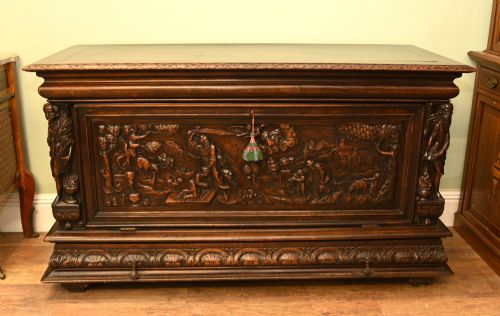
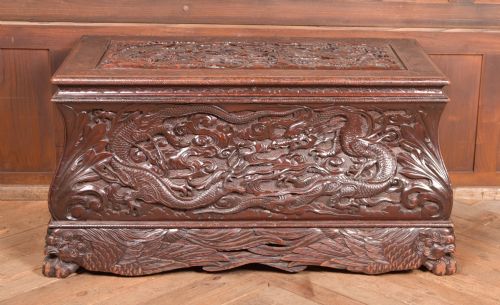
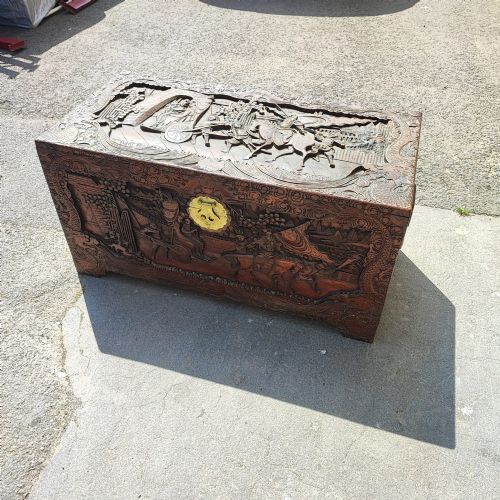


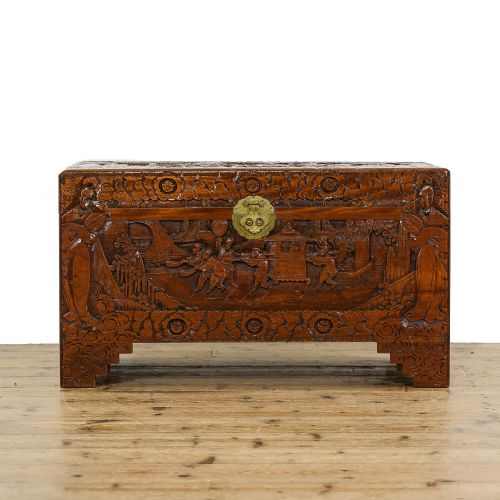


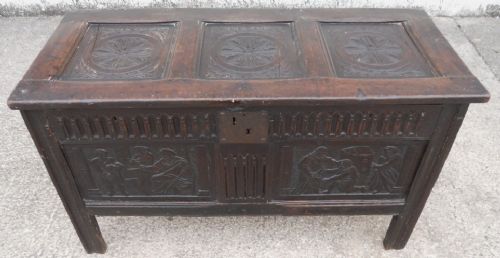
Relief Carved Storage Chest
A relief carved storage chest offers deep utility and rich surface detail, combining robust construction with intricate sculptural decoration.
Relief Carved Storage Chest
A relief carved storage chest provides a practical vessel for textiles and household goods while displaying dense ornamentation across the timber surface. When exploring a relief carved storage chest, buyers encounter forms ranging from large blanket boxes and luggage trunks to smaller caskets and cabinets.
The selection on this page draws primarily from nineteenth-century and early twentieth-century examples, spanning Chinese export, Anglo-Indian, and traditional European styles. Regional expressions vary from camphor wood trunks to oak blanket chests bearing biblical scenes.
Buyers will find that many of these objects serve multiple interior functions, acting as functional furniture pieces that anchor a room with distinct historical character. The forms include rectangular trunks, hall benches, and cabinet configurations designed for secure storage.
Materials and construction methods
Carpenters utilised native and exotic timbers such as oak, teak, and camphor wood to build these storage vessels, selecting materials based on regional availability and structural demand. Camphor wood was frequently chosen for its aromatic qualities and natural resistance to insects.
Woodworkers applied chisels and gouges to execute the deep surface carving, raising motifs above the background plane to create shadow and depth. Brass hardware, including hinges, straps, and corner brackets, was often incorporated to reinforce joints and protect corners.
Relief Carved Storage Chest Retail Price Guide 2026
Typical asking prices for relief carved storage chest among the pieces listed under this phrase on Sellingantiques today, from the lower quarter to the upper quarter. They describe what is for sale here now, not the wider market.
Listings span periods from seventeen-fifty through the nineteen-thirties, featuring woods such as oak, teak, and camphor.
Distinctions in quality
The depth and clarity of the chisel work define the visual merit of the carving, separating routine production from more ambitious sculptural execution. Crisp edges and well-defined pictorial narratives indicate greater skill by the maker.
Timber selection and structural joinery also govern the standard of the piece, with sound seasoning preventing warping across large lid panels. Well-fitted brass mounts and intact internal compartments contribute to the integrity of the object.
The Relief Carved Storage Chest Glossary
- Camphor wood
- A fragrant timber native to Asia, commonly utilised for storage chests due to its insect-repellent properties. It often retains a distinct aroma.
- Relief carving
- A sculptural technique where figures or patterns are carved into a solid block of wood, projecting outward from the background surface. This method adds significant textural dimension to furniture.
- Blanket chest
- A large rectangular container designed primarily for storing linens, blankets, and textiles. These pieces often feature hinged lids and sturdy timber construction.
- Tea caddy
- A small lidded box historically used for storing loose tea leaves, often subdivided into internal compartments. Victorian examples frequently display fine cabinetwork.
- Hall bench
- A dual-purpose seating furniture item incorporating a storage compartment beneath the seat or within the base structure. These items were typically placed in entrance halls.
Relief Carved Storage Chest: Frequently Asked Questions
What were camphor chests used for?
Camphor wood trunks served primarily to store garments, blankets, and valuable textiles safely within domestic interiors. The natural fragrance of the wood protected fabrics from moths and damp conditions during storage.
Travellers and merchants also utilised these sturdy boxes for maritime transport, relying on the robust timber and metal hardware to protect contents during long journeys.
How do I care for an antique wooden chest?
Keep wooden storage chests away from direct heat sources and drastic humidity fluctuations to prevent the timber from splitting or warping. Dust the carved surfaces regularly with a dry cloth and avoid harsh chemical polishes.
Applying a light coat of appropriate wax periodically helps maintain the sheen of the wood without building up heavy residues in the recessed carvings.
Where were Chinese export chests made?
Chinese export chests were produced in coastal treaty ports and regional workshops to satisfy Western demand during the nineteenth and early twentieth centuries. Artisans combined traditional local woodworking techniques with motifs tailored to foreign markets.
These pieces were subsequently shipped abroad via maritime trade routes, becoming popular furnishings in European and American homes.
What is the difference between a coffer and a trunk?
A coffer generally describes a heavy, deeply constructed wooden chest reinforced for security and valuable storage, often associated with earlier periods. A trunk typically implies a portable container built for travel, frequently featuring reinforced corners and carrying handles.
Both forms utilise hinged lids, but their historical context and structural weight often distinguish domestic furniture from luggage.