
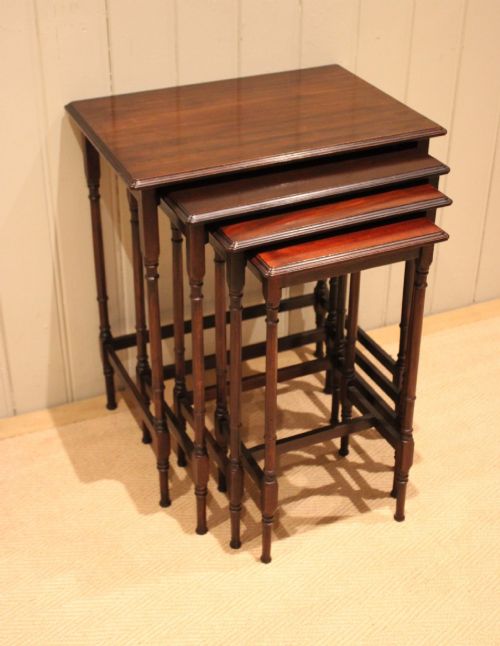
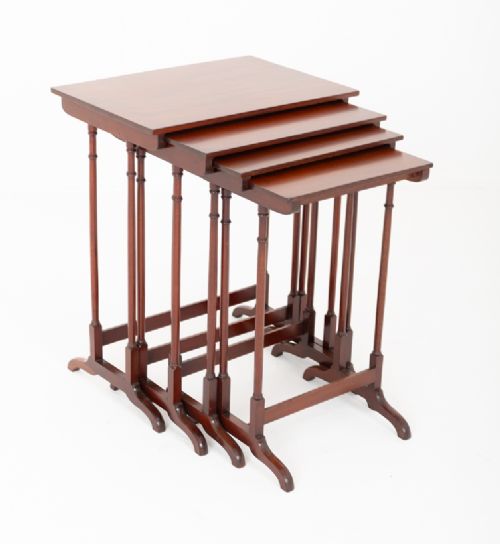
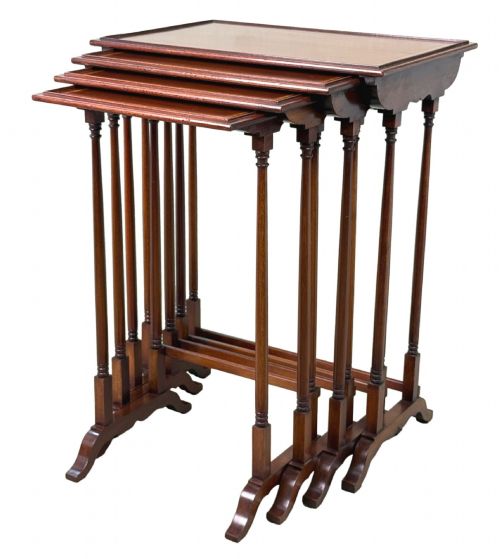
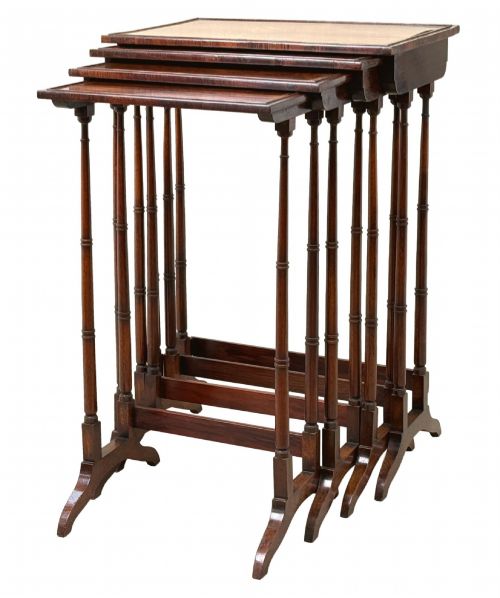

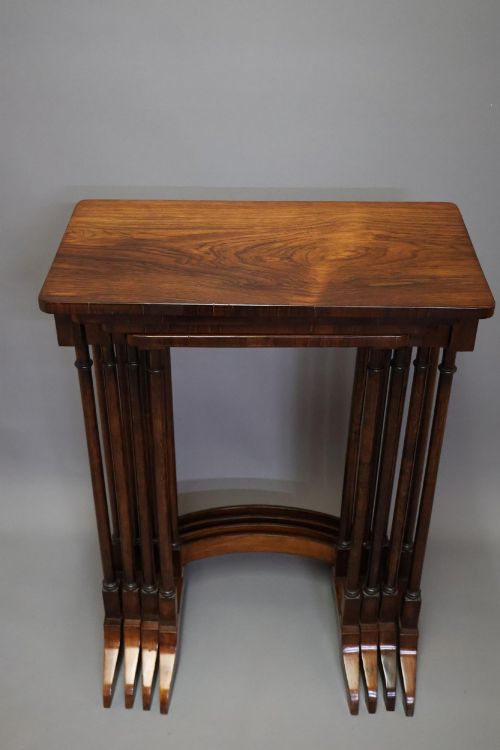

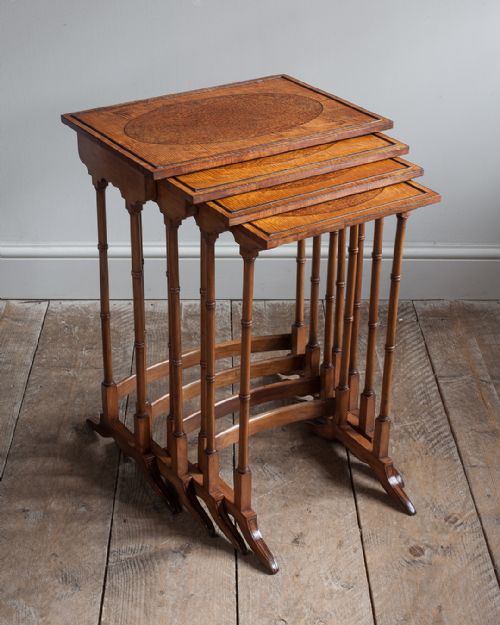


Regency Stacking Tables
Regency stacking tables are graduated sets of occasional surfaces designed to tuck neatly together, offering flexible display space without crowding a room.
Regency Stacking Tables
When you search for regency stacking tables, you are looking at sets of freestanding occasional tables, frequently known historically as quartetto tables, built to slide sequentially one beneath another. These pieces originated as functional furniture for the drawing room, serving tea, holding books or displaying decorative objects.
The versions you are most likely to meet on this page span the nineteenth century and later revivals, executed in forms consisting of three or four graduated tables. They appear primarily in mahogany and rosewood, alongside satinwood and black lacquer finishes decorated in the Chinoiserie taste.
Makers designed these sets with slender turned or pillar supports, often joined by trestle feet or stretcher bases to ensure the smaller tables clear the frames of the larger ones above them. The grading in height and width allows the entire group to occupy the footprint of a single small table when not in use.
How they were made
Cabinet makers utilised dense hardwoods such as mahogany and rosewood, selected for their stability and capacity to take a fine polish on small surface areas. Veneers of satinwood and yew appear across tabletops, supported by solid timber frames that required precise joinery to withstand frequent sliding.
Decorative treatments include surface gilding, gold leaf, and intricate Chinoiserie lacquer work depicting oriental motifs on dark grounds. Workshops applied multiple coats of varnish and wax to build up a durable sheen on both the primary surfaces and the graduated underframes.
Materials recorded across the site range from solid mahogany and rosewood to Chinoiserie lacquer and gold leaf.
What varies in quality
The distinction between standard production and the finest examples rests on the selection of timber grain and the precision of the graduating dimensions. Finer sets display matched veneers, tightly figured rosewood or mahogany, and hand-applied lacquer work with crisp detail rather than heavy, uniform finishes.
Structural integrity also separates grades, visible in how smoothly the tables slide together and the restraint shown in the turning of the slender legs. Superior sets maintain rigidity across the smallest table despite the reduced scale of the frame.
Gillows
The Regency Stacking Tables Glossary
- Quartetto
- A set of four tables graduated in size to nest together. This term appears frequently in nineteenth-century records for nesting tables.
- Satinwood
- A durable hardwood yielding a yellowish timber with a lustrous, satiny sheen. Makers used it extensively for veneered tabletops.
- Mahogany
- A heavy, reddish-brown tropical hardwood prized for furniture making. It forms the primary structure for the majority of these listings.
- Regency Revival
- A design movement later in the nineteenth and early twentieth centuries copying earlier Regency aesthetics. Pieces from this period often replicate earlier quartetto proportions.
Regency Stacking Tables: Frequently Asked Questions
How do you use stacking tables?
These tables provide independent surfaces that you can pull out around a room as needed for drinks or books. When the gathering ends, they slide back into a single compact stack.
Their graduated design means they take up minimal floor space while offering multiple tiers of surface area.
What is a quartetto table?
A quartetto is a matched set of four occasional tables built to nest inside one another. The term derives from musical quartets, reflecting the four parts that form a unified group.
Cabinet makers designed them primarily for drawing rooms during the Regency period and subsequent revivals.
How do I distinguish original Regency from revival pieces?
Original Regency tables date from the early nineteenth century and show construction methods, timber patination, and wear consistent with that era. Revival pieces often date from the Edwardian period or the nineteen-twenties, using machine-standardised joints and cleaner factory finishes.
Examining the underside of the tabletops and the wear on the feet helps clarify the age of the set.
Can these tables support heavy items?
The smaller tables in a nest feature slender legs and lighter frames designed for lamps, cups, or books rather than heavy loads. The largest table in the set offers the most stability for heavier objects.
Placing excessive weight on the smallest table risks straining the delicate stretcher joints.