
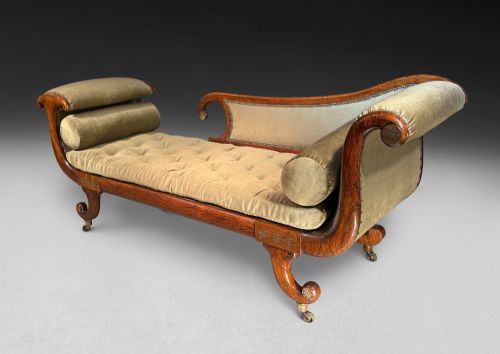
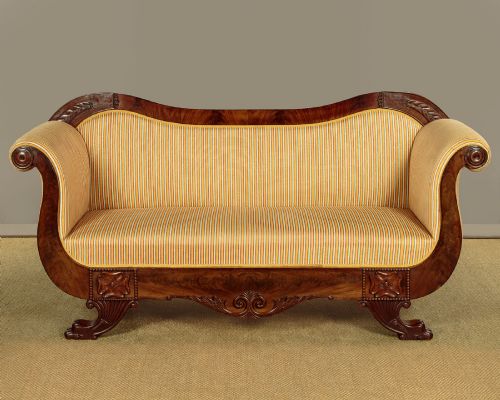
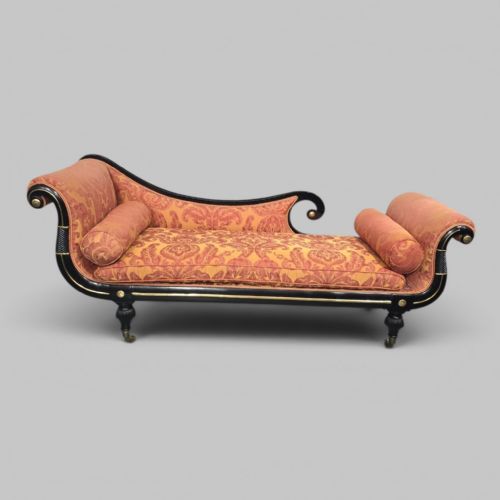
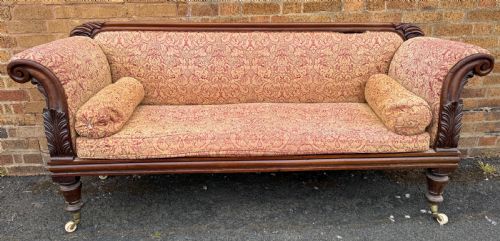
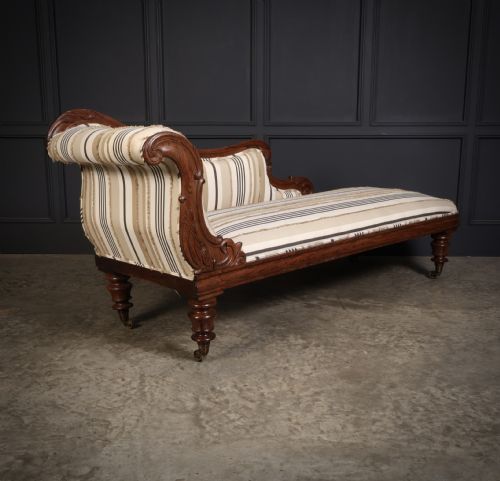


Regency Scroll End Sofa
A regency scroll end sofa brings monumental classical line and deep horizontal repose to a grand interior.
Regency Scroll End Sofa
A regency scroll end sofa is a long seating form defined by sweeping, outward-curling arms at one or both ends. These pieces appear primarily from the Regency and William IV periods, often taking the form of a chaise longue, daybed, or double-ended settee.
The profile draws directly from classical Greek and Roman daybeds, designed for reclining rather than upright sitting. Most examples seen here utilise solid mahogany, rosewood, or simulated rosewood frames, frequently fitted with brass inlay or carved show wood details.
Variations range from single-ended couches with a high back and one scroll to symmetrical double-ended settees and larger country house daybeds. They function as architectural anchors in a room, traditionally placed against a wall or floating to display the grain of the timber.
Judging Quality
The distinction between standard output and the finest workshop production lies in the crispness of the timber carving and the precision of the brass inlay. Superior frames use choice cuts of figured mahogany or highly grained rosewood that wrap cleanly around the tight curves of the scroll ends.
Proportion and scale dictate the visual success of the piece, with better examples maintaining balanced lines across large four-seater frameworks or grand scale daybeds. The integrity of the show wood frame and the depth of the classical carving separate simpler country pieces from high-style London commissions.
Listings feature mahogany, rosewood, simulated rosewood, and brass inlay across both Regency and William IV periods.
Willian Trotter
The Regency Scroll End Sofa Glossary
- Scroll end
- An armrest that curls outward in a tight or sweeping spiral shape. This defining feature emulates ancient Hellenistic seating designs.
- Récamier
- A type of daybed or chaise longue with one raised end and a partially open back, named after the famous portrait of Madame Récamier. It is built for semi-recumbent resting.
- Simulated rosewood
- A painted or stained finish applied to a secondary timber to imitate the dark, contrasting grain of genuine rosewood. Craftsmen used this technique during the Regency period to achieve an expensive look with accessible materials.
- Ebonised wood
- Timber treated with chemical stains or black finishes to resemble ebony. It provides a dense, light-absorbing dark surface popular in Regency and William IV design.
- Hessian
- A coarse woven fabric made from jute or hemp fibres, used historically as the foundational webbing and internal cover for upholstery stuffing.
Regency Scroll End Sofa: Frequently Asked Questions
How do I style a regency scroll end sofa in a modern room?
These pieces possess a strong architectural presence that suits large open spaces or high-ceilinged drawing rooms. Position the sofa to showcase the sweeping lines of the timber frame and the profile of the scroll ends.
Keep surrounding furniture lower in scale to let the classical silhouette remain the focal point of the interior.
Were these sofas intended for sitting or lying down?
The low back and extended scroll arms indicate that these forms were primarily designed for reclining, lounging, or resting during the day. The asymmetric single-ended versions allowed the user to lean against the high scroll while stretching their legs out.
Double-ended variations permitted resting from either direction depending on the placement within the room.
How do I tell a Regency period sofa from a William IV one?
Regency pieces dating from the early nineteenth century generally display leaner, sharper classical proportions with delicate brass inlay and simulated rosewood or mahogany surfaces. William IV examples from the 1830s tend to be heavier in scale, featuring bolder carved mahogany show wood frames and richer rosewood veneers.
Both styles utilise the scroll end motif but differ in weight and decorative restraint.