




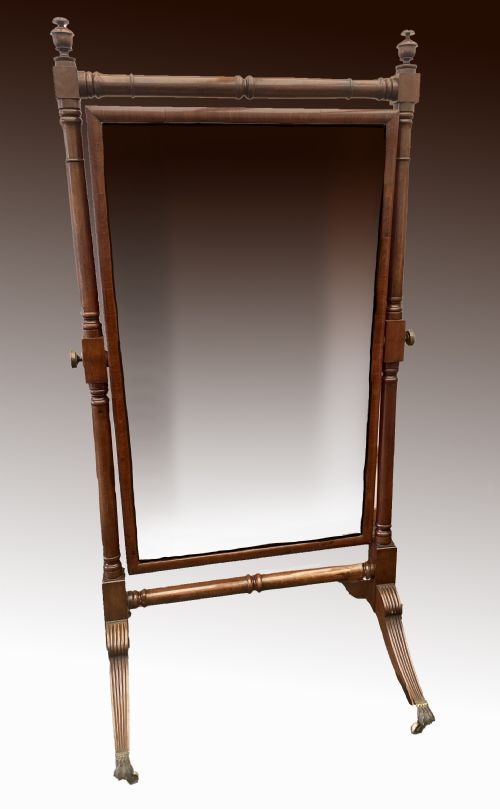


Regency Psyche Mirror
A regency psyche mirror stands as a commanding floor-standing glass that reflects both stature and refined taste.
Regency Psyche Mirror
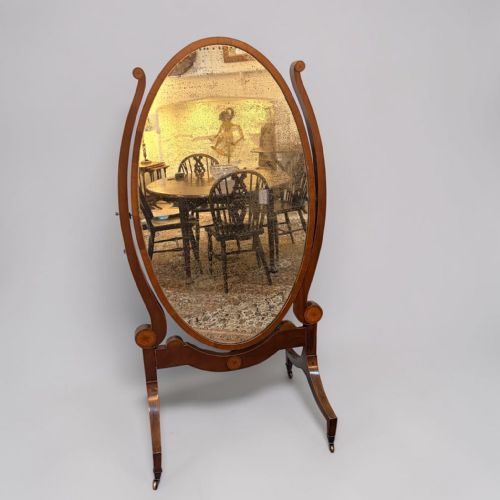
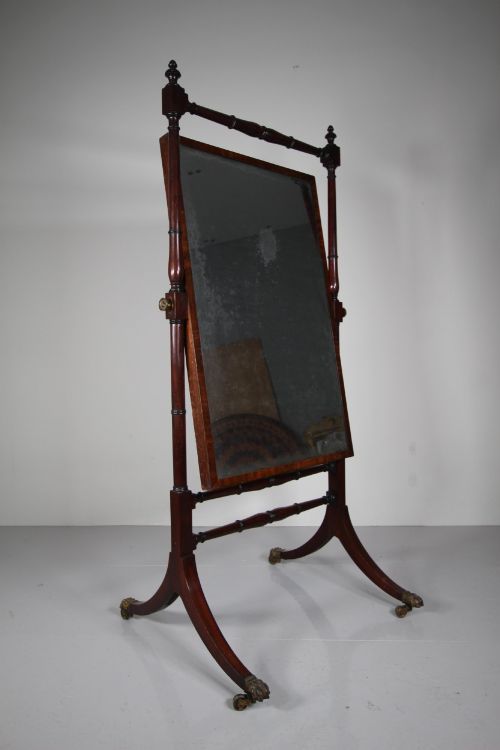
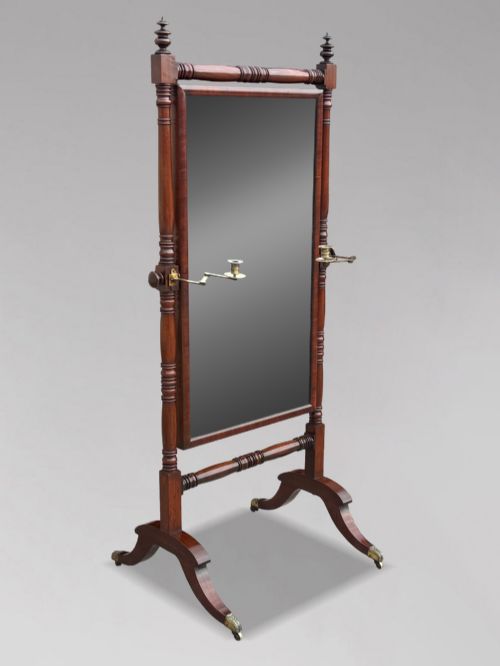
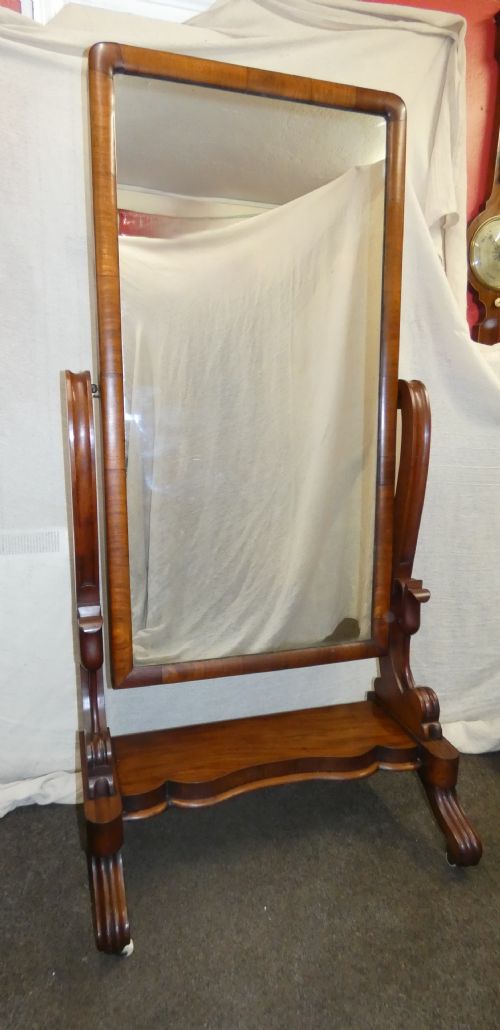
A regency psyche mirror, more commonly styled as a cheval mirror in the trade, provides a full-length reflection supported by a freestanding frame. The selections here comprise tall swivelling glasses designed to stand independently within a bedroom or dressing room rather than rest upon a surface.
The dominant material visible across these listings is mahogany, shaped during the Regency, Georgian, and William IV periods. Pieces frequently date from the early nineteenth century around eighteen ten to eighteen fifty, showing the sustained popularity of this tall dressing form.
Makers constructed these mirrors with pivoting frames held between upright pillars, allowing the user to tilt the glass plate to various angles. While smaller dressing table mirrors appear among the selections, the floor-standing cheval remains the primary form encountered.
How they were made
Cabinet makers utilised solid and veneered mahogany to construct the robust frames and supporting trestles required to hold heavy glass plates. Timber selection focused on rich grain patterns, which workers polished to a deep lustre.
Brass fittings play a vital mechanical role, securing the swivelling pivots and forming sabots upon the feet. Many examples incorporate castors to allow smooth movement across the floor.
Mirror glass of the period was set within turned or moulded wooden frames, balanced carefully on trunnions so the plate holds its position at the desired tilt without slipping.
Regency Psyche Mirror Retail Price Guide 2026
Typical asking prices for regency psyche mirror among the pieces listed under this phrase on Sellingantiques today, from the lower quarter to the upper quarter. They describe what is for sale here now, not the wider market.
Every listed piece utilises mahogany as the primary timber, spanning the Georgian, Regency, and William IV eras up to eighteen fifty.
What varies in quality
Proportion and timber selection dictate the standing of a piece within its class. Finer examples display carefully chosen flame mahogany veneers and crisp turning on the supporting pillars rather than plain, unfigured boards.
The sophistication of the base architecture marks the distinction between standard workshop production and superior cabinet work. Graceful sabre legs paired with well-cast brass sabots and working castors elevate the construction above simpler four-legged stands.
The Regency Psyche Mirror Glossary
- Cheval mirror
- A large freestanding full-length mirror mounted on a frame that allows the glass to swing. The name derives from the French word for horse, referencing the four-legged trestle support.
- Sabre leg
- A curved, outwardly tapering leg resembling a cavalry sword, commonly found on seating and mirror frames of the Regency period. This form provides both stability and visual lightness.
- Sabot
- A metal sleeve, usually brass, fitted to the foot of a furniture leg for protection and decoration. They frequently incorporate castors for mobility.
- Trunnion
- A cylindrical projection that acts as a pivot, allowing the mirror plate to tilt forward and backward within its upright supports. Proper tension keeps the glass fixed at the chosen angle.
Regency Psyche Mirror: Frequently Asked Questions
Where should a cheval mirror be placed?
These tall mirrors function best in bedrooms or dressing spaces where full-length reflections are practical. Positioning them near a window maximises natural light distribution across the room.
Because they stand independently on the floor, ensure the supporting surface is level so the frame rests securely on its feet or castors without undue strain on the pivots.
How do I tilt the mirror safely?
Most frames operate via brass side pivots that can be adjusted by hand or with a proper fitting tool. Support the centre of the glass plate while altering the angle to prevent sudden movement.
Avoid forcing the mirror past its intended range of motion, as excessive pressure can stress the upright pillars and the joints connecting them to the base.
How do I date a mahogany frame?
Look to the overall silhouette and secondary details such as the shape of the legs and the turning of the pillars. Regency and Georgian pieces often feature architectural moulding and refined proportions.
Later Victorian interpretations tend to be heavier in construction and may use different secondary timbers behind the mahogany veneer, reflecting changing workshop practices.
How do I care for the mahogany timber?
Maintain the finish by dusting with a soft, dry cloth and avoiding modern silicone-based polishes that build up over time. Natural wax applied sparingly preserves the depth of the grain.
Keep the piece away from direct sunlight and heat sources to prevent the mahogany from drying out or the veneer from lifting over the years.