
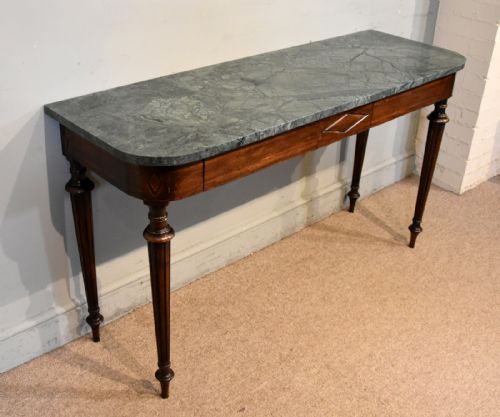
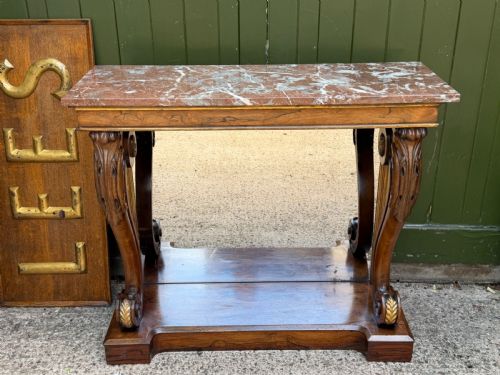
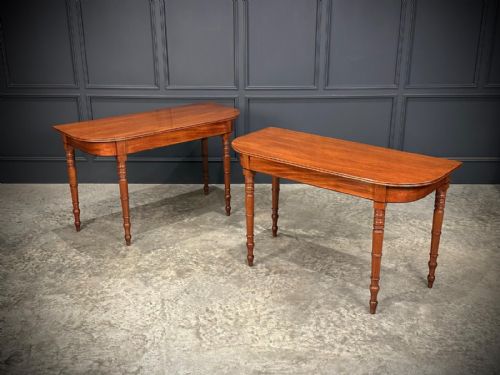


Regency Period Pier Table
A regency period pier table is a formal architectural console designed to sit against a wall, bringing polished timber and marble into a grand interior.
Regency Period Pier Table
A regency period pier table sits flat against the wall between windows, functioning as a console or serving table within formal rooms. These pieces emerge predominantly from the Regency, George IV, and William IV eras, spanning the late eighteenth and early nineteenth centuries.
The forms on this page appear primarily as console tables, frequently utilising architectural styling. Makers fashioned these tables from timber such as mahogany and rosewood, often pairing them with figured marble tops.
Buyers meet variations ranging from plain mahogany to rosewood examples enhanced with parcel-gilt and inset mirror-backs. Certain pieces reflect specific design vocabularies, including Empire and classical empirical architectural inspiration.
How they were made
Cabinet makers utilised dense hardwoods including solid mahogany and rosewood, frequently applying flame mahogany veneer to achieve rich surface figures. They incorporated structural elements of brass and glass, particularly within mirror-backed consoles.
Surface decoration relies heavily on parcel-gilt details and painted wood finishes applied to carved wooden frames. Heavy marble tops sit upon these timber structures, providing a cool and durable surface for the console.
The listings on this site record mahogany, rosewood, and painted wood as the primary timbers used for these tables.
What varies in quality
The choice of timber underpins the visual weight of each piece, distinguishing simple cuts of mahogany from richly figured rosewood and flame mahogany veneer. Superior examples incorporate complex decorative treatments like parcel-gilt work and inset mirror-backs rather than plain painted wood.
Design ambition separates standard console tables from those executed in specific high-style idioms such as Empire or classical empirical architectural inspiration. The integration of heavy marble tops and substantial brass mounts further defines the execution of the piece.
Gillows
The Regency Period Pier Table Glossary
- Pier table
- A table designed specifically to stand against the wall pier between two windows. These architectural console tables often support heavy marble tops.
- Console table
- A table supported by wall brackets or console legs rather than four independent vertical posts. They sit flush against a wall in formal rooms.
- Parcel-gilt
- Woodwork partially covered in thin gold leaf to highlight carved details and mouldings. This technique adds bright contrast against dark rosewood or mahogany.
- Flame mahogany veneer
- A thin slice of mahogany timber cut from the fork of the tree to create a distinctive flickering flame pattern. Cabinet makers applied this over a secondary wood base.
- Mirror-back
- A mirrored glass panel set into the rear frame of a console table to reflect light and interior space. These appear frequently in nineteenth-century designs.
Regency Period Pier Table: Frequently Asked Questions
Where should I place a pier table?
These tables belong against a flat wall, traditionally positioned in the space between two windows where they catch natural light.
Their shallow depth ensures they do not obstruct walkways while providing a formal surface for display.
What is the difference between a console and a pier table?
While the terms often overlap in period furniture, a pier table specifically occupies the wall space between architectural openings.
Console tables generally describe any wall-mounted or bracket-supported table regardless of its exact architectural placement.
How do I care for a marble top?
Marble requires gentle cleaning with a damp cloth and mild soap to protect the polished surface from acidic spills and staining.
Avoid placing unsealed liquids directly onto the stone to preserve the natural figure of the marble.
How do I identify Regency style?
Regency pieces draw heavily on classical Greek, Roman, and Egyptian motifs, favouring clean architectural lines and rich dark timbers.
Look for symmetrical forms, brass inlay, and structural details inspired by the Empire period.