
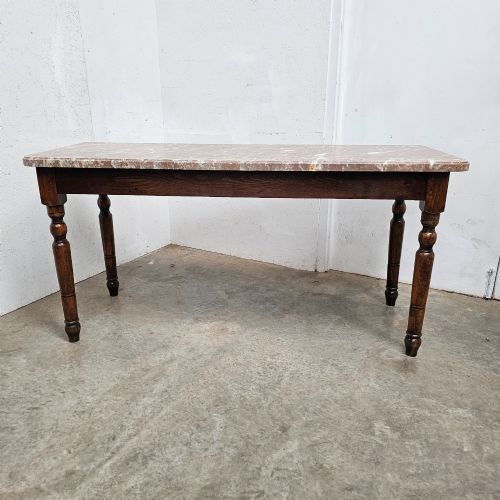


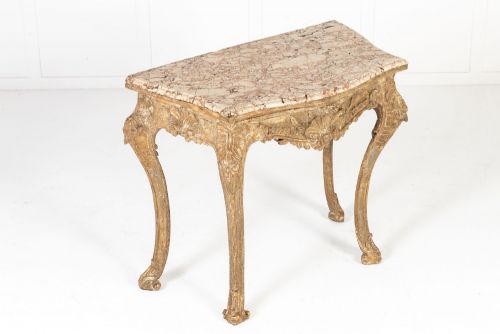


Pink Marble Console Table
A pink marble console table brings classical grandeur and striking mineral colour to a room, offering a solid stone surface set into a decorative frame.
Understanding the pink marble console table
When you search for a pink marble console table, you are looking at substantial wall-against furniture featuring decorative stone tops. These pieces originate across several periods and traditions, appearing in forms from Chinese hardwood centre tables to French parcel gilt consoles.
The versions you meet on this page span the late nineteenth century through to the early twentieth century. They include Regency painted and gilt designs, Victorian Baroque forms with detailed mounts, and Qing Dynasty carved hardwood frames.
Makers adapted these tables for various interiors, pairing the distinct rouge or pink marble panels with mahogany, boxwood, and giltwood. Some examples incorporate matching mirrors, creating a unified decorative scheme for a hallway or reception room.
Materials and construction
Makers combined heavy natural marble with supportive wooden frames carved from hardwood, mahogany, or painted wood. Structural elements often received parcel gilt or solid giltwood finishes to highlight the carved details.
Surface decoration involved intricate hand carving, inlay work, and applied brass or metal elements. Frames incorporate classical motifs such as rams and maiden heads, fixed securely to support the heavy stone slab above.
Retail Price Guide 2026
Typical UK retail prices for pink marble console table, calculated from the Sellingantiques database of over a million retail prices indexed since 2003. This retail price guide relies exclusively on Sellingantiques data; no external sources or auction records are used, so the figures do not describe the wider market.
Victorian furniture makers occasionally sculpted fierce iron rams directly into console frames to stare down bewildered hallway guests.
Distinctions in quality
Quality rests in the depth and crispness of the hand carving on the wooden frames, whether showing Baroque scrolls or Qing Dynasty floral motifs. Superior pieces demonstrate precise joinery that successfully balances the immense weight of the inset marble panel.
The mineral character of the marble itself elevates a piece, with richer veining and flawless integration into the surround setting apart the finest examples. Gilding and painted finishes executed with genuine gold leaf create a depth missing from simpler painted alternatives.
The Pink Marble Console Table Glossary
- Console table
- A table designed to stand against a wall, traditionally supported by fixed brackets or decorative legs rather than four freestanding supports. These pieces frequently feature prominent marble or stone tops.
- Parcel gilt
- A finishing technique where specific carved details or raised ornaments are highlighted with gold leaf while the underlying wood or paint remains visible. This method accentuates the craftsmanship of the frame.
- Rouge marble
- A deep reddish or pink limestone marble prized for its striking mineral veining and smooth polished finish. It forms a robust and decorative surface for tabletops.
- Baroque
- A flamboyant artistic style characterised by dramatic ornamentation, curved lines, and rich sculptural details. In furniture, it manifests in heavy scrolls and figural carvings such as rams and maiden heads.
- Giltwood
- Timber that has been coated with a thin layer of gold leaf or gold paint to simulate solid gold. It reflects light and adds theatrical presence to formal nineteenth-century interiors.
Frequently Asked Questions
Where should I place a console table?
These tables sit flat against a wall, making them ideal for hallways, reception rooms, or living spaces where floor depth is limited. Their decorative surfaces allow them to function as focal points beneath mirrors or artwork.
Because they often feature heavy stone tops, positioning them on stable flooring ensures they remain secure and balanced in daily use.
How do I care for the marble top?
Marble is a natural and porous stone that benefits from regular dusting with a soft, dry cloth. Avoiding acidic liquids and harsh chemical cleaners preserves the polished surface.
Using coasters and placemats protects the stone from moisture rings and scratching during everyday use.
How do I identify the period of a table?
Dating relies on examining the construction methods, tool marks, and stylistic vocabulary of the wooden frame. Details such as Regency painted finishes or Victorian Baroque cast metal mounts provide clear period indicators.
Comparing the carving style against known historical design books helps confirm whether a piece belongs to the nineteenth or early twentieth century.
Are these tables freestanding?
Traditional console tables are designed to stand against a vertical surface for structural stability. Some variations, such as centre tables, can stand away from the wall in the middle of a room.
Checking the finish on the back edge of the frame reveals whether the piece was intended to be viewed from all sides.