
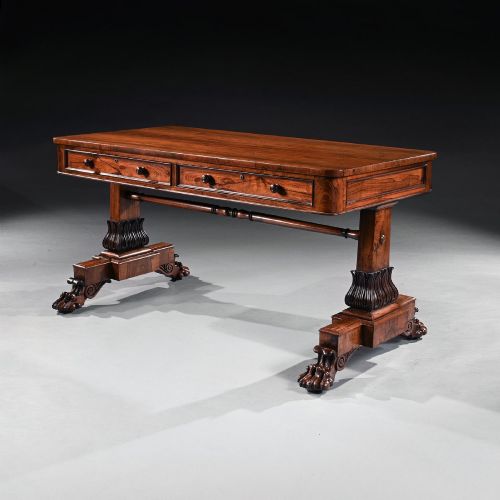


Regency Period Pedestal Desk
A regency period pedestal desk offers formal symmetry and rich timber surfaces, making it a commanding centrepiece for any study.
Regency Period Pedestal Desk
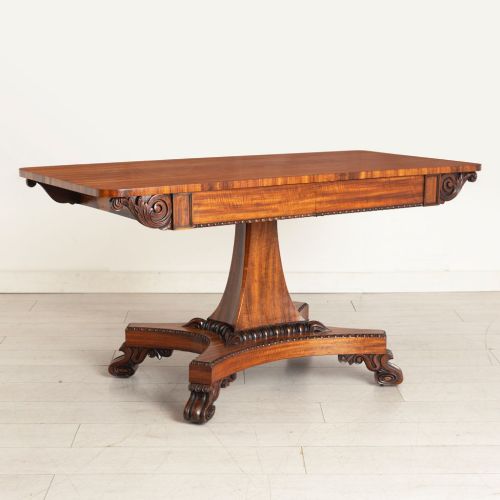
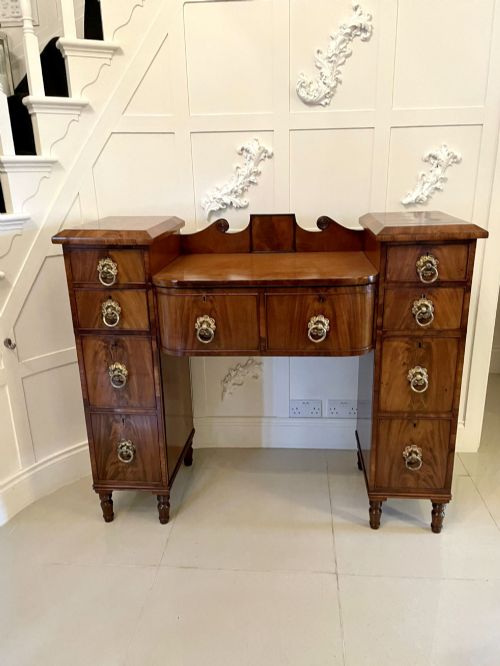
A regency period pedestal desk is a substantial workspace featuring twin supporting pillars and a central writing surface. These pieces emerge primarily from the nineteenth century, built during the Regency and George III or George IV eras. They provide grand architectural presence alongside practical drawers for correspondence and ledgers.
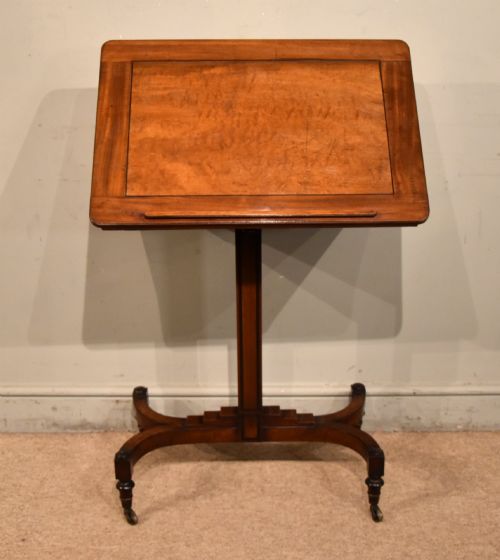
While the inventory encompasses diverse forms such as sofa tables, library tables, drum tables, and partners desks, the core of a pedestal desk design remains the two structural underpinnings. Mahogany forms the backbone of these surfaces, accompanied by rosewood, burr oak, and walnut. Buyers meet both single-sided writing desks and double-sided partners variations tailored for shared use.
The aesthetic draws heavily on classical lines, occasionally incorporating Chippendale style touches or brass inlay. Proportions range from diminutive models to large partners desks designed for central room placement. Every iteration reflects the disciplined symmetry characteristic of the period.
Materials and construction methods
Cabinet makers built these desks using dense tropical hardwoods, predominantly mahogany and rosewood, chosen for their stability and deep grain patterns. Burr oak and walnut also appear, offering varied figure and warmth. These timbers were expertly selected and applied as veneers over sturdy secondary woods like oak, or used in solid form for structural members.
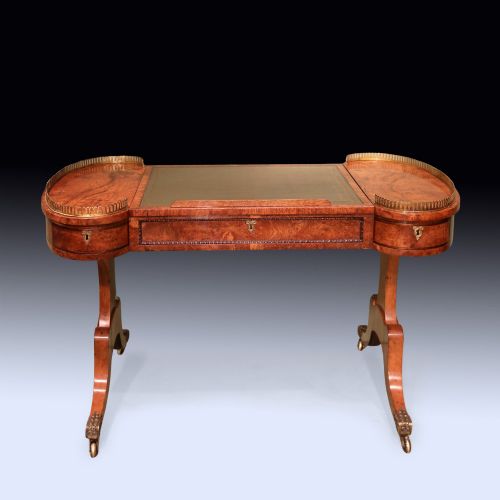
Decorative enrichment relied on precision craftsmanship rather than excessive ornamentation. Brass inlay, boxwood stringing, and parcel gilt accents catch the light against dark timber fields. Carved details such as lions paw feet or lyre ends required skilled hand-chiselling by specialist artisans.
Leather inserts provided a durable, smooth writing surface, often tooled with gold leaf borders. Drawer linings utilised secondary timbers like oak, joined with hand-cut dovetails that ensure enduring strength. Brass hardware, including handles and gallery rails, completed the construction.
The site listings feature desks and tables spanning the Regency, George III, George IV, and Victorian periods.
Markers of distinction and build quality
The distinction between ordinary and exceptional pieces rests upon the choice of timber and the quality of its figure. Desks constructed from highly figured mahogany, dense burr oak, or richly grained rosewood command greater appreciation. The grain alignment across multiple drawers demonstrates the maker's discipline and patience.
Carving and inlay execution separate standard production from masterwork output. Crisp hand-carving on structural elements like feet and pedestals displays depth and precision. Similarly, meticulously fitted brass inlay or delicate boxwood stringing indicates superior workshop standards.
Proportion and architectural harmony dictate desirability. Pieces maintaining balanced dimensions without clumsy overhangs or heavy-handed restorations retain their integrity. Original secondary timbers and undisturbed drawer construction further elevate the standing of a desk.
Gillows of Lancaster
The Regency Period Pedestal Desk Glossary
- Pedestal desk
- A freestanding desk comprising two supporting banks of drawers beneath a rectangular top. This form provides substantial storage while allowing the piece to sit centrally in a room.
- Partners desk
- A double-sided pedestal desk designed for two people to work opposite one another simultaneously. These large desks feature drawers and cupboards accessible from both long sides.
- Library table
- A large freestanding table used for reading and writing, equipped with frieze drawers. These pieces often feature finished backs so they appear presentable from any angle.
- Sofa table
- A small rectangular table traditionally placed in front of a sofa, featuring drop leaves at either end. They frequently incorporate double pedestal or trestle supports.
- Drum-top table
- A circular library table containing drawers around the frieze, mounted on a single central pillar and pedestal base. The top surface frequently rotates for ease of access.
Regency Period Pedestal Desk: Frequently Asked Questions
What is a partners desk?
A partners desk is a double-sided version of the pedestal desk built to accommodate two people working opposite each other. It contains matching banks of drawers and cupboards on both front and back faces.
These large desks were designed for use in professional offices, libraries, or grand country house studies where two individuals needed independent workspace.
How do I care for mahogany surfaces?
Maintenance requires regular dusting with a soft, dry cloth and the occasional application of traditional beeswax to nourish the timber. Avoid placing the desk near direct heat sources or strong sunlight to prevent the wood from drying out.
Leather writing inserts benefit from careful cleaning with specialised balms to keep the material supple and prevent cracking over time.
Are these desks suitable for daily use?
These pieces were originally built for intensive administrative work and remain exceptionally sturdy for modern writing tasks. Their solid timber construction and dovetailed drawers easily accommodate contemporary stationery and equipment.
Care should be taken with moisture and sharp objects to protect the historic polished finishes and leather work surfaces from accidental damage.
How do I identify Regency styling?
Regency design is characterised by clean classical lines, architectural symmetry, and inspiration drawn from ancient Greece and Rome. Decoration is typically restrained, utilising contrasting timber veneers, brass inlay, and carved elements like paw feet rather than heavy surface carving.
Proportions remain balanced and formal, reflecting the aesthetic standards of the early nineteenth century.