
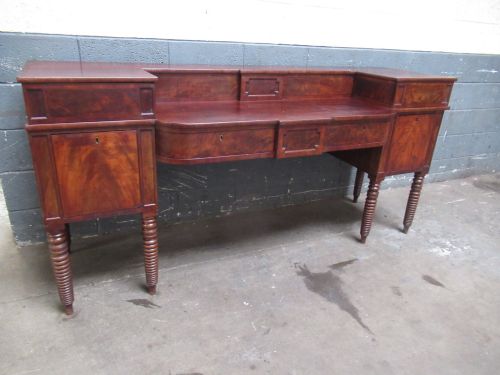
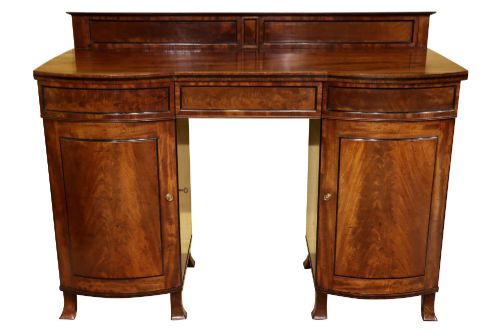
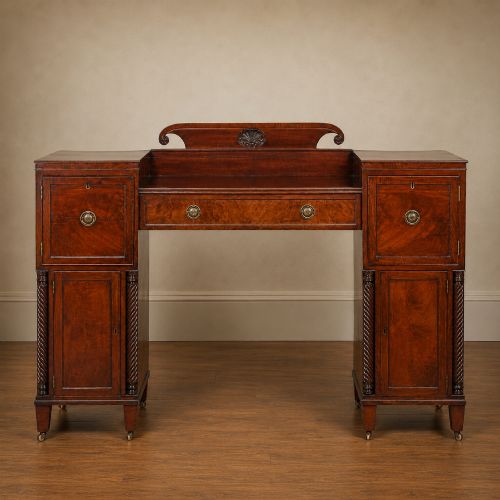
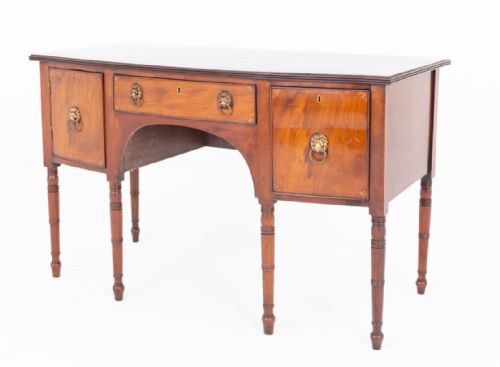

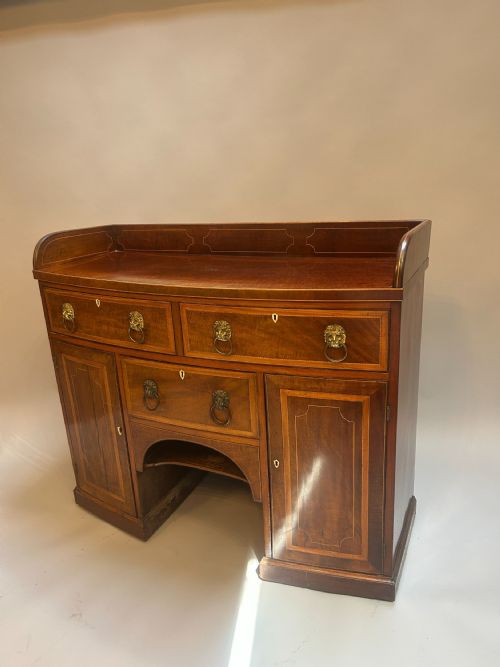
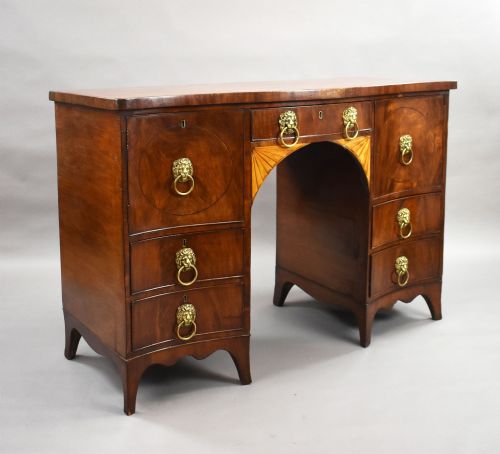


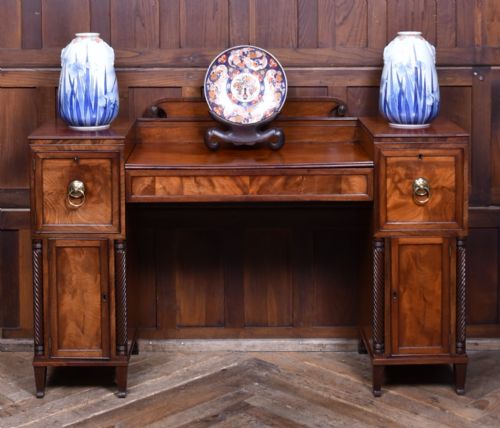
Regency Pedestal Credenza
A regency pedestal credenza or sideboard brings architectural dignity and generous timber grain into a formal dining room.
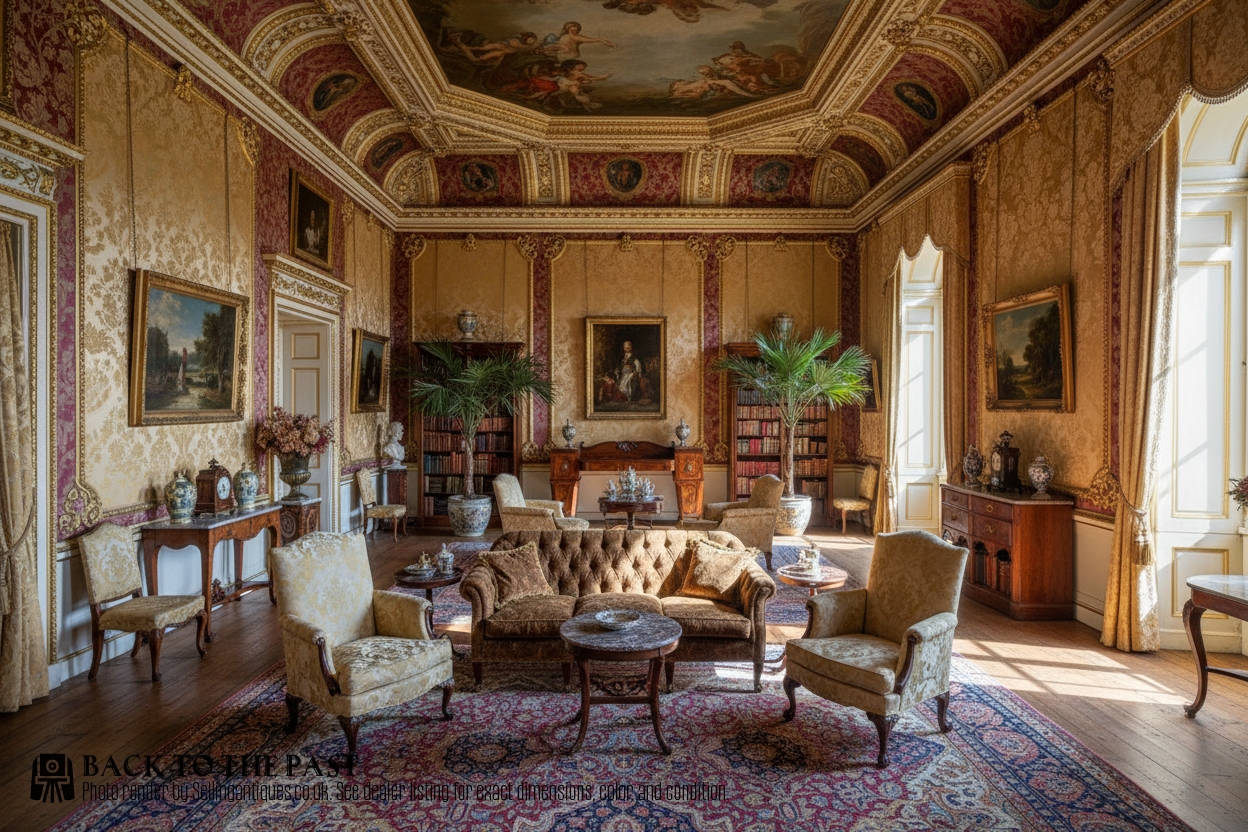
Regency Pedestal Credenza
A regency pedestal credenza is a substantial dining room furnishing featuring flanking pedestals connected by a central board or cabinet section. These pieces date principally from the nineteenth century, spanning periods such as Georgian, Regency, William IV, and George IV.
The versions most commonly found here are constructed from rich timbers with architectural proportions, often incorporating twin pedestals, brass galleries, or drop wells. They serve as impressive serving tables and storage units within traditional interiors.
Materials and construction methods
Cabinet makers utilised solid mahogany and flame mahogany veneer as the primary structural and visual surfaces, often selecting figured timber for maximum decorative impact. Secondary woods provided sturdy internal framing for the heavy pedestals.
Details were enhanced through contrasting inlay and stringing using satinwood, boxwood, and king-wood, alongside exotic woods like goncalo alves and rosewood. Cast brass galleries and mountings frequently crowned the upper tiers of these formal sideboards.
Listings feature nineteenth century cabinetwork executed in flame mahogany, goncalo alves, rosewood, and satinwood.
Assessing craftsmanship and distinction
Quality in a regency pedestal credenza rests upon the selection of timber figures, where symmetrical flame mahogany veneer elevates a standard carcase into a piece of high status. The depth of carved ornamentation, such as the classical motifs seen on William IV examples, indicates the maker's investment of time and skill.
Proportion and scale dictate the desirability of these large furnishings, with smaller chiffoniers or pedestal designs requiring precise balance. Integrated brass galleries and original fittings further separate standard utility pieces from high-status salon and dining room furniture.
Gillows·S. Jamar·Holland and Sons·H Mower and Stephenson
The Regency Pedestal Credenza Glossary
- Pedestal
- A structural support column or housing positioned at either end of a sideboard. These enclosed units often contain fitted cellarets or shelving.
- Flame mahogany
- A veneer cut from the fork of the mahogany tree to produce a dramatic, flickering grain pattern. It was favoured for high-status cabinet doors and drawer fronts.
- Brass gallery
- A decorative metal railing fitted along the upper rear edge of a sideboard. It prevented serving dishes from sliding off during use.
- Chiffonier
- A compact sideboard or low cabinet equipped with doors enclosing shelves. They frequently appeared in smaller proportions during the early nineteenth century.
Regency Pedestal Credenza: Frequently Asked Questions
What is a regency pedestal credenza used for?
These pieces served primarily as dining room server boards for organising food, silver, and glassware before and after meals. The pedestals frequently concealed compartments for cooling wine bottles or storing linens.
Today, they function as striking focal points in large dining rooms or hallways, offering substantial surface area and concealed storage capacity.
How do I tell Regency from William IV pieces?
Regency furniture tends to display refined classical restraint, drawing inspiration from ancient Greek and Roman forms with delicate brass inlay and subtle reeding. Proportions are generally lighter and more linear.
William IV pieces, by contrast, exhibit heavier, bolder proportions with robust carved scrollwork, lion paw feet, and deeply figured mahogany veneers that signal a transition towards Victorian tastes.
Where should I place a pedestal sideboard?
These substantial furnishings require ample wall space in a dining room, hallway, or spacious drawing room to accommodate their generous depth and twin pedestals. They command attention against a solid wall, often positioned opposite a dining table.
Ensure the room has sufficient clearance for the cabinet doors or pedestal compartments to open fully without obstruction from surrounding furniture.
How do I care for antique mahogany surfaces?
Maintain the timber by dusting regularly with a soft, dry cloth and applying traditional beeswax sparingly to nourish the grain. Avoid placing antique furniture in direct sunlight or near heat sources to prevent the veneer from drying and splitting.
Protect the polished top from moisture and heat by using coasters and placemats when utilising the credenza for serving food and drink.