


Regency Library Steps
Regency library steps offer a clever solution for reaching high bookshelves, combining practical height with ingenious folding mechanisms.
Regency Library Steps
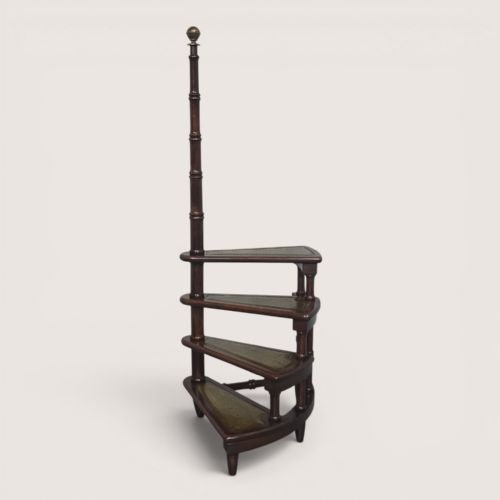
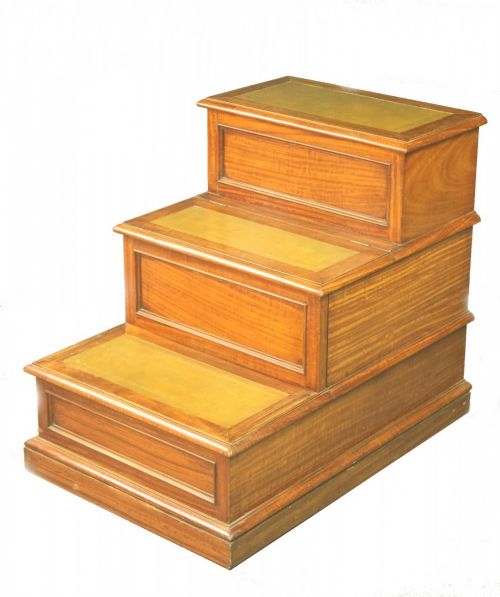
Regency library steps represent a specialised form of furniture designed to assist readers in accessing high shelves within a private library. These pieces appear in various configurations, ranging from stationary sets of steps to ingenious metamorphic designs that transform between armchairs, stools, and tables.
The pieces listed on this page span the Regency period alongside later interpretations from the nineteenth and twentieth centuries. Buyers frequently encounter traditional tiered sets as well as spiral forms and dual-purpose seating options.
Makers of the period adapted these practical items to suit elegant interiors, ensuring that utility met refinement. The surviving examples demonstrate how libraries required functional accessories disguised as fine furniture.
Construction and Materials
Makers constructed these steps primarily from mahogany, utilising the timber's density and deep colour for stability and visual appeal. Secondary timbers such as walnut and oak also appear in the historical record of these items.
Many treads feature inset leather surfaces, often tooled with gold leaf, providing grip and a refined appearance. Brass fittings and turned supports provide structural reinforcement while adding metallic contrast to the timber frames.
Retail Price Guide 2026
Typical UK retail prices for regency library steps, calculated from the Sellingantiques database of over a million retail prices indexed since 2003. This retail price guide relies exclusively on Sellingantiques data; no external sources or auction records are used, so the figures do not describe the wider market.
Listings on this site span the Regency period as well as later twentieth-century iterations, incorporating mahogany, cane, brass, and leather.
Judging Quality
Superior examples distinguish themselves through the precision of their joinery and the ingenuity of their mechanical actions. Metamorphic pieces that shift smoothly between configurations demonstrate a higher tier of cabinetmaking skill than static forms.
The choice of timber and the preservation of original leather treads influence the overall standing of a piece. Finer items retain crisp turnings on their supports and balanced proportions when extended or closed.
Gillows·Morgan and Sanders·Lodge and Co
The Regency Library Steps Glossary
- Metamorphic furniture
- Pieces designed to transform from one form of furniture into another, such as an armchair converting into a set of library steps. This ingenuity defined much of the intelligent design of the period.
- Tread
- The horizontal upper surface of a step upon which a person places their foot. These are frequently inset with leather in finer examples.
- Spiral steps
- A configuration of steps arranged around a central axis rather than in a straight ascending tier. This form saved floor space in cramped library alcoves.
- Turned support
- A vertical wooden column shaped on a lathe to provide structural bracing between the treads or frame. These add decorative detail to the otherwise utilitarian structure.
Frequently Asked Questions
How do metamorphic library steps work?
Metamorphic library steps utilise hinged frames and pivot points that allow the furniture to fold out into an ascending staircase from a compact stool or chair shape.
These clever mechanisms required precise cabinetmaking so the pieces could lock securely into position during use.
Were these steps only used in libraries?
While primarily designed for high bookshelves in domestic libraries, similar small steps served bedrooms as bed steps for climbing into high four-poster frames.
Their portable nature meant owners could move them between rooms as household needs dictated.
Are leather treads original?
Leather inserts on the treads frequently show replacement due to the heavy wear these surfaces endured from footwear over the centuries.
Original leather survives in exceptional cases, typically displaying characteristic craquelure and faded tones.
How do I distinguish Regency from later copies?
Period pieces from the Regency era display specific timber patination, hand-cut joinery, and traditional brass hardware characteristic of early nineteenth-century workshops.
Later nineteenth and twentieth-century interpretations often reveal machine-made elements and different internal construction methods.