

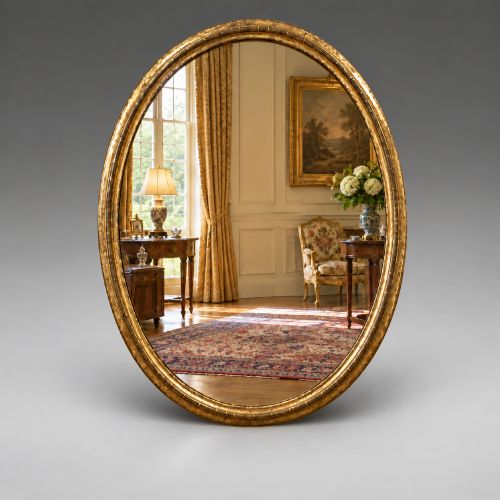
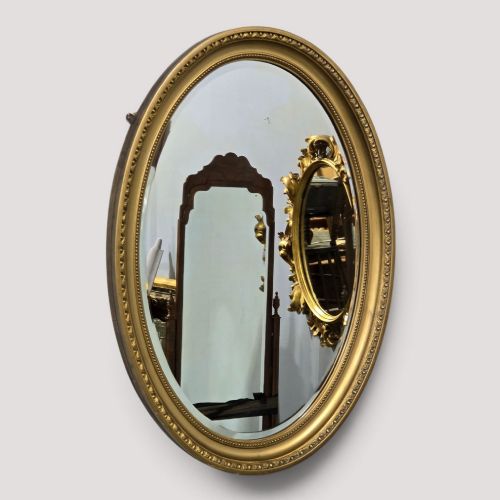
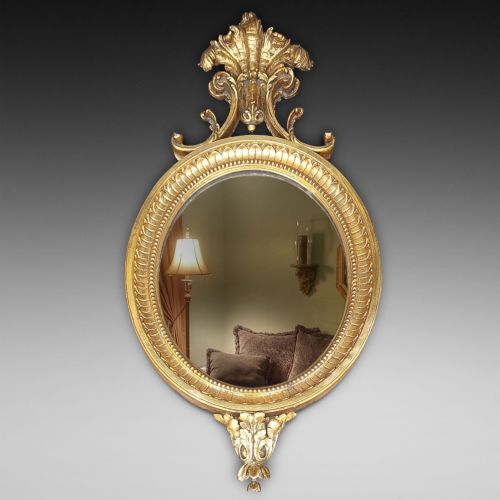
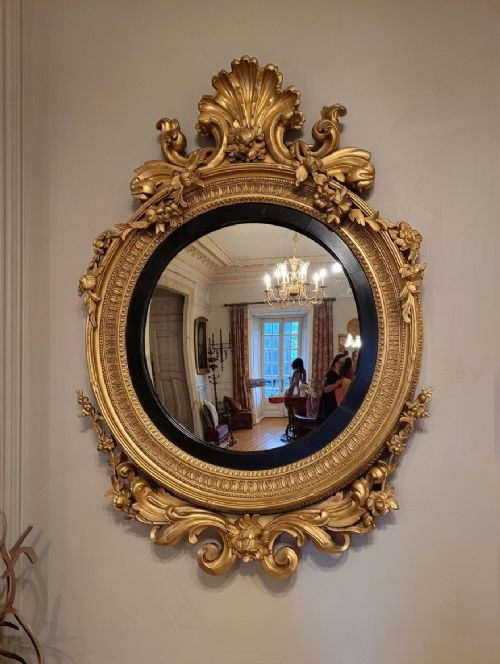


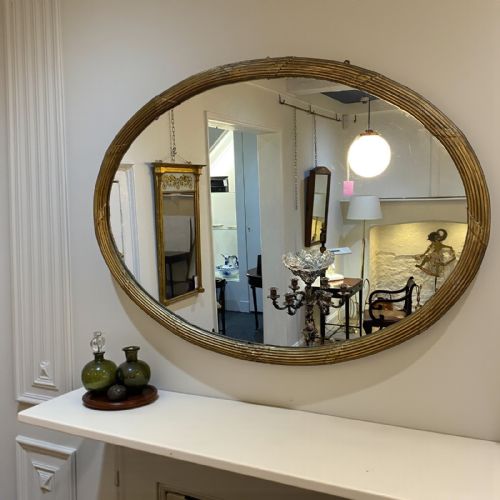
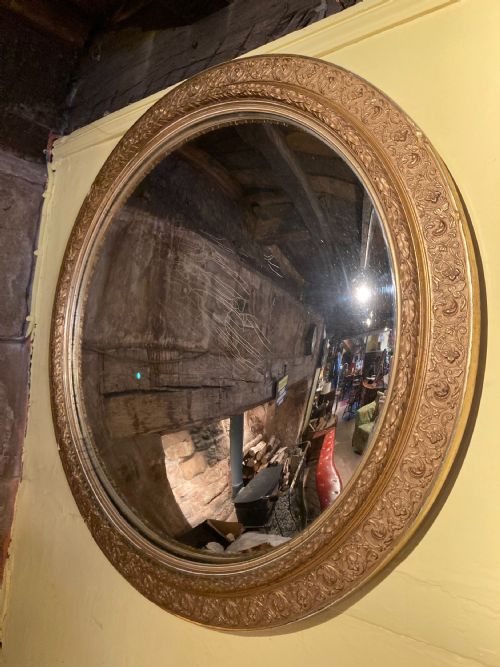


Regency Giltwood Oval Mirror
A regency giltwood oval mirror brings architectural presence and reflected light to a room, combining curved frames with brilliant surface gilding.
Regency Giltwood Oval Mirror
A regency giltwood oval mirror is a wall-hanging or overmantel glass framed in carved or moulded timber finished with gold leaf or composition ornaments. These pieces date principally from the nineteenth century, including works from the Regency period proper alongside later Victorian and Edwardian revivals.
The format ranges from small, hand-carved miniature pairs to large overmantel mirrors designed to sit above a fireplace. Forms include simple rope twist frames, models topped with carved eagles, and girandoles incorporating candle sconces.
Most examples encountered on this page belong to the broader nineteenth century, spanning original Regency manufacture down to late Victorian interpretations in the French Chateau and neoclassical styles.
How they were made
Frames are constructed primarily from pine or other native softwoods, often built up with gesso layers to receive fine details. Carved decoration and moulded composition details provide the characteristic relief work found along the borders.
Gilding is applied using gold leaf or metal leaf laid over a prepared bole, creating the reflective warm metallic sheen associated with the style. Original mirror glass, sometimes showing natural foxing, sits within the rebate behind secured wooden backs.
Regency Giltwood Oval Mirror Retail Price Guide 2026
Typical asking prices for regency giltwood oval mirror among the pieces listed under this phrase on Sellingantiques today, from the lower quarter to the upper quarter. They describe what is for sale here now, not the wider market.
Several miniature pairs on offer prove that even nineteenth-century makers appreciated the charm of hanging tiny gilded ovals in tight spots.
What varies in quality
The standard of a regency giltwood oval mirror depends on the depth and crispness of the hand-carved ornament versus moulded composition substitutes. Crisp undercut foliage, rope twists, and heraldic details indicate superior workshop execution.
The integrity of the original gilded surface dictates the visual impact of the piece. Surviving gold leaf with honest patination sits apart from later, heavy-handed overpainting that obscures the underlying detail of the gesso.
The Regency Giltwood Oval Mirror Glossary
- Giltwood
- Timber decorated with gold leaf applied over a prepared ground. This material forms the primary visual structure of these frames.
- Gesso
- A plaster mixture applied to wood frames to create a smooth surface for carving or moulding details. It accepts gilding exceptionally well.
- Overmantel mirror
- A large horizontal or vertical glass designed specifically for placement above a fireplace mantelpiece. These pieces often anchor the proportions of a principal reception room.
- Girandole
- A wall mirror featuring attached candle sconces that reflect candlelight into the room. They multiply the ambient illumination of nineteenth-century interiors.
- Composition
- A moulded mixture of whiting, resin, glue, and oil pressed into ornament strips. Makers utilised it to replicate intricate carvings efficiently.
Regency Giltwood Oval Mirror: Frequently Asked Questions
Where should I hang an oval mirror?
An oval mirror suits narrow wall spaces, hallways, or above a mantelpiece where the curved frame softens architectural angles. They work effectively when centered above a console table or chest of drawers.
Larger overmantel formats anchor the wall above a fireplace, while smaller pairs balance proportions on either side of a doorway or window.
How do I identify a true Regency mirror?
Look for construction markers typical of the early nineteenth century, such as old pine secondary woods, hand-cut screws, and original silvered glass with subtle distortion. True Regency frames often display crisp gesso work and genuine gold leaf rather than modern synthetic finishes.
Compare the style against later Victorian revivals, which frequently employ heavier composition ornaments and different backboard assemblies.
What is the difference between giltwood and painted gold?
Giltwood involves the application of extremely thin gold leaf over a prepared bole and gesso base, producing a warm, luminous metallic depth. Over time, genuine leaf wears softly to reveal the red or yellow undercoat beneath.
Painted gold uses metallic bronze powder suspended in a medium, yielding a flat, uniform sheen that lacks the dimensional complexity of true leaf.