

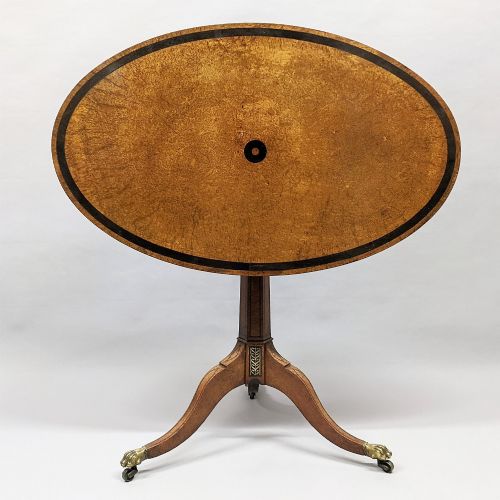


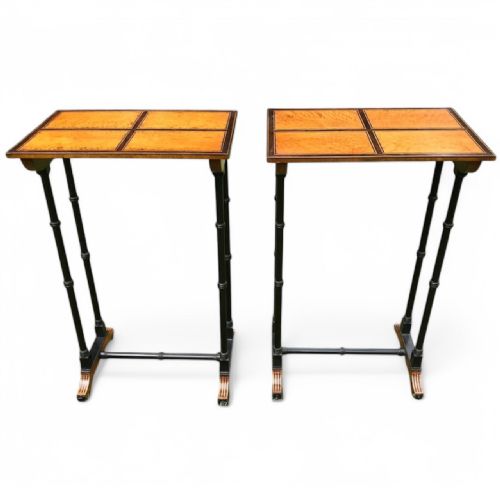


Regency Ebony Table
These pieces show how a regency ebony table combines rich tropical timber with disciplined English cabinet-making to anchor a formal room.
Regency Ebony Table
A regency ebony table covers a variety of forms designed for public rooms, from pembroke and sofa tables to games and centre pieces. The periods span the Regency and Georgian eras, alongside pieces simply catalogued as nineteenth century or around eighteen hundred.
Origins stretch from domestic English workshops to Anglo-Indian colonial production, giving a wide range of proportions and decorative schemes. Side and occasional tables appear frequently, often displaying precise line inlay or brass mounts.
How they were made
Constructed around substantial timber carcases, these pieces employ veneers of amboyna, satinwood, and macassar ebony fixed with traditional animal glues. Solid ebony elements appear alongside ebonised wood and contrasting stringing lines.
Cabinet-makers utilised brass ring handles, Greek key motifs, and finely mitred banding to accent the dark grain. Surface finishes rely on polished polish and oil rather than modern synthetics, preserving the depth of the wood.
Regency Ebony Table Retail Price Guide 2026
Typical asking prices for regency ebony table among the pieces listed under this phrase on Sellingantiques today, from the lower quarter to the upper quarter. They describe what is for sale here now, not the wider market.
The listings show a prominent use of satinwood and mahogany alongside ebony, creating strong tonal contrast across various table forms.
What varies in quality
The distinction between ordinary and superior work lies in the selection of the veneers and the precision of the stringing. Grain matching across hinged flaps and table tops reveals the skill of the original workshop.
Structural integrity of the pedestals, tripod bases, and brass mounts separates standard regional output from pieces attributed to major London cabinet-makers. The crispness of the inlay and the weight of the secondary timbers dictate the standing of each example.
L Vick of Stroud·Louis Recordon·Gillows·George Oakley·Marsh and Tatham·George Smith
The Regency Ebony Table Glossary
- Ebony
- A dense, heavy black or very dark brown heartwood yielded by various tropical trees. It provides a sharp visual contrast when used for stringing and banding on lighter woods.
- Stringing
- Thin inlaid lines of contrasting timber set into the surface of a panel or drawer front. This technique defines the edges and geometric panels of many tables.
- Banding
- A border of veneer laid around the perimeter of a table top, chosen to contrast with the central timber field. It often frames figured mahogany or satinwood.
- Tilt top
- A table mechanism allowing the surface to pivot to a vertical position when not in use. This clever space-saving device was popular for occasional and breakfast pieces.
- Sofa table
- A rectangular piece designed to stand in front of a sofa, fitted with drop leaves and twin pedestals or end supports. They typically feature small drawers for writing equipment.
Regency Ebony Table: Frequently Asked Questions
What rooms suit a regency ebony table?
These tables fit naturally into drawing rooms, libraries, and formal dining spaces where dark timber accents anchor the surrounding decor. Their compact forms also work well as lamp or console surfaces in hallways.
Because the materials are rich and dark, they contrast effectively against lighter walls and fabrics while offering practical surface space for everyday use.
How do I care for antique ebony veneer?
Maintain these surfaces by keeping them away from direct heat sources and strong sunlight, which can dry out old timber and brittle glue. Dust gently with a soft cloth and feed the wood periodically with appropriate wax.
Avoid using modern liquid polishes or silicone sprays, as they build up residue and can damage the historical finish of the surface.
How do I distinguish Regency from Georgian pieces?
Georgian examples often lean towards restraint and classical proportions, while Regency items embrace bolder contrasts, brass mounts, and exotic veneers like macassar and amboyna. The transition between the periods shows a gradual shift toward heavier neoclassical influences.
Examining the secondary woods and construction methods inside drawers helps clarify the exact manufacturing period of an unmarked table.
Were these tables used for dining?
Certain large formats, such as extending dining tables and breakfast tables, served specifically for meals. Smaller pembroke and sofa tables were designed for tea, reading, and needlework.
Many game and card tables accommodated evening entertainment, folding out to reveal baize-lined playing surfaces.