



Regency Eagle Girandole Mirror
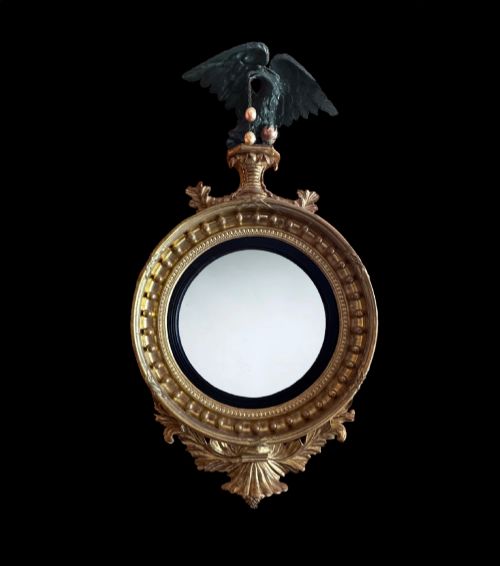
A regency eagle girandole mirror brings fierce neoclassical presence and warped spherical reflection into a room.
Regency Eagle Girandole Mirror
When searching for a regency eagle girandole mirror, a buyer seeks a convex wall glass set within a heavily moulded circular frame, often crowned by a carved bird. These objects emerge primarily from the Regency period, though later 19th Century iterations, Victorian examples, and 1920 revivals also appear across the inventory.
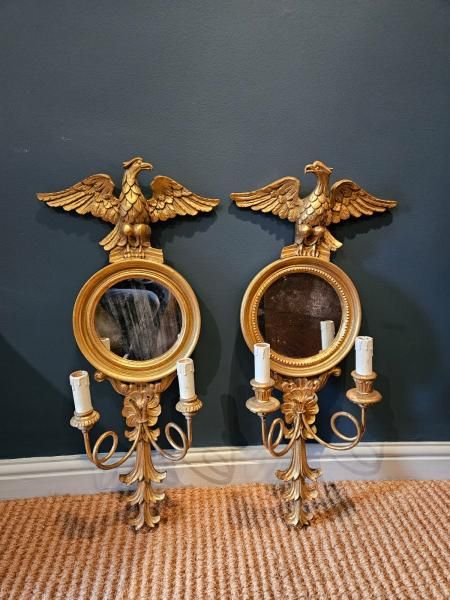
The dominant form takes a circular convex plate designed to throw panoramic light across an interior, frequently flanked by candle sconces. Examples on this page span straightforward wall mirrors, paired wall sconces, and grand carved giltwood centrepieces with heraldic eagle surmounts.
Most pieces seen here reflect the Regency, Grand Regency, and Regency Revival styles. They function as dramatic focal points, originally intended to monitor servants or illuminate grand dining rooms from a single wall.
Materials and construction
Makers built the primary structures from timber and gesso before applying gold leaf to achieve the characteristic bright metallic finish. Giltwood, ebonised wood, and brass elements combine with heavy mirror glass and occasional crystal drops to construct the frames and sconces.
Carvers shaped the decorative details by hand, creating complex foliage, reeded ebonised bezels, and the characteristic perched eagle surmounts. The convex glass plates were blown or cast to create the spherical distortion central to the optical effect of the piece.
Listings feature items from the Regency period through to 1920, utilising giltwood, ebonised wood, and brass.
Distinctions in quality
The depth and crispness of the wood carving separate standard framing from exceptional sculptural work, particularly in the rendering of the eagle wings and surrounding acanthus foliage. Superior examples display meticulous gilding over well-prepared gesso without heavy obscuring overpaint.
The integrity of the original convex glass plate heavily influences the stature of the piece, with period mercury silvering and minimal foxing commanding greater interest. Structural soundness in the joinery of the heavy circular frame and secure mounting for any attached candle sconces also define superior craftsmanship.
The Regency Eagle Girandole Mirror Glossary
- Girandole
- A wall mirror equipped with one or more candle branches or sconces attached to the frame. These arms project light outward into the room.
- Convex mirror
- A round mirror with an outward-curving surface that produces a wide, fisheye reflection of the entire interior space. It was often called a butler's mirror.
- Giltwood
- Timber coated with gold leaf applied over a prepared gesso ground. It provides a durable and brilliant reflective surface.
- Gesso
- A plaster-like mixture applied to wood frames to create a smooth base for carving and gilding. It allows for sharp decorative details.
- Ebonised wood
- Timber treated to imitate ebony, producing a dense black finish. This dark treatment frequently provides visual contrast against gilt mouldings.
Regency Eagle Girandole Mirror: Frequently Asked Questions
What is a girandole mirror?
A girandole mirror is a wall-hanging glass featuring integrated candle arms or sconces attached directly to the frame. These branches held candles to multiply the illumination in a room.
They combine practical lighting with decorative reflection, often positioned between windows to maximise available daylight.
How do convex mirrors work?
Convex mirrors curve outward toward the viewer, bending light rays to display a wide-angle, miniaturised reflection of the entire space. This optical property allowed people to observe a whole room from a single vantage point.
Historically, they were placed in public rooms or dining spaces for security and decorative impact.
Where should I hang these mirrors?
These pieces require solid wall fixings due to the considerable weight of the timber, gesso, and glass construction. They suit principal reception rooms, hallways, or above mantelpieces where their reflective capacity can expand the visual space.
Position them opposite a light source to make the most of their panoramic optical effect.
How do I date a convex mirror?
Dating relies on examining the construction methods of the timber frame, the composition of the gesso, and the characteristics of the mirror glass. Regency originals typically display period pine or hardwood carcasses with hand-carved detailing.
Later 19th Century and 1920 revival pieces often utilise machine-cut elements or different backing boards.