
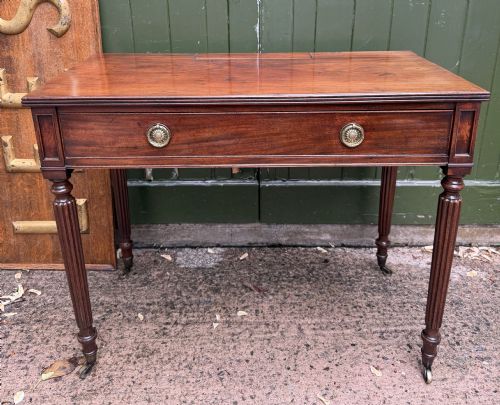


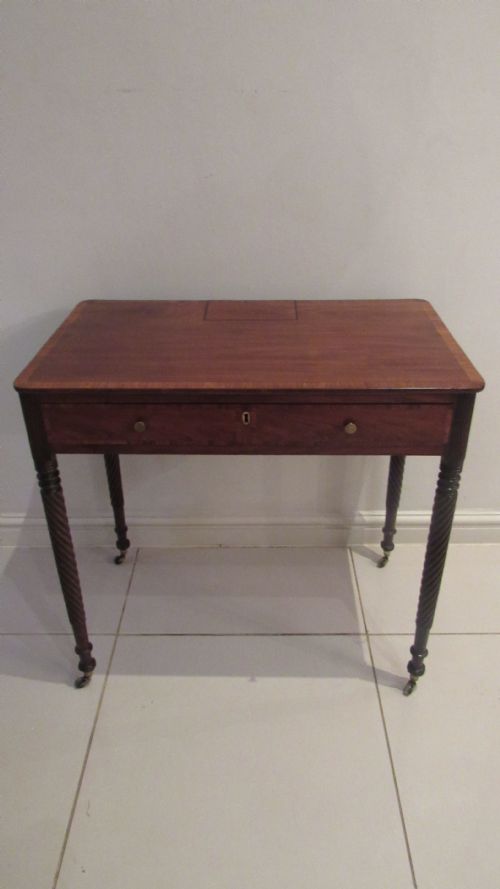


Regency Chamber Table
These regency chamber table pieces are compact writing and bedside items designed for private rooms, offering refined timber work and classic proportions that suit any period interior.
Regency Chamber Table
A regency chamber table typically serves as a compact writing desk or a specialised bedside piece created during the Georgian and Regency eras. Buyers searching for a regency chamber table frequently encounter mahogany examples featuring ebony banding or bow front designs.
The material palette spans standard and flame mahogany alongside oak, complemented by brass and silver plate hardware. These items originated primarily in the early nineteenth century under the aesthetic influence of makers such as Gillows of Lancaster.
Materials and construction
Makers utilised solid and veneered mahogany, frequently selecting flame mahogany to create striking grain patterns on top surfaces. Secondary timbers like oak appear in drawer construction, adhering to traditional cabinetmaking standards of the period.
Metal accents involve cast brass fittings, handles, and occasional ebony stringing to delineate edges and panels. Silver plate and copper also surface on related lighting and accessory forms associated with chamber use.
The listings span the nineteenth century, Georgian, Regency, and George IV periods, utilising mahogany, oak, brass, and ebony.
Markers of distinction
Quality rests in the choice of timber figures, where rich flame mahogany and precise ebony banding elevate an example above plain stock. Timber selection and grain matching across the top and drawer fronts demonstrate the cabinetmaker's skill.
Attribution to documented workshops like Gillows brings refined proportions and crisp detailing that distinguish superior pieces. The integration of functional elements such as hinged lidded pentrays further separates standard items from the finest examples.
Gillows of Lancaster
The Regency Chamber Table Glossary
- Ebony banding
- A thin strip of dark wood inlaid into the margins of a table top or drawer front to create a contrasting border. It defines the geometric outlines typical of Regency design.
- Bow front
- A convex curved cabinet front that swells outward at the centre. This curved form softens the linear profile of smaller chamber tables and commodes.
- Old Sheffield Plated
- A composite material formed by fusing a layer of silver to a copper base using heat and pressure. It appears on candlesticks and hardware dating from the eighteenth and nineteenth centuries.
Regency Chamber Table: Frequently Asked Questions
What is a regency chamber table?
A regency chamber table is a small-scale piece of furniture designed for use in a private bedroom or dressing room. These items often incorporate writing surfaces, drawers, or compartments for daily correspondence and personal effects.
Most examples date from the early nineteenth century and reflect the classicism of the Regency and George IV periods. Their compact proportions made them versatile additions to domestic chambers.
Are these desks or tables?
The terminology often overlaps, with pieces catalogued as writing tables, writing desks, or chamber tables depending on their specific internal fittings. Many feature leather-lined tops and stationary compartments suited to correspondence.
Their smaller footprint distinguishes them from large library tables, allowing them to function easily against walls or beside a bed.
How should I care for mahogany?
Mahogany benefits from stable room temperatures and protection from direct sunlight to preserve the depth of the timber colour and finish. Regular dusting with a dry, soft cloth maintains the surface without the buildup of heavy waxes.
Leather inserts require occasional gentle cleaning and conditioning to prevent the material from drying out over time.