

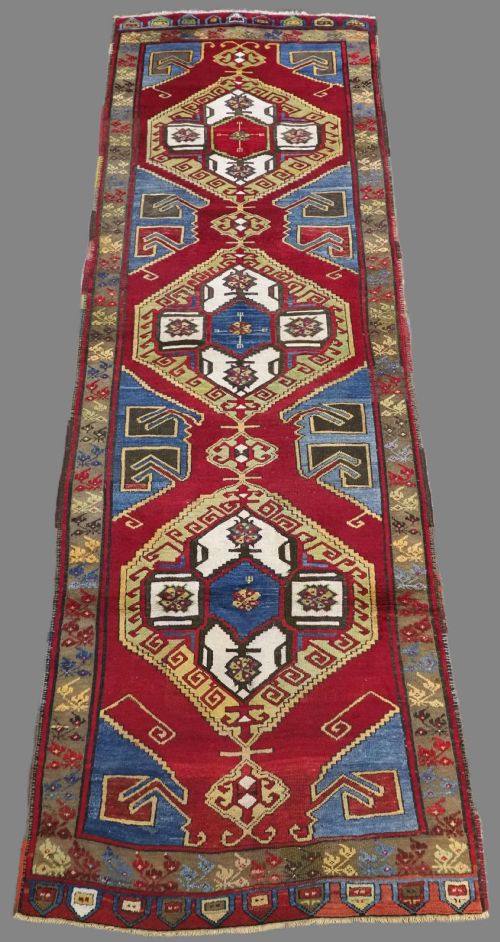


Red Turkish Long Rug
A red turkish long rug brings warmth and linear rhythm to a hallway, woven through traditions of Anatolian and Persian design.
Red Turkish Long Rug
When you search for a red turkish long rug, you enter a category defined by elongated floor coverings created in various regions of Anatolia. These pieces typically take the form of runners, narrow rugs, or long carpets designed to span corridors and large rooms.
The selections available here span from the late nineteenth century into the early decades of the twentieth century, including periods such as 1880, 1890, 1900, 1910, 1920, and 1930. The forms you are most likely to meet on this page are runner rugs and narrow floor coverings originating from traditional workshops and tribal weavers.
Design vocabulary across these examples draws heavily on Anatolian tribal, Anatolian traditional, and Persian tribal styles. Specific regional identifiers appear within the titles, pointing to origins such as Konya, Karapınar, Malatya, Yagcibedir, Taspinar, and Yuruk.
Materials and Construction
These textiles rely on fundamental natural materials recorded consistently across the inventory, utilising wool for the pile and foundation structures alongside cotton. Weavers built these long rugs by hand, employing traditional knotting and flatweaving techniques.
The construction methods encompass standard pile woven runners as well as half kilim kelim variations, where flatwoven sections combine with knotted pile areas. Regional weaving centres such as Yagcibedir and Taspinar apply distinct structural densities and handling of wool to achieve durable floor coverings.
Listings span production dates from the 1880s through the 1930s, constructed entirely in wool and cotton across regional Anatolian styles.
Evaluating Quality and Condition
Quality in these long rugs rests upon the integrity of the wool foundation, the precision of the tribal motifs, and the depth achieved in the red dye work. Examples described as distressed display historical wear that alters the pile height and softens the overall texture.
The distinction between standard execution and finer work lies in the clarity of regional attribution, such as Konya Karapınar or Yuruk pieces featuring defined medallion layouts. Variations in scale, from narrow corridors under sixty centimetres wide to grand runners exceeding four metres, dictate the presence and proportion of geometric ornament.
Konya Karapinar·Yagcibedir·Taspinar·Malatya·Yuruk
The Red Turkish Long Rug Glossary
- Runner
- A long, narrow carpet format specifically proportioned for corridors, hallways, and staircases. These pieces measure significantly longer than they are wide.
- Kilim
- A flatwoven textile produced without a pile, sometimes combined with knotted pile sections in hybrid runner formats. This technique creates a lighter, reversible fabric.
- Anatolian
- Pertaining to the geographical region of Asia Minor, encompassing numerous distinct weaving traditions and village workshops. This origin defines the primary cultural context for these rugs.
- Medallion
- A central ornamental motif incorporated into the field design of a rug, often repeated in linear sequences along long runners. Yuruk pieces frequently employ multi-medallion layouts.
Red Turkish Long Rug: Frequently Asked Questions
Where should I place a long runner?
These narrow formats suit hallways, long corridors, and bedside spaces where linear floor coverage is required. Their proportions draw the eye down a passage while protecting high-traffic wooden floors.
Ensure you measure the clear floor space carefully, allowing adequate clearance for doors to swing freely over the wool pile.
How do I care for an antique wool rug?
Regular gentle vacuuming without a rotating brush roll prevents dust accumulation within the wool foundation. Address spills immediately by blotting with a clean, dry cloth rather than rubbing the fibres.
Professional cleaning tailored to antique textiles preserves the integrity of the natural dyes and wool structure over decades of use.
What does a distressed finish mean?
A distressed description indicates historical wear, sun fading, or low pile resulting from age and active use. This condition softens the visual impact of the reds and blues, creating a muted aesthetic.
Such examples offer a relaxed appearance that integrates easily into contemporary interiors without demanding excessive caution in daily use.
How do regional styles differ?
Regions such as Yagcibedir, Taspinar, and Konya utilise distinct palettes, knot densities, and geometric vocabulary passed down through generations. Village and tribal weavers incorporated local symbols and structural habits into each runner.
Examining the border arrangements and medallion structures helps identify the specific Anatolian district where the textile originated.