
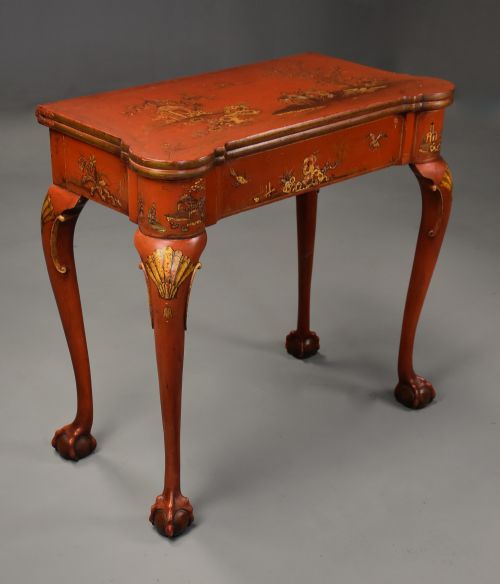


Red Painted Occasional Table
These red painted occasional table examples bring rich colour and varied cultural motifs into a room, offering both practical surface space and distinct decorative character.
Red Painted Occasional Table
A red painted occasional table encompasses forms such as side tables, nests of tables, games tables, and centre tables originating from the eighteenth century through to the early twentieth century. You encounter regional interpretations ranging from English country pieces to Italian revival and Swedish rococo designs, alongside exotic variations influenced by Asian and colonial aesthetics.
The version you are most likely to meet on this page is the nineteenth century Chinoiserie decorated lacquer nest of four tables or a similar Asian-influenced side table. These pieces employ striking red pigment and lacquer surfaces that immediately draw the eye within domestic interiors.
Earlier Georgian and eighteenth century lamp tables appear alongside later Victorian and 1920s examples, showing that makers returned to red painted finishes across multiple generations. Each form serves a specific function, from holding a lamp to providing modular surfaces when entertaining guests.
Materials and construction methods
Constructed primarily from wood, these tables rely on skilled application of paint, lacquer, pigment, and gesso to build up rich, layered surfaces. Artisans applied successive coats of red lacquer or polychrome pigment, often incorporating gilt highlights to accentuate decorative motifs.
Specialised techniques varied by region, with English, French, and Italian workshops employing traditional joinery alongside applied lacquer work, whilst Burmese and Indian examples utilise regional lacquer traditions on native timber bases. Brass fittings and hardware appear selectively on functional forms like games tables and nests.
Listings feature periods spanning from the eighteenth century through the Victorian era and up to 1920, utilising wood, lacquer, paint, gesso, and gilt.
Assessing quality in decorative tables
Quality reveals itself in the depth and execution of the surface decoration, distinguishing master-applied lacquer and polychrome work from simpler painted finishes. The crispness of Chinoiserie detailing, the finesse of gilt work, and the stability of the underlying wood construction determine the standing of each piece.
Finer examples demonstrate harmonious proportions and careful handling of pigment that ages gracefully over centuries, whilst simpler provincial pieces rely on rustic charm and straightforward utility.
The Red Painted Occasional Table Glossary
- Chinoiserie
- European artistic interpretation of Chinese and East Asian artistic traditions, popular in furniture decoration. This style frequently employs red lacquer and gilt motifs on occasional tables.
- Gesso
- A plaster mixture applied to wood as a smooth base for painting and gilding. It provides the foundation for intricate relief work on decorative tables.
- Lacquer
- A clear or coloured varnish applied in multiple coats to wood and cured to a hard finish. Asian and European variations create glossy, durable red surfaces.
- Polychrome
- Decorated in multiple colours. This technique appears on Italian revival and nineteenth century occasional tables.
- Nest of tables
- A set of graduated tables designed to fit neatly beneath one another. They provide flexible surface space in principal rooms.
Red Painted Occasional Table: Frequently Asked Questions
What is an occasional table used for?
An occasional table provides a movable, secondary surface in a room for holding lamps, books, or drinks when needed. Their modest proportions allow them to sit beside seating or in corners without dominating the floor plan.
Historically, specific forms like games tables or nests served multi-functional roles during social gatherings, easily repositioned around a drawing room.
How do I date a painted table?
Dating relies on examining the timber construction, tool marks, and the chemical composition of the paint or lacquer layers. Stylistic indicators like Chinoiserie motifs or Italian revival details also point to specific manufacturing eras from the eighteenth century onward.
Wear patterns and the natural ageing of gesso and pigment offer further clues to a piece's true age and origin.
Where should I place a red lacquer table?
These tables thrive as focal points in neutral rooms where the vibrant red pigment can stand out against plain walls. Placing them beside neutral sofas or in hallways draws the eye and warms the interior.
Avoid positioning antique lacquer directly in strong, prolonged sunlight to preserve the richness of the pigment and prevent surface fading.
How do I care for painted wood furniture?
Maintenance requires gentle dusting with a soft, dry cloth and avoiding modern chemical polishes that can damage historic lacquer or paint. Keeping tables away from direct heat sources and drastic humidity changes protects the wood and gesso foundation.
Treating the surface with care ensures the delicate gilt and polychrome details remain intact for future generations.
What distinguishes Chinoiserie from standard painted furniture?
Chinoiserie specifically imitates East Asian artistic motifs, featuring landscapes, figures, and architectural elements rendered in lacquer and gilt. Standard painted furniture often relies on European floral patterns, geometric designs, or plain polychrome decoration.
The inclusion of raised lacquer work and distinctive Oriental styling separates Chinoiserie tables from purely Western decorative traditions.