



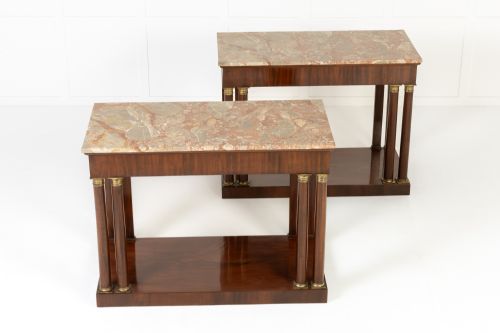


Red Mahogany Console Table
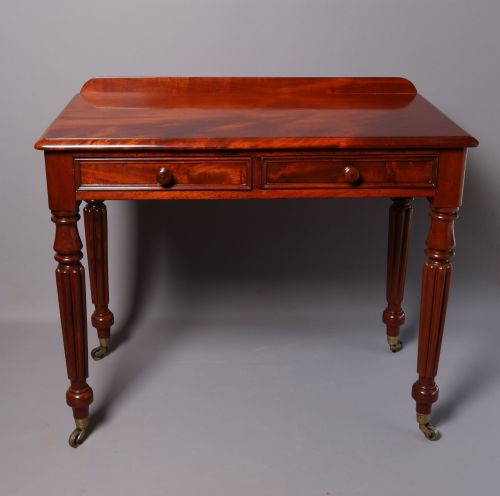
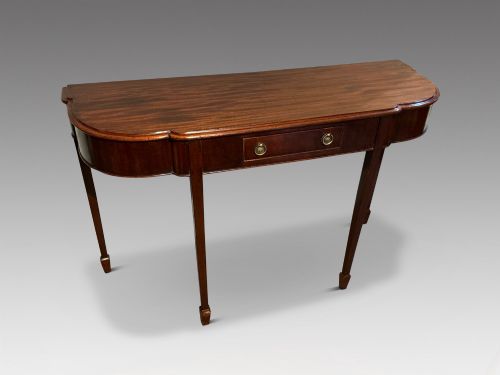
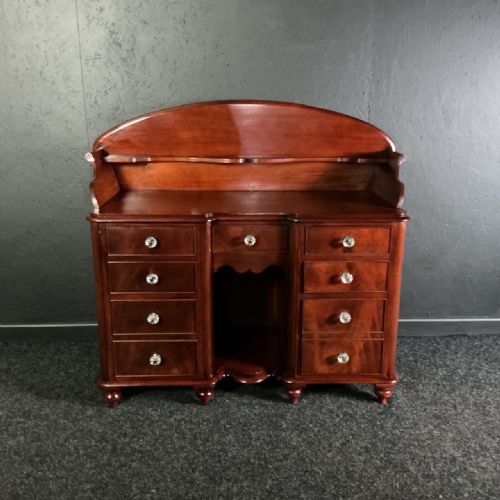
These red mahogany console table examples bring rich timber grain and classic proportion into a room, offering both surface space and historical presence.
Red Mahogany Console Table
A red mahogany console table provides a narrow surface suited to halls, living rooms, and dining spaces. These pieces appear across Georgian, Victorian, and Edwardian periods, manifesting in forms such as demi-lune shapes, side tables, and occasional furniture.
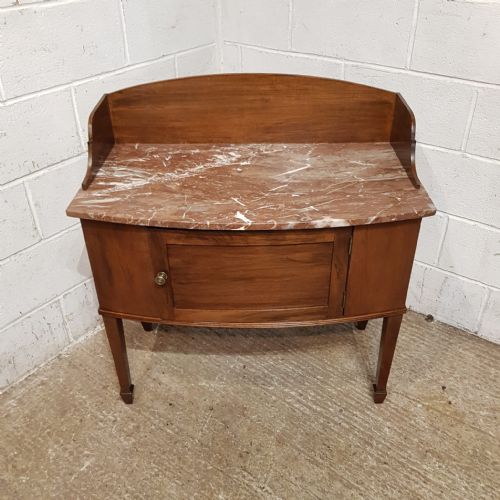
The version most commonly encountered on this page combines a rich reddish timber surface with period characteristics like single drawers, drop leaves, or marble tops. They serve primarily as display surfaces or serving pieces against interior walls.
Makers adapted these forms across centuries, producing straight fronts, serpentine curves, and folding table tops that convert from compact consoles into dining or tea tables.
Materials and construction methods
Makers relied on solid mahogany and figured mahogany veneers to achieve deep red tones and striking grain patterns. Cabinetmakers enhanced surfaces with secondary timbers like satinwood and boxwood inlay.
Structural elements frequently incorporated brass hardware, marble inserts, and gilded mounts, particularly on Regency and French Empire examples. Joinery techniques varied from simple dovetailed drawers to complex folding mechanisms for card and tea tables.
Listings feature 19th-century, Georgian, and Victorian periods alongside materials such as marble, brass, and flame mahogany.
Factors influencing distinction
The visual impact depends heavily on the choice of timber, with highly figured flame mahogany and matched pairs commanding greater attention than plain variants. Precision in edge shaping, such as crisp pie-crust borders or smooth serpentine curves, distinguishes finer cabinetwork.
Integration of secondary materials like inset marble tops and refined brass mounts elevates the overall execution. Original hardware and undisturbed surface patination contribute significantly to the integrity of each piece.
James Shoolbred
The Red Mahogany Console Table Glossary
- Demi-lune
- A half-moon shape popular for console tables designed to sit flat against a wall. This profile allows the piece to occupy minimal floor space.
- Flame mahogany
- A veneer cut from timber where the grain resembles flickering flames, prized for its dramatic pattern. Cabinetmakers reserved this timber for prominent surfaces.
- Serpentine
- A gently undulating curved line featuring a convex centre flanked by concave sides. This shape adds visual movement to table fronts.
- Ormolu
- Gilded bronze mounts applied as decorative ornaments to furniture surfaces. French and Regency pieces frequently use this technique.
- D-end
- A table end shaped in the form of a capital letter D, allowing multiple sections to join together for dining.
Red Mahogany Console Table: Frequently Asked Questions
Where should I place a console table?
These tables fit naturally in entrance halls, long corridors, or against living room walls where floor space is limited. Their narrow profile provides a convenient surface for lamps and decorative objects without obstructing pathways.
Pairs of demi-lune consoles also function effectively as serving tables in dining rooms or combine into larger dining surfaces when equipped with drop leaves or folding tops.
How do I identify a Georgian console table?
Georgian examples typically display restrained classical proportions, straight or tapering legs, and solid mahogany construction with minimal ornamentation. Drawer linings and secondary timbers of the period help confirm the era.
Later revival pieces from the Victorian and Edwardian periods often replicate these forms but can exhibit different internal construction methods and timber selections.
Can these tables be used for dining?
Many examples designed with folding mechanisms, D-ends, or tea table tops were specifically engineered to expand for dining use. Single console tables remain primarily decorative or functional surface furniture.
Reviewing the mechanism of folding tops reveals whether a piece was built to support occasional conversion into a dining surface.
What maintenance does mahogany require?
Mahogany benefits from occasional dusting with a soft cloth and treatment with traditional beeswax to preserve the timber moisture and lustre. Direct sunlight and excessive heat sources should be avoided to prevent veneer cracking.
Marble-topped variants require mild soap and water for stone cleaning while keeping liquids away from the wooden frame.