
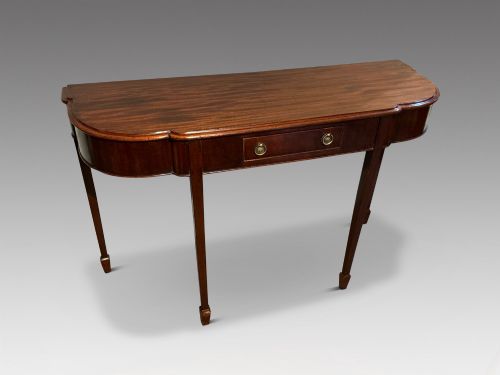
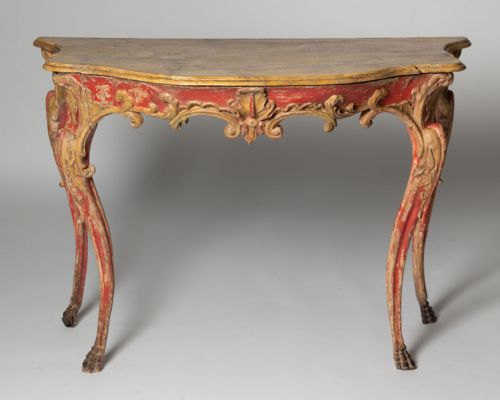


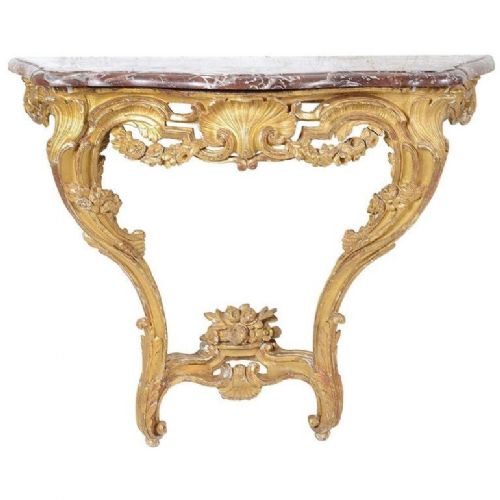


Red Entry Console Table
A red entry console table brings a striking punch of colour and historical character to a hallway.
Red Entry Console Table
A red entry console table is a narrow surface designed to stand against a wall in a hallway, corridor or reception space. The listings for this search phrase comprise console tables, side tables and hall tables dating from the eighteenth and nineteenth centuries.
The examples available range across multiple geographical origins and design traditions, including Georgian, Qing Dynasty, Italian Rococo and Italian Neoclassical styles. Buyers are most likely to encounter nineteenth-century interpretations alongside eighteenth-century works.
These tables serve primarily as decorative anchor pieces in an entranceway, often topped with marble or finished in rich lacquer. Their narrow proportions allow them to sit flush against domestic walls without obstructing movement.
How they were made
Makers constructed these tables from solid timbers such as mahogany and carved wood, applying surface treatments like gesso, gold leaf and red lacquer. Italian neoclassical and French rococo examples frequently feature elaborate carved giltwood frames supporting heavy marble slabs.
Asian export pieces utilise traditional lacquer techniques on wood, emulating earlier Kangxi period designs with vibrant red finishes. European pieces often combine painted wood surfaces with faux porphyry and marble to create rich contrasting textures.
The current selection spans the eighteenth and nineteenth centuries, featuring mahogany, carved wood, gesso, gold leaf, marble and red lacquer across Georgian and Qing Dynasty styles.
What varies in quality
Quality in these tables rests upon the crispness of the carved details and the depth of the surface finish, whether in the layering of red lacquer or the application of gold leaf over gesso. Finer pieces demonstrate superior control in wood joining and stone mason work for the marble tops.
The sophistication of the stylistic execution distinguishes standard regional work from high-style Italian neoclassical or George III craftsmanship. Proportion and balance in the carved wooden frames dictate the visual success of each piece.
The Red Entry Console Table Glossary
- Console table
- A table designed to be fixed against a wall, traditionally supported by two front legs and secured by brackets at the rear. These pieces are intended for display in formal entryways and reception rooms.
- Giltwood
- Timber that has been coated with a thin layer of gold leaf or gold powder over a prepared gesso ground. This technique creates a luminous, reflective surface popular in eighteenth-century European furniture.
- Lacquer
- A durable finish applied in multiple thin layers to wood surfaces, originating in Asian decorative arts and widely imitated in European furniture. It produces a smooth, glossy red or black coating.
- Porphyry
- A hard igneous rock with large crystals, highly prized in antiquity and imitated in later decorative painting to lend an air of classical grandeur to tabletops.
- Rococo
- An ornate design style characterised by asymmetrical scrolls, shell motifs, and naturalistic curves that flourished in Europe during the eighteenth century.
Red Entry Console Table: Frequently Asked Questions
Where should I place a console table?
These narrow tables suit entrance halls, corridors and living rooms where floor space is limited. They fit flat against walls to display lamps, mirrors or decorative objects without blocking walkways.
Positioning one near an entrance creates a practical drop-off surface as well as an immediate visual focal point for visitors entering the home.
How do I care for a lacquered table?
Lacquered surfaces require gentle dusting with a soft, dry cloth to prevent scratching the delicate finish. Avoid placing damp items or direct heat sources directly onto the wood.
Keep these tables away from direct sunlight to preserve the richness of the red pigment over time.
What is the difference between a console and a hall table?
Console tables traditionally rely on wall brackets for additional stability alongside their front legs, whereas hall tables stand entirely on their own four legs. Both share narrow proportions suited to transitional spaces.
Historical examples often use the terms interchangeably depending on the formality of the room they occupied.
How can I tell an eighteenth-century piece from a nineteenth-century one?
Dating relies upon examining the construction methods, tool marks on the underside of the timber, and the ageing patterns of the gesso or lacquer. Eighteenth-century pieces typically show hand-cut joinery and period-specific carving profiles.
Nineteenth-century works often reproduce earlier styles like the Kangxi period or Georgian aesthetics while exhibiting nineteenth-century joinery techniques.