




Red Carnelian Seal
These red carnelian seal pieces are wearable archives of personal history, prized by collectors for their deeply carved intaglios and lustrous stones.
Red Carnelian Seal
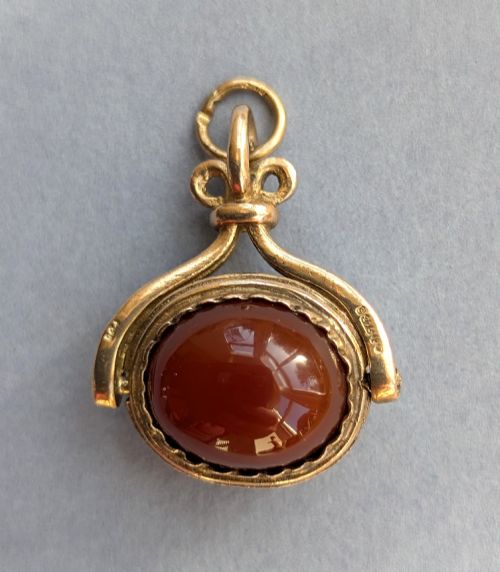
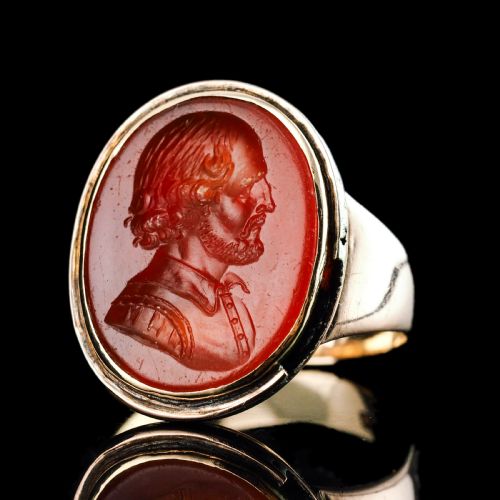
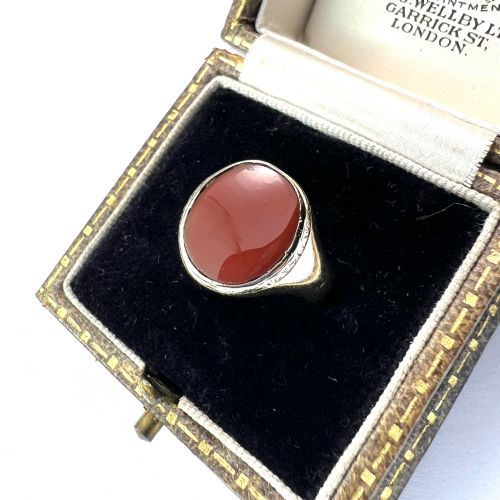
A red carnelian seal is a historical object designed for impressing wax, most frequently encountered here as a fob, pendant, or ring. These pieces originate from the eighteenth and nineteenth centuries, spanning the Georgian and Victorian eras.
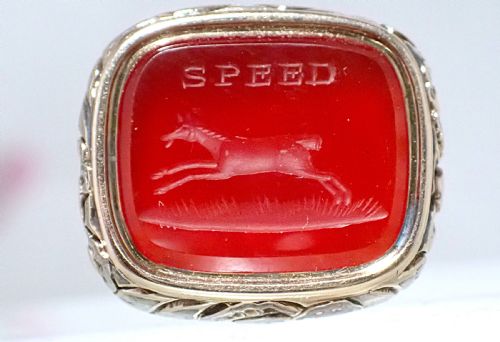
The forms on this page range from small swivel pendants to substantial gold signet rings. Each item centres on the distinctive reddish-orange chalcedony stone, historically cut with intaglio designs such as portraits, crests, or mottoes.
How they were made
The construction of these seals relies upon the pairing of hard stone with precious or base metals. Craftsmen shaped carnelian and cornelian into polished cabochons or flat faces before hand-carving intricate intaglio motifs into the surface.
Metal mounts were forged to house the stones securely, utilising 9ct gold, 18ct gold, gilt metal, or gold cased metal. Many items feature swivel mechanisms or intricate wirework typical of Georgian and Victorian goldsmithing.
Red Carnelian Seal Retail Price Guide 2026
Typical asking prices for red carnelian seal among the pieces listed under this phrase on Sellingantiques today, from the lower quarter to the upper quarter. They describe what is for sale here now, not the wider market.
The current selection spans the eighteenth and nineteenth centuries, encompassing both Georgian and Victorian design idioms.
What varies in quality
Quality in these pieces is defined by the precision of the stone carving and the substance of the metal mount. Crisp execution of an intaglio portrait or heraldic device marks the distinction between standard production and masterwork carving.
The choice of material also dictates the grade of the piece, moving from gilt or gold cased metal up to solid 9ct and 18ct gold settings. Heavier metal gauge and sophisticated swivel engineering elevate the overall character of the seal.
The Red Carnelian Seal Glossary
- Carnelian
- A brownish-red variety of the mineral chalcedony, traditionally polished smooth and used for signet rings and fobs. It provides a durable surface for detailed intaglio carving.
- Intaglio
- A gem or stone carved in reverse so that when pressed into sealing wax, it produces a raised relief impression. This technique was standard for personal signatures and crests.
- Fob seal
- A small pendant attached to a pocket watch ribbon or chain, featuring a hardstone matrix at the base for stamping wax. They were essential accessories in Georgian and Victorian daily dress.
- Gold cased metal
- A composite material formed by fusing a layer of gold to a base metal core, common in nineteenth-century jewellery production. It offered the appearance of solid gold with greater structural rigidity.
- Swivel pendant
- A mounting design that allows the central seal to rotate on a central axis, often displaying two different faces or a stone on one side and a locket compartment on the reverse.
Red Carnelian Seal: Frequently Asked Questions
What is a red carnelian seal used for?
These pieces were originally utilised to stamp hot sealing wax on correspondence and legal documents, serving as a personal signature.
Today, collectors wear them as rings or suspend them from chains as pendants and fob charms.
How do I date a Georgian seal?
Georgian seals typically display characteristic hand-carved intaglios, closed-back settings, and distinctive neoclassical motifs reflecting the eighteenth and early nineteenth centuries.
Examining the metalwork techniques and the style of the engraved portrait or lettering helps narrow down the production period.
Are these seals made of solid gold?
The listings include a mixture of solid precious metals and alternative compositions. Pieces are variously forged from 9ct gold and 18ct gold.
Other examples utilise gilt metal or gold cased metal over a base core, which was common practice for durable daily accessories.
Can I still use the seal for wax?
Most seals retain their original carved stone matrix intact, featuring reversed initials, crests, or figural intaglios.
They remain fully capable of impressing warm sealing wax, provided the stone surface is handled with care.