







Red Balkan Wool Rug
A red balkan wool rug brings centuries of regional weaving traditions into a modern room through bold geometric patterns and deep madder dyes.
Red Balkan Wool Rug
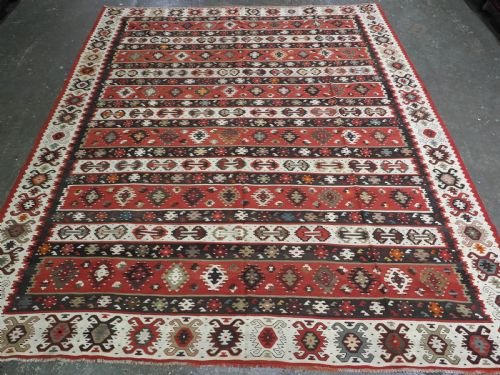
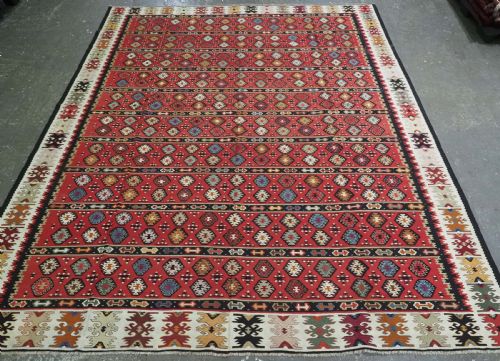
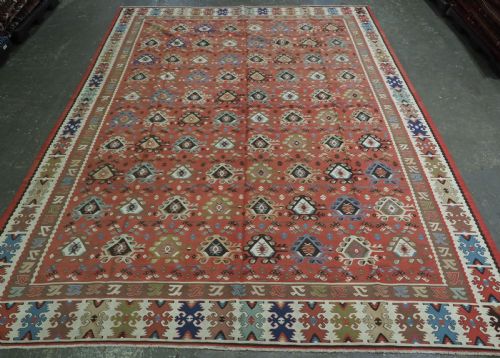
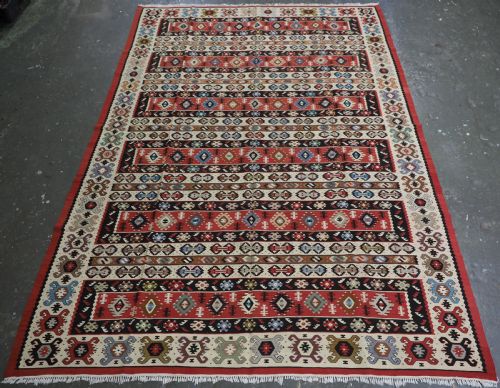
A red balkan wool rug encompasses flatweave kilims and knotted prayer rugs originating from nineteenth and early twentieth century centres such as Pirot, Sarkoy, Monastir and Thrace. These pieces emerge from Ottoman and Balkan folk traditions, displaying classic banded, lattice, flowering tree and repeat medallion layouts.
The version most commonly encountered on this page is the Sarkoy or Pirot kilim, typically dated around 1920. These flatweaves rely heavily on striking red grounds combined with traditional motifs passed down through generations of village weavers.
Materials and construction
These floor coverings are constructed primarily from natural wool yarns spun by hand and dyed using traditional methods to achieve varied red, soft and pastel tones. Cotton frequently serves as a sturdy foundation or warp material to support the heavier wool weft face.
Weavers employ slit-weave and banded tapestry techniques to create sharp geometric boundaries between distinct colour blocks without introducing bulk. This flatweave method produces a reversible textile that withstands heavy foot traffic while maintaining crisp visual patterns.
Village weavers occasionally hid small intentional asymmetries in repeating borders to ward off bad fortune.
Assessments of standard
The upper tier of these textiles is distinguished by the clarity and saturation of the red dye, alongside the precision of the geometric repeat or lattice arrangement. Superior examples demonstrate a careful balance between the dominant red field and secondary motifs.
Design complexity and scale also differentiate the output, with large room sizes and scarce medallion compositions demanding greater technical skill from the weaver. Pieces displaying harmonious soft palettes and crisp traditional layouts represent the higher echelon of surviving material.
The Red Balkan Wool Rug Glossary
- Kilim
- A flatweave textile produced without a pile by tightly interweaving warp and weft threads. This technique results in a thin, durable rug with smooth sides.
- Pirot
- A specific town and weaving centre known for producing finely detailed flatweave rugs with intricate geometric motifs. These pieces often feature distinct border arrangements and balanced symmetry.
- Sarkoy
- A geographical origin associated with Balkan flatweaves traded through Ottoman markets. Such pieces frequently display banded or floral tree designs.
- Warp
- The stationary vertical threads stretched on a loom that form the structural foundation of the rug. Cotton is commonly utilised for this purpose in Balkan weaving.
- Weft
- The horizontal coloured threads passed through the warp to create the visible pattern and surface design. Wool is the primary material selected for these strands.
Red Balkan Wool Rug: Frequently Asked Questions
How do I clean a wool kilim?
Gentle surface brushing and regular light vacuuming without a beater bar help maintain the wool fibres. Professional textile cleaning is recommended for deeper maintenance to protect natural dyes.
Water saturation should be avoided to prevent dye migration or shrinkage in the antique cotton and wool structure.
Where were these rugs made?
Production centres span the historical Balkan regions, including Pirot, Sarkoy, Monastir and Thrace. Weavers in these towns and villages produced flatweaves influenced by Ottoman design traditions.
Specific towns often developed distinct visual signatures, such as banded layouts or repeated medallion motifs.
Are these rugs reversible?
Flatweave kilims lack a raised pile, meaning both sides display the woven pattern clearly. This construction allows the rug to be flipped periodically to distribute wear evenly.
Initial weaving threads are neatly tucked away, making the reverse side nearly identical to the face.
How do I date a Balkan rug?
Dating relies on stylistic analysis, material evaluation and comparison with documented regional design archives. Dyes, wool preparation methods and specific structural motifs offer clues to whether a piece originates from the nineteenth or early twentieth century.
Most surviving examples on this page cluster around the decades leading up to and following nineteen twenty.