


Recording Barograph Drum
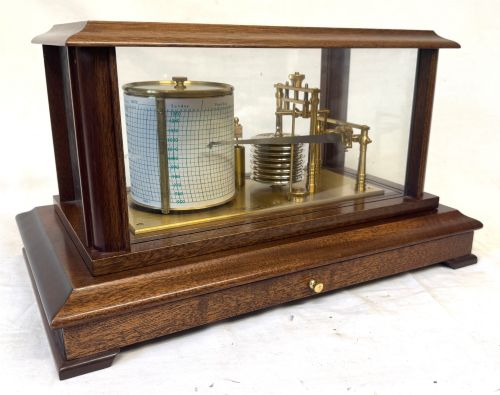
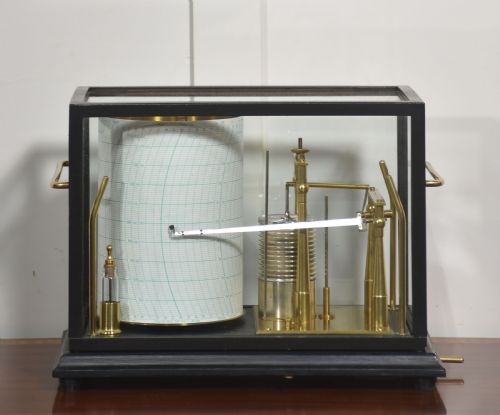
These recording barograph drum mechanisms trace atmospheric pressure onto paper charts, housed in glazed wood cases.
Recording Barograph Drum
A recording barograph drum sits at the heart of these weather instruments, rotating slowly to capture continuous barometric changes on paper charts. When you search for a recording barograph drum, you are looking at scientific apparatus designed to log atmospheric pressure over time.
The examples available here span the Victorian, Edwardian, and mid-twentieth century periods. Most pieces on this page combine brass clockwork mechanisms with wooden cases and bevelled glass panels.
Makers such as Short & Mason, Jules Richard, and Richard Freres feature among the scientific instruments and weather instruments listed. Cases range from light oak and mahogany to walnut, occasionally incorporating barometer dials or storage drawers.
How they were made
Maker workshops constructed these instruments using seasoned hardwoods including mahogany, oak, and walnut for the protective enclosures. Cabinetmakers fitted bevelled glass panes into frames to protect the sensitive movement while keeping the rotating drum and paper charts visible.
Inside the case, skilled instrument makers assembled brass clockwork mechanisms alongside steel parts and vacuum chambers that responded to air pressure. The rotating drum relied on a spring-driven clock movement to turn at a steady rate over the course of a week.
Some miniature barograph models were built small enough to travel, ensuring you could track a low pressure front from a steamer trunk.
What varies in quality
The refinement of the cabinetmaking and the precision of the brass movement separate standard pieces from finer examples. Higher quality instruments feature heavier mahogany or walnut cases, bevelled glass panels, and signed brass beds by established makers.
Short & Mason London·Jules Richard·Richard Freres·Russell Norwich·Baines Harrogate·Depree and Young Ltd Exeter
The Recording Barograph Drum Glossary
- Barograph
- A self-recording barometer that plots atmospheric pressure over time onto a revolving paper chart. It translates invisible barometric shifts into a permanent inked line.
- Aneroid
- Operating without liquid, utilising a flexible sealed metal box that expands or contracts with changes in air pressure. This expansion moves the recording arm across the drum.
- Clockwork
- A mechanical drive system powered by a mainspring and regulated by an escapement. This mechanism rotates the drum at a constant speed.
- Bevelled glass
- Glass panes with angled edges fitted into the wooden housing. This technique adds depth and clarity to the viewing windows of the instrument case.
Recording Barograph Drum: Frequently Asked Questions
How does a recording barograph drum work?
The brass cylinder rotates via an internal clockwork mechanism while an inked arm traces pressure changes onto paper charts.
Changes in the atmosphere cause sealed metal boxes inside the instrument to expand or contract, moving the arm vertically.
What woods were used for the cases?
Maker workshops utilised dense hardwoods such as mahogany, oak, and walnut to build the protective enclosures.
These timbers were polished or inlaid, particularly during the Edwardian period and Art Nouveau era.
How do I date a barograph?
Dating relies on the style of the wooden case, maker signatures, and mechanical details spanning the Victorian era to the mid-twentieth century.
Edwardian and Victorian examples often feature distinct cabinetwork proportions and maker plates.
Where should I place a barograph at home?
Keep the instrument on a stable, level surface away from direct sunlight, drafts, and sudden temperature shifts.
Placing it in a study or hallway allows easy viewing of the rotating drum and paper charts.