


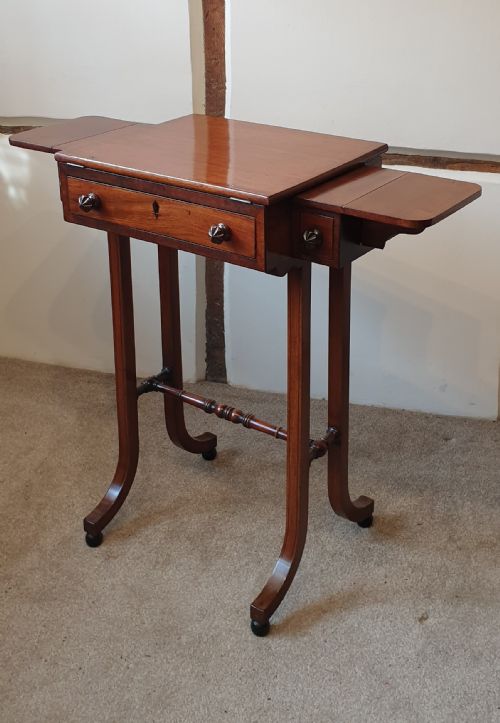
Ratchet Top Table
A ratchet top table gives you an adjustable surface for reading, drawing, or writing, combining clever mechanical function with fine period cabinet-making.
Ratchet Top Table
A ratchet top table provides an adjustable inclined surface designed for reading, writing, drafting, or architectural work. These pieces span the Georgian, Regency, and Victorian eras, taking forms such as reading tables, architects' desks, and occasional tables with adjustable stands.
The most common examples you will encounter on this page are mahogany reading tables from the Georgian and Regency periods. They frequently incorporate clever mechanical supports beneath the top to allow variable angles for books or papers.
Makers adapted these designs for specific domestic and professional uses, ranging from library desks to artist workstations. You may also find more ornate variants featuring marquetry inlay or brass and ebony details.
How they were made
Cabinet-makers relied heavily on dense timbers such as mahogany, Cuban mahogany, rosewood, and walnut for the primary structure. Finer details often incorporated contrasting woods like boxwood or ebony for inlay and stringing.
Functional metal components, specifically brass ratchets and hinges, were integrated into the framework to support the adjustable mechanism. Leather inserts frequently appeared on writing surfaces, providing a durable plane for daily use.
Ratchet Top Table Retail Price Guide 2026
Typical asking prices for ratchet top table among the pieces listed under this phrase on Sellingantiques today, from the lower quarter to the upper quarter. They describe what is for sale here now, not the wider market.
The listings on this page span the Georgian, Regency, and Victorian periods, constructed from materials including mahogany, rosewood, walnut, and fruitwood.
What varies in quality
Quality rests in the precision of the mechanical ratchet mechanism and the smoothness of its operation. Superior pieces retain robust, well-fitted brass components that hold the heavy wooden top securely at multiple angles without wobble.
The selection of timber dictates the visual merit of the piece, with richly figured Cuban mahogany or intricate Dutch marquetry inlay marking out the upper tier of execution. Secondary woods and the crispness of edge mouldings further distinguish workshop standards.
Gillows·Marsh & Tatham
The Ratchet Top Table Glossary
- Ratchet
- A mechanical device consisting of a gear wheel and pawl that allows movement in only one direction. This is the core component that enables the table top to incline and lock at various angles.
- Marquetry
- The art and craft of applying pieces of veneer to a structure to form decorative designs. 18th-century Dutch examples frequently showcase elaborate floral or geometric patterns in contrasting woods.
- Secretaire
- A piece of furniture containing a drawer or compartment that folds down to form a writing desk. Some multi-functional library tables combine this feature with an adjustable reading slope.
- Stringing
- A narrow inlay of contrasting timber used to outline panels, drawers, or table tops. Cabinet-makers used this technique to add linear definition to mahogany and rosewood surfaces.
Ratchet Top Table: Frequently Asked Questions
How does the ratchet mechanism work?
A metal ratchet arm engages with a series of teeth mounted beneath the table top, allowing you to lift the surface to the desired angle.
gravity and a support strut hold the board securely in place until you lift it past the final tooth to lower it flat again.
What were these tables used for originally?
These pieces served as functional workstations for reading heavy folios, drafting architectural plans, and writing correspondence.
The adjustable top reduced neck strain by bringing books or paper closer to the user's eye level.
How do I distinguish Georgian from Victorian examples?
Georgian and Regency pieces tend to feature lighter proportions, finer timber selection, and restrained brass mounts.
Victorian iterations often appear heavier in construction, utilising denser mahogany or rosewood with more pronounced mouldings.
Can I use a ratchet top table daily?
Yes, these tables remain sturdy and practical for contemporary use as desk spaces or reading stands.
Care should be taken not to force the mechanical ratchet beyond its intended range of movement.