
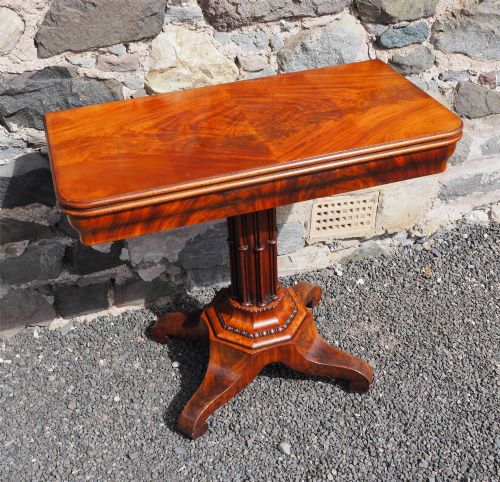
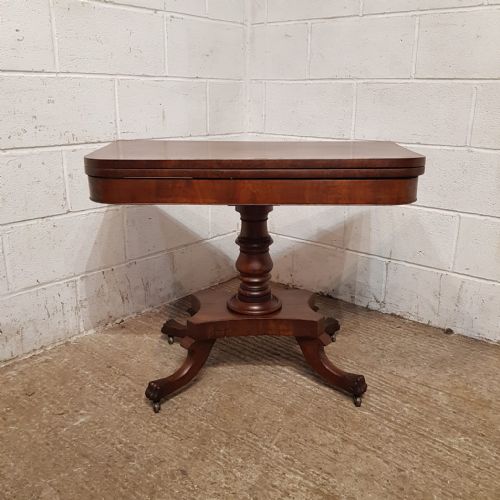
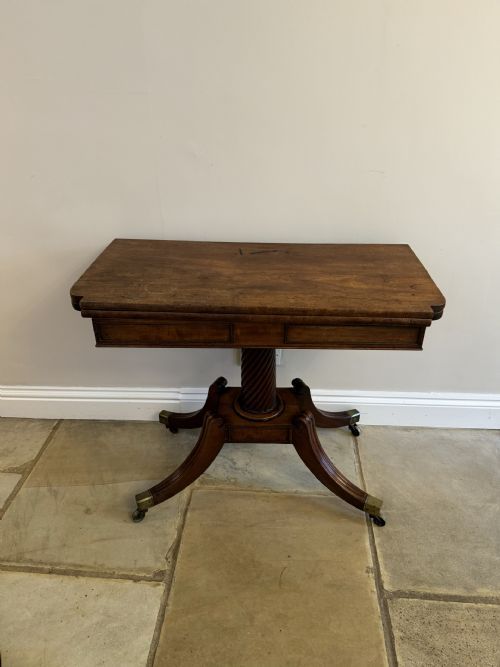
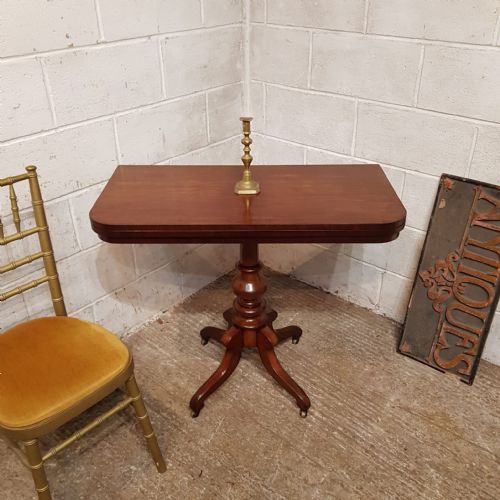


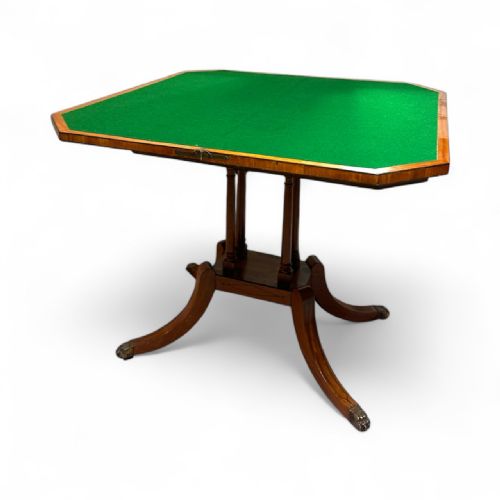

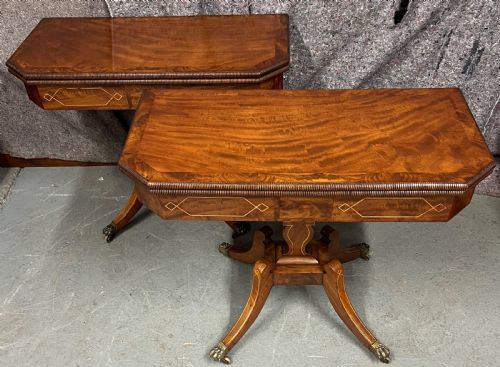


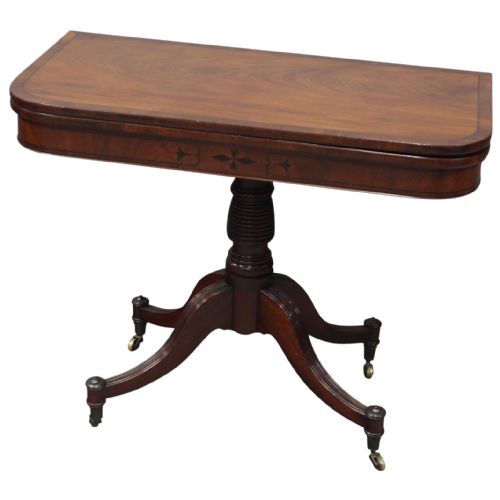
Quadruped Pedestal Games Table
These quadruped pedestal games table examples offer clever folding tops and sturdy four-footed supports, making them both practical and handsome centrepieces.
Quadruped Pedestal Games Table
A quadruped pedestal games table combines a folding top with a central pillar supported by four feet, appearing frequently across the Regency and Victorian periods. These pieces serve primarily as card tables, side tables, or tea tables, adapting easily to different rooms.
The materials seen on this page include mahogany, rosewood, burr walnut, walnut, and satinwood, often paired with brass mounts or inlay. The forms include fold-over tops designed to conceal or reveal playing surfaces as needed.
Materials and construction
Makers utilised solid timbers alongside flame mahogany veneer and rosewood, applying precise cabinet-making techniques to achieve stable pedestals and smooth folding mechanisms. Brass inlays and gilding appear on select examples to accent the timber grain.
The quadruped base requires careful joinery to distribute weight evenly from the central pillar out to the four individual feet. Turning and carving shape the central pedestals before french polishing finishes the timber surfaces.
Quadruped Pedestal Games Table Retail Price Guide 2026
Typical asking prices for quadruped pedestal games table among the pieces listed under this phrase on Sellingantiques today, from the lower quarter to the upper quarter. They describe what is for sale here now, not the wider market.
Listings feature woods such as mahogany, rosewood, burr walnut, and satinwood across the Regency and Victorian periods.
Judging quality
Quality rests upon the choice of timber figure, such as richly grained flame mahogany or burr walnut, alongside the crispness of any brass inlay or gilding. Finer examples display meticulous attention to the pivot and folding mechanisms that allow the top to rotate and rest squarely.
The proportion of the central pedestal relative to the four feet dictates the visual balance of the piece. Superior construction ensures the top remains level and firm when opened for play.
William Trotter
The Quadruped Pedestal Games Table Glossary
- Quadruped
- A support structure featuring a central pillar resting on four distinct feet rather than three. This design provides robust stability for tables with folding tops.
- Fold-over
- A hinged table top that opens out to double its surface area, frequently lined with baize or felt for card games. When closed, it functions as a side or tea table.
- Flame mahogany
- A veneer cut from timber where the grain creates a distinctive flickering flame pattern. It appears on prominent surfaces of Regency and nineteenth-century pieces.
- Pedestal
- The central vertical column supporting the table top above the foot base. It is often turned, carved, or veneered.
Quadruped Pedestal Games Table: Frequently Asked Questions
What is a quadruped pedestal games table?
A quadruped pedestal games table is a piece of furniture featuring a central column supported by four feet and a top that opens out. These tables were designed for card games, tea, or general display in the parlour.
They bridge the Regency and Victorian eras, reflecting changing tastes in timber and ornamentation while keeping a practical folding format.
How do you date these tables?
Dating relies on observing the timber types, decorative details, and structural proportions typical of periods like the Regency or mid-nineteenth century. Rosewood and brass inlay lean towards earlier Regency designs, while burr walnut is more common later on.
Secondary woods and the style of the quadruped base also offer clear clues to the decade of manufacture.
Were these tables only used for cards?
While many feature fold-over tops specifically sized for card playing, they also function as tea tables and side tables. The enclosed top protects interior surfaces when not in use for games.
Their versatility made them central items in nineteenth-century sitting rooms where space and multi-purpose furniture mattered.
How do I care for rosewood and mahogany surfaces?
Maintaining these timbers involves keeping them away from direct sunlight and sudden temperature changes that can dry out the polish. Regular dusting with a soft, dry cloth preserves the finish.
Avoid liquid cleaners and silicone sprays, relying instead on traditional beeswax applied sparingly when the wood appears dull.