





Qing Dynasty Export Seating
Qing dynasty export seating brings distinct craftsmanship to the room, offering carved hardwood and porcelain forms made for international trade.
Qing Dynasty Export Seating
Qing dynasty export seating comprises armchairs, garden seats, benches, and suites produced in China for overseas markets during the eighteenth and nineteenth centuries. These pieces combine traditional forms with decorative motifs designed to appeal to Western tastes of the period.
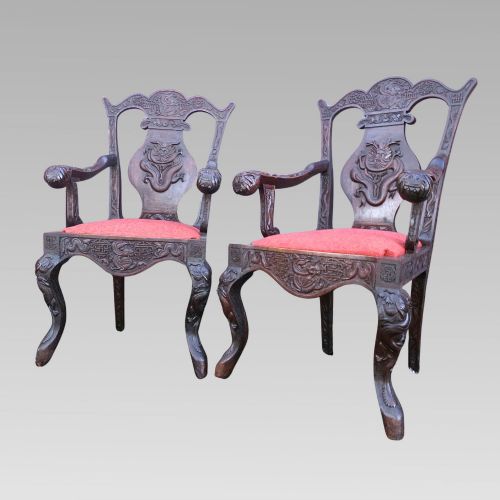
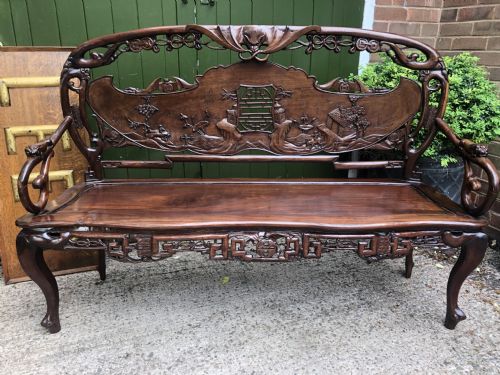
The examples available here lean heavily toward nineteenth-century production, alongside eighteenth-century works. Buyers will frequently encounter rosewood, teak, elm, and hardwood constructions, often enriched with carved dragons or inlaid mother-of-pearl.
Seating arrangements range from single hall chairs and eccentric corner armchairs to matched pairs of rose medallion porcelain garden seats. Larger suites combine benches and chairs to create unified groupings.
How they were made
Makers utilised dense timbers such as rosewood, teak, and elm, building robust frames designed to withstand long journeys overseas. Joinery was executed to accommodate the natural movement of dense hardwoods without losing structural integrity.
Decoration relied on deep carving, bone inlay, and mother-of-pearl embellishments set directly into the wooden surfaces. Ceramic garden seats incorporated intricate enamel painting, particularly the rose medallion palette applied to fired porcelain.
Qing Dynasty Export Seating Retail Price Guide 2026
Typical asking prices for qing dynasty export seating among the pieces listed under this phrase on Sellingantiques today, from the lower quarter to the upper quarter. They describe what is for sale here now, not the wider market.
Listings feature periods spanning the eighteenth century through to the early twentieth century, utilising rosewood, elm, teak, porcelain, and bone inlay.
What varies in quality
Quality rests in the crispness and depth of the carved ornamentation, particularly around complex motifs like dragons and foliage. Pieces executed with sharp, well-defined relief work stand apart from softer, more perfunctory carving.
The choice and integration of secondary materials also differentiate the range. The precise setting of mother-of-pearl or bone inlay and the vibrancy of porcelain enamels distinguish standard production from exceptional examples.
The Qing Dynasty Export Seating Glossary
- Rose medallion
- A distinctive style of Chinese porcelain decoration featuring panelled designs filled with figures, birds, and flowers, predominantly in pink and gold enamels. This palette appears on ceramic garden seats.
- Hardwood
- A dense timber classification including rosewood and teak, chosen for its strength and ability to take fine carved detail. These woods form the primary structure of most seating here.
- Settle
- A wooden bench featuring a high back, solid arms, and often enclosed storage or shielding beneath the seat to block drafts. Examples in this category display elaborate oriental carved detailing.
- Corner armchair
- A seating form designed to fit into the corner of a room, featuring a continuous curved arm rail supported on multiple pillars. Eighteenth-century versions demonstrate eccentric and curvaceous proportions.
- Mother of pearl
- The iridescent internal layer of mollusc shells, utilised for thin decorative inlays set into dark wooden furniture surfaces. It creates striking contrast against rosewood and dark hardwoods.
Qing Dynasty Export Seating: Frequently Asked Questions
What materials were used for qing dynasty export seating?
Makers relied heavily on dense timbers such as rosewood, teak, elm, and general hardwoods for frames and structural elements. Additional decorative materials included bone inlay, mother-of-pearl, and enamelled porcelain.
Surface enrichment was achieved through deep wood carving or ceramic glazing techniques. These varied components were selected for durability during overseas transport and visual richness.
How do I identify eighteenth century pieces?
Earlier pieces often exhibit distinctive structural proportions and eccentric, curvaceous designs that differ from later nineteenth-century production. Wood selection and the specific style of joinery offer further clues to age.
Comparing carved motifs and overall framing against dated examples helps establish the period. Eighteenth-century items remain less common than nineteenth-century counterparts.
Were garden seats used indoors?
Porcelain garden seats were manufactured for both interior display and outdoor use in courtyards or gardens. Their glazed ceramic construction made them resilient against moisture.
In domestic interiors, they functioned as portable occasional seating or decorative stands. Pairs of these seats are frequently encountered in nineteenth-century designs.
How do suites differ from single chairs?
Seating suites comprise matched collections of benches and chairs designed to furnish a room in a unified aesthetic. Single items, such as hall chairs or settle benches, were produced individually or as pairs.
Suites often incorporate coordinated inlay work like mother-of-pearl across all component pieces. This ensures visual harmony throughout the set.