


Qashqai Geometric Carpet
When you search for a qashqai geometric carpet, you are looking at woven tribal floor coverings from southwest Persia made by nomadic weavers using traditional motifs.
Qashqai Geometric Carpet
A qashqai geometric carpet brings together tribal Persian aesthetics with structured layouts, predominantly appearing as rugs, carpets, kilims, and runner rugs from the late nineteenth and early twentieth centuries. These pieces originate from the nomadic and village traditions of southwest Persia, often sharing stylistic crossover with Khamseh, Luri, and Shiraz weaving traditions.
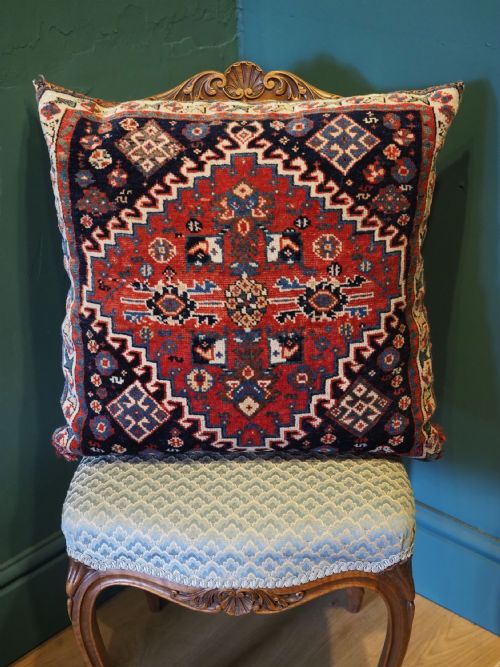
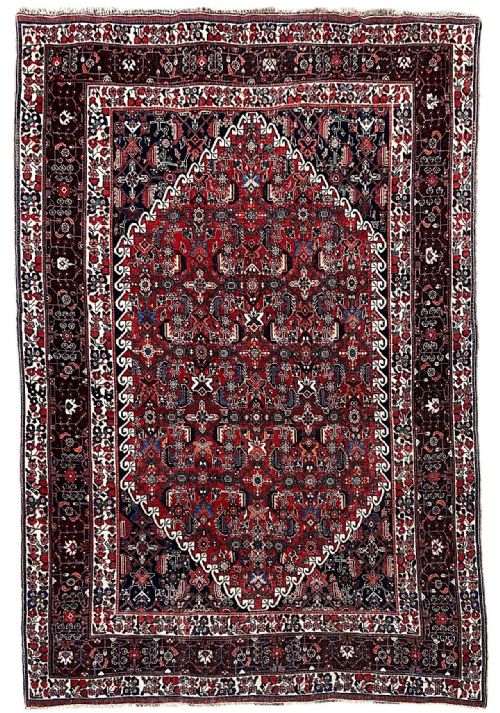
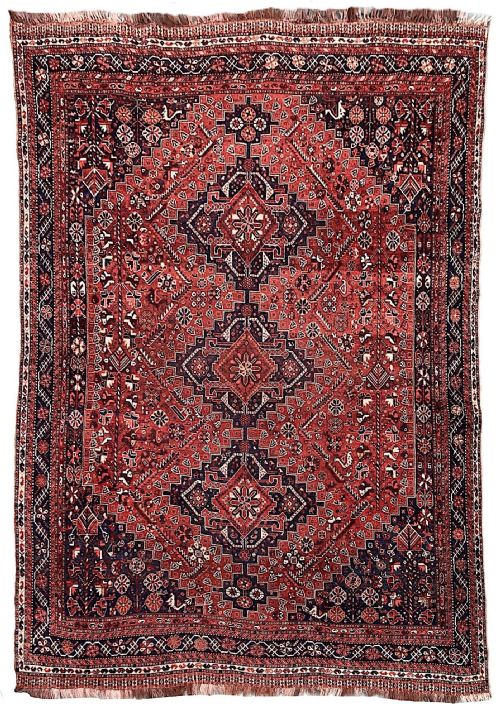
The most common formats on this page include room-sized carpets and smaller tribal rugs, along with flatwoven kilims and utility items such as saddle bag cushions. The designs rely heavily on traditional iconography, including central medallions, geometric repeats, and occasional animal motifs like peacocks.
Dating ranges from the mid-nineteenth century through the 1930s, capturing a period when natural dyes and hand-spun materials remained standard practice among tribal weavers before synthetic alternatives became widespread.
How they were made
The physical construction of these textiles relies on wool and hand-spun wool pile woven onto cotton or wool foundations, providing the dense yet flexible structure characteristic of nomadic work. Flatwoven kilims omit the pile entirely, relying instead on interlocking warp and weft threads to create sharp geometric boundaries.
Colour comes from natural dyes applied to hand-prepared fibres, producing deep tones and subtle variations across the surface of the weave. This traditional dyeing method ensures that the colours age gracefully over decades of light exposure and use.
Keep an eye out for small woven peacocks hiding amongst the geometric fields.
What varies in quality
The primary distinction in quality lies in the tightness of the weave and the precision of the knotting, which dictates how sharply the geometric patterns are rendered. Finer examples display high knot densities and more intricate drawing within medallions and peripheral motifs.
Material preparation also separates standard utility pieces from exceptional ones, particularly the use of finely hand-spun wool and deeply saturated natural dyes. Older nineteenth-century examples often demonstrate superior handling of wool preparation compared to later twentieth-century productions.
The Qashqai Geometric Carpet Glossary
- Gabbeh
- A coarse, thick pile rug traditionally woven by nomadic groups with minimal geometric patterning and wide expanses of open colour. These pieces emphasise functional warmth over intricate detail.
- Kilim
- A flatwoven textile produced without a pile, resulting in a thin and durable fabric suitable for floors or hanging. The geometric designs are formed by tightly packing the coloured weft threads over the warps.
- Khamseh
- A confederation of pastoral tribes in southwest Persia whose weaving traditions closely parallel those of their Qashqai neighbours. Their carpets frequently share similar colour palettes and bird motifs.
- Medallion
- A central ornamental design motif placed in the field of a carpet, often taking a geometric or diamond shape. It serves as the focal point around which the surrounding field and borders are organised.
- Kashkuli
- A sub-tribe of the Qashqai known for producing exceptionally fine and closely knotted wool rugs. Pieces attributed to this group often command attention for their superior handle and refined drawing.
Qashqai Geometric Carpet: Frequently Asked Questions
How do I identify a genuine tribal carpet?
Authentic tribal carpets display irregularities in symmetry and hand-spun wool textures that reflect nomadic production rather than factory standardisation. Examining the foundation and edge finishes helps reveal traditional construction methods.
Look for natural colour variations within the pile, which indicate hand-dyeing processes typical of nineteenth and early twentieth-century Persian weaving.
Can I use these antique rugs on high traffic floors?
These wool and cotton textiles were built for daily nomadic use and withstand normal walking traffic when paired with a quality underlay. Placing them in moderate-use areas helps preserve the pile and structure over time.
Avoid damp environments and direct heavy sunlight to maintain the integrity of the natural dyes and hand-spun fibres.
What is the difference between a carpet and a kilim?
Carpets feature a thick wool pile knotted onto a foundation, providing a plush surface underfoot. Kilims are flatwoven without any pile, creating a lighter and flatter textile.
Both forms utilise similar geometric designs, but their physical structure and weight differ entirely.
How should I clean my antique Persian rug?
Gentle surface brushing and professional specialist cleaning tailored for antique textiles represent the safest maintenance approach. Avoid harsh chemical detergents and excessive water immersion.
Regular light vacuuming without a rotating power head prevents dust accumulation within the wool pile.